Young Lee’s Need to Dance

Young Lee’s Need to Dance

Young Lee’s Need to Dance

Young Lee, finance and grants management specialist, has been at Stanford Prevention Research Center (SPRC) for two and half years now. Her current job focuses on finance, including the management of grants and contracts for SPRC. She’s been at Stanford since 2000, when she moved to California from the east coast. She’s a kind, warm person and an excellent employee, but this article is about something else: her dancing.

Because Young Lee leads a double life: Stanford employee by (week)day and competitive ballroom dancer by night (or, at the very least, evenings and weekends). In fact, she competed six times in the nine months between September 2021 and June 2022, and she won her last two competitions. Her division, among many others, is very proud of her. We spoke with Lee about her background in dancing and all the gritty details of training and competing.

What is your current role at Stanford?

I’ve been a financial analyst for SPRC for more than two years. Before that, I worked at the Freeman Spogli Institute for International Studies for many years.

How long have you been interested in dance?

My body was always moving whenever I listened to music. I don’t have a dance background but was kind of athletic. I started dancing when I became single not long after I came to California. We have to do something when we’re alone, right?

When did you get more serious about dancing?

I was a social dancer for many years while taking some group and private lessons. But when the pandemic started, that was another turnaround in my life. I was working from home and alone most of the time. I started dancing more and started training to compete with my current teacher, who was a successful professional dancer. Now I’m a more serious dancer than I ever was. I’m focused and motivated; I want to get better and better. Dancing is a demanding activity. To dance well, we have to be physically strong, fit, and flexible, and be able to connect with a partner.

How did you meet your teacher and start doing competitions?

I started going to the Starlight Ballroom Studio in San Jose about six years ago, and that’s where I met my current teacher, who used to compete as a professional. He trains me in standard ballroom dances, which include waltz, tango, foxtrot, quickstep, and Viennese waltz. My first competition was in September 2021.

What’s your training schedule like?

I’ve been taking private lessons with my teacher three or four times a week, and usually each lesson is about 45 minutes. But when it gets closer to competition time, I have to do more.

I also am trying to practice more on my own. A lot of times I get there early before my lesson to stretch and practice my weak points and go through my steps.

Do you have a favorite dance?

I always liked foxtrot because it’s so classic. But I also love waltz; dancing waltz well to beautiful music can be quite an amazing experience. I also like quickstep. You have to move fast, so it’s fun and cheerful. Each dance is beautiful and challenging in its own way.

Can you describe what the competitions look like?

Several competitors, in formal competition attire (including hair and makeup), are out on the floor dancing in front of judges and audiences. In my case, my male teacher is a professional and I’m an amateur, but there are female teachers competing with male students, too. It can be quite crowded on the dance floor. The judges score us while we dance. The first time I won, in Las Vegas in March 2022, it felt quite good. I never thought I was a competitive person, but it was still very nice.

What’s next? Are you planning to compete regularly?

I will definitely compete more. The next one will be in early September in Los Angeles. There are different levels of competition: bronze, silver, gold, and open. Lately I’ve been dancing at the gold level, but at some point, I’d like to compete in an open category, which is the most competitive level.

And finally, why do you love to dance?

Dancing brings me closer to my true inner self. So it’s been fascinating. I always enjoyed dancing, and it only gets better the longer I dance. This is how I get to know myself and connect to others.

Young Lee performs the Viennese Waltz

Wen-Kai Weng: A True Birder at Heart

Wen-Kai Weng: A True Birder at Heart

Wen-Kai Weng: A True Birder at Heart

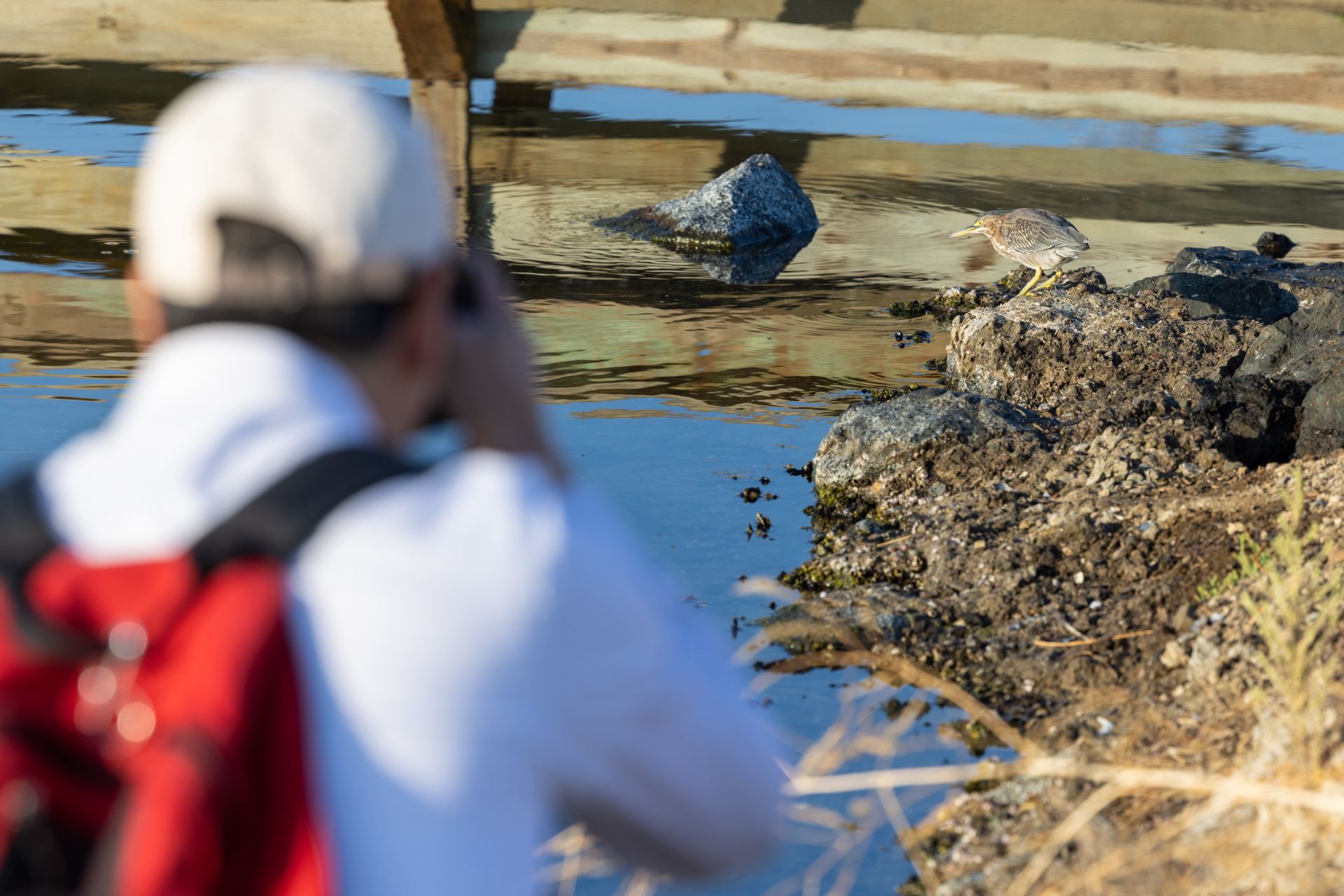
Wen-Kai Weng, MD, PhD with his camera in Palo Alto Baylands Nature Preserve.

Wen-Kai Weng, MD, PhD, associate professor of blood and marrow transplantation (BMT), has a hobby. No, more than a hobby, really: a passion. In addition to being a doctor and cell therapist and a newly awarded 2021 Master Teacher in the Department of Medicine, Weng is a dedicated nature photographer (specifically focusing on birds) who develops a yearly calendar of his nature photography and gives all the proceeds to BMT patients. Below, he answers our most pressing bird-photography questions.

What is your role at Stanford, and how long have you been here?

I am a transplanter and cell therapist, who specializes in treating people with hematologic malignancy. My clinical and research focus is on lymphoma. I started my medical oncology fellowship at Stanford in 1999 and joined the faculty of the division of blood and marrow transplantation in 2007.

When did you first become interested in photography? Did your love of birds or your love of photography come first?

I started playing with my camera when I was in high school. However, I got really interested in birding in medical school. Once I became a serious birder, bird photography was a natural next step. I mostly photograph birds, since they don’t complain about the results.

What kind of camera do you use? What’s the process you go through to develop photos?

I’ve always used a Nikon system. My current camera is a Nikon D850 with 300 mm telephoto lens. Since all the photos are digital now, I use Photoshop to help me edit. But I don’t edit heavily — I just try to reflect what I see in the field.

What’s your favorite thing about photography?

Birding needs patience, and so does photography. Bird photography forces me to practice delayed gratification. I also enjoy the challenges involved.

How did you get the idea to make a calendar of your bird photography?

The idea first came to me when I donated two old prints of my photos to an auction to raise funds for transplant patients in need and their families. They sold, and I thought that making a calendar would be a natural way to make use of the photos I took and link them to a meaningful purpose. I’ve been making and selling the bird calendars since 2017, and I use the proceeds to set up a fund to help those same patients and families. I have been humbled by people’s generosity in helping this project for all these years. It has raised more than $50,000 thus far.

How do you think your hobby has influenced your work at Stanford, if at all?

To me, it’s a pleasure to be able to link my two passions together, medicine and photography. Doing the calendar also obviously motivated me to go out to the field and get more good photography.

What’s your favorite bird you’ve ever seen and photographed?

It is hard to pick a favorite bird. However, I can pick a favorite experience. It was at Hawk Ridge at Duluth, Minnesota, in the fall when the raptors were migrating south for the winter. Seeing more than 40,000 birds (mostly broad-winged hawks) fly through in one day was an experience I will never forget.

Any favorite spots for birding?

I do a mix of planned and casual trips for birding and photography. Given my busy work schedule, the planned trips happen less and less. I like seeing and photographing any birds, even the common ones. And it’s nice because in the United States, there are three major flyways for bird migration, including the Pacific Flyway crossing California. And as part of the flyway, the Sacramento River Valley is a great spot for wintering ducks and geese.

Finally, what advice do you have for amateur photographers who want to do what you do?

Pick up a camera and start taking pictures. You will find your vision in time.

Having a Blast Teaching Residents How to Teach

Having a Blast Teaching Residents How to Teach

Medical Education Elective Teaches Teaching Skills for Future Attending Physicians

Sharmin Shekarchian, MD (left) and Julia Armendariz, MD

Sharmin Shekarchian, MD (left) and Julia Armendariz, MD

Having a Blast Teaching Residents How to Teach

Medical Education Elective Teaches Teaching Skills for Future Attending Physicians

Much of medical training is based on one person passing on knowledge to the next person in line. A fellow teaches a third-year resident, who teaches an intern, and so on down to students in medical school.

But for all the education that takes place at an academic medical center like Stanford, there is surprisingly little formal training in how to be an effective educator.

That’s the scenario Poonam Hosamani, MD, clinical associate professor of medicine, set out to change. Hosamani is one of six associate program directors in the Stanford Medicine residency program and also a full-time hospitalist, caring for patients and leading bedside rounds with residents.

Creating Medical Educators

The underpinning of medical residency training is a series of brief, intensive experiences in mostly hands-on patient care. Each rotation lasts two to four weeks. Stanford Medicine offers 65 rotations in emergency medicine, intensive care, cardiology, global health, and many other specialized areas. There is a core of required rotations, but residents choose to enroll in additional rotations, called electives, based on their interests.

Most Stanford Medicine residents want to stay in academic medicine, so their ability to be effective teachers is important to their future roles as attending physicians. Hosamani wanted to address that issue through a pilot program called the Medical Education Elective. The key question was: How can residents build skills to be more effective educators?

The opportunity to focus on effective education arose in 2021 when an international rotation was canceled because of COVID-19. Residents who had been scheduled to go abroad asked Hosamani to create an alternative rotation for them. “I immediately saw the opportunity to solidify teaching skills earlier in the rigorous training all physicians go through, from medical school to fellowship training,” she recalls.

Poonam Hosamani, MD

The pilot was launched in spring 2021 with five residents. “We organized lectures and workshops for them with faculty from the Palo Alto Veterans Affairs Medical Center and Stanford School of Medicine,” Hosamani explains. To date, the Medical Education elective has been offered five times for 25 residents.

Sharmin and I have an absolute blast doing this. We love it with all our hearts, and we’ve both grown a lot through this experience… This elective enables learners to take the time to think about how they can be better educators, and to enrich their career path with joy.

– Julia Armendariz, MD

Sharmin and I have an absolute blast doing this. We love it with all our hearts, and we’ve both grown a lot through this experience… This elective enables learners to take the time to think about how they can be better educators, and to enrich their career path with joy.

– Julia Armendariz, MD

Julia Armendariz, MD, and Sharmin Shekarchian, MD

Two Course Directors Added

Having established the program and seen it through its pilot phase, Hosamani passed its implementation on to two junior faculty members who are as passionate about educating educators as she is: Julia Armendariz, MD, affiliated clinical assistant professor of hospital medicine, and Sharmin Shekarchian, MD, affiliated clinical assistant professor of hospital medicine.

“Sharmin and I have an absolute blast doing this. We love it with all our hearts, and we’ve both grown a lot through this experience,” comments Armendariz. “Medicine is hard, and being a physician is not easy. A person could get lost doing all the things it takes to learn how to be a good doctor. This elective enables learners to take the time to think about how they can be better educators, and to enrich their career path with joy.”

Shekarchian adds, “For me, the highlight of the rotation is the four hours observing and listening to all the residents present their talks. We celebrate their achievements, and we always learn from the residents through their presentations.”

Tools of the Trade

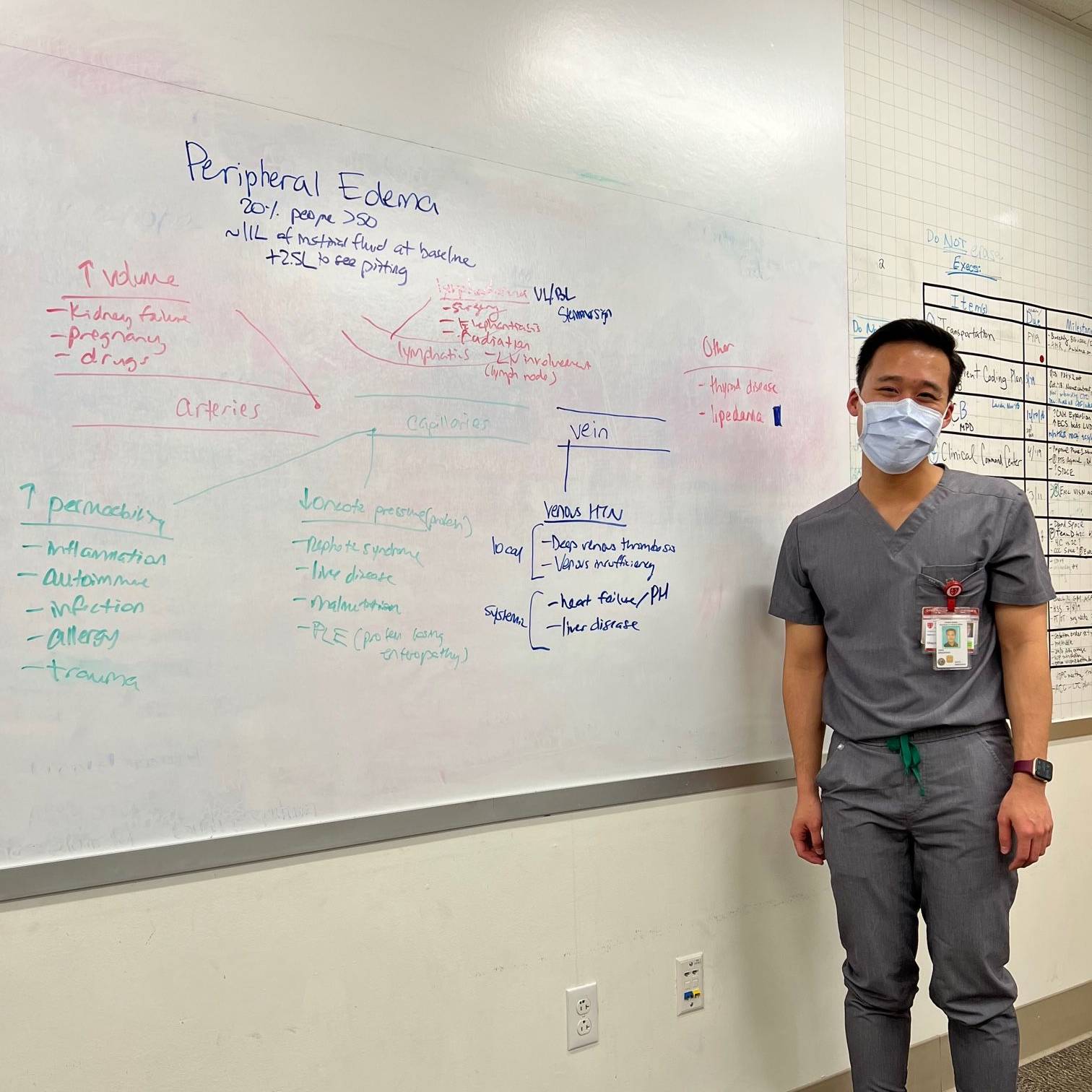
The rotation includes daily lectures on topics such as how to present a chalk talk (using a whiteboard and markers), how to set expectations with learners, principles of adult learning, how to give feedback, how to design teaching objectives, and many others.

“One of the best parts of the rotation is observing the residents presenting their own work,” Hosamani says. “I remember vividly one resident who used a football as part of his chalk talk to demonstrate teaching how to place the probes for a bedside cardiac ultrasound. He held the football over his heart as he walked through the process, moving the probes into their appropriate places on the football.”

Much of the learning occurs in small-group interactions among the residents as they apply learning concepts to the clinical setting.

Muhammad Fazal, MD, was a third-year resident when he enrolled in the Medical Education elective; he is now a fellow in cardiology at Stanford. “The whole process was very rewarding,” he recalls. “It made me realize how hard it is to give an effective chalk talk that is short enough to maintain interest yet long enough to present the information.” He regrets not having taken the elective sooner in his training and hopes to see it as a requirement at some point.

Fazal also appreciated the emphasis on the “softer science” of medicine: how to communicate and listen. “These are skills you don’t learn in a textbook,” he notes. “It made me realize that often just being there to listen and be supportive is what the patient needs.”

The Sky’s the Limit

“It’s a great honor to have Dr. Hosamani endow us with the opportunity to further develop this program,” Armendariz states. “She is a great mentor and will continue to advise us on how to get things done.”

Looking ahead, Armendariz, Hosamani, and Shekarchian all envision adding topics to the curriculum, adapting the elective for other medical subspecialties, inviting more faculty members to participate, incorporating technology into some of the teaching modalities, and presenting their work at medical conferences to enable others to create their own programs.

“The sky’s the limit,” Hosamani declares. “Our only constraint is the availability of resources to expand and further enrich this elective.”

Apply Here for Support and Growth

Apply Here for Support and Growth

New Department of Medicine Staff Share Their Stories

Apply Here for Support and Growth

New Department of Medicine Staff Share Their Stories

Workers across the United States have faced multiple challenges during the COVID-19 pandemic. Many workers have lost jobs, gotten sick, relocated, or left jobs to care for loved ones and relatives. For some workers, however, the pandemic presented opportunities to leave their jobs for something better. This was true for four recent hires in the Department of Medicine, profiled below, which include a former real estate administrator, a preschool teacher, a newly married mother juggling work and her personal life, and a government worker in San Mateo County.

When these four applied to new positions, they had their eyes set on jobs with career growth opportunities, supportive management, positive work environments, and more, and the Stanford Department of Medicine fit the bill.

Greater Engagement and Work-Life Balance

Lisa Moore-Long, an administrative coordinator in the Chair’s Office and a former administrator at several commercial real estate companies, came to Stanford in spring 2021, in pursuit of something new. Like many others, she had started to work remotely during the pandemic and felt that she needed to “shake things up.”

Before the pandemic, Moore-Long saw there wasn’t enough work-life balance at previous jobs. As she recalls, “It was that old-school feeling that, if you didn’t stay late and work weekends, you weren’t really working hard.” Working at Stanford was a welcome change. “You’re super-busy during the day here,” Moore-Long explains, “but there’s a conscious effort to say, when 5:00 p.m. comes, you’re not expected to answer emails and you’re not expected to work over the weekends.”

As her previous office changed to a work-from-home model due to COVID, there was less engagement among co-workers. Moore-Long remarks, “There would be days where no one would talk to me at all. I mean, not even an email, nothing.” The lack of connection among the staff compelled her to look elsewhere, so she applied for her current role at Stanford.

“They’re really training you for your future, and they’re hoping it is with Stanford.”

– Lisa Moore-Long

Moore-Long recalls that when she came to Stanford, everyone was consistently engaged. Leadership would speak to her about her day, and there was an active interest in staff training. Professional development and wellness programs like the BeWell program are available to help staff improve their lives. “They go above and beyond because they’re not only interested in training you for whatever job you’re in right now,” says Moore-Long. “They’re really training you for your future, and they’re hoping it is with Stanford. They want you to progress, and they want to include everybody, and they’ll go to great lengths to do that. They want you to grow and learn and prosper, all those good things.”

She remembers that her supervisor pulled her aside once and asked where she wanted to be in five years. “I want to be here,” Moore-Long replied. “I’m happy in my department. I don’t know what all the possibilities are yet.”

“Here at Stanford, everyone wants to share credit for successes.”

– Tiffany Woo Sung

Skills Development and a Truly Collaborative Environment

Before coming to Stanford in March 2021, Tiffany Woo Sung, an administrative associate in the Division of Hospital Medicine, worked for six years as a preschool teacher in Mountain View. “I loved being around and working with children,” says Sung. “I loved the classroom environment.”

Eventually, however, Sung started feeling the need to apply her skills in a different field. “I have always believed that in order for me to be successful professionally, I need to continue to feel challenged in what I am doing,” she says. “I had gotten to the point where I felt like I wasn’t getting enough opportunities to build upon the existing skills that I had.”

Like others experiencing the pandemic, Sung started to reflect on what she wanted for her professional life and began seeking other opportunities. “I thought, OK, what better time than now to make a change?

“When I came to Stanford, it felt like starting with a blank slate,” Sung recalls. “I didn’t know what to expect other than what I read in the job description.

It’s great that my team is full of wonderful individuals who are so patient, open, and willing to support me during my transition into the new role.”

Sung truly values the people she works with. After accepting her role at Stanford, she was greeted warmly by her manager and team. She became engrossed in her role, enjoying the chance to work alongside other professionals and collaborators. “I didn’t expect everyone to encourage collaboration so highly,” says Sung. “At a lot of places I’ve either worked at or heard of, if you’re successful, you want everyone to know it was your success so that you can stand out from the rest of the employees. But here at Stanford, everyone wants to share credit for successes.”

Elsie J. Wang, division manager of hospital medicine, offered Sung resources to encourage personal growth by pointing out the numerous classes that Stanford offers to its staff, furthering their education and providing them with leadership opportunities. Sung also appreciates the opportunity to network at Stanford. “All these benefits have been refreshing and encouraging,” Sung says. “It shows me that the people around me want to invest in my future.”

“I’m learning every day. My team feels more like a family than a group of co-workers.”

– Asmaa Ali

questions, and she knows they’ll give her the help she needs to be successful. She claims with confidence, “With the right tools, I’m able to succeed.”

When Ali’s manager, Erica Dapelo-Garcia, primary care and population health (PCPH) division manager, took maternity leave, Ali received support from another division manager, and she was always able to reach someone for support. This made her adjustment into her current role much simpler. As Ali says, “The support I got made for smooth sailing.”

Limitless Potential for Impact and Career Advancement

Erica Zuniga-Lumidao, assistant division manager in PCPH with a bachelor’s degree in accounting and business, originally worked as a human resources technician for San Mateo County.

But when she started to feel the limitations of her ability to have an impact in that environment, Zuniga-Lumidao looked for different job opportunities and applied at Stanford.

She recalls, “In some Zoom interviews, you could feel the energy and the atmosphere of the workplaces, even in a virtual environment. In some cases, I could see the people interviewing me not paying attention, and I could tell they weren’t engaged or excited.” During her interview with Stanford, however, Zuniga-Lumidao’s interviewers made a great impression that stayed with her as she interviewed for other jobs. She kept thinking back to her virtual Stanford interview.

Zuniga-Lumidao accepted a role at Stanford in July 2021 and transitioned

“Here, I can progress with my career and I don’t feel any limits.”

– Erica Zuniga-Lumidao

quickly into her new job. She enjoys the challenges of her new position, saying, “Here, I can progress with my career and I don’t feel any limits.”

Recently, PCPH division manager Erica Dapelo-Garcia asked Zuniga-Lumidao about her goals, and she realized that she now has a whole new set of opportunities for career advancement. “That’s been really exciting,” she says. “I don’t necessarily know exactly what the next step in my career will be, but I know what’s available to me, and I think that’s important.”

Chariots of Fire

Chariots of Fire

Hematology Administrator Bhuvana Ramachandran Reveals What Makes a Division Run

Chariots of Fire

Hematology Administrator Bhuvana Ramachandran Reveals What Makes a Division Run

The Department of Medicine’s 14 divisions would quickly grind to a halt without the guidance of division managers. They handle all administrative, financial, training, and educational aspects of a division and collaborate with Human Resources, Faculty Affairs, Medical Development, and several units in Stanford School of Medicine. As hematology division chief Ravi Majeti, MD, PhD, said about his division manager, Bhuvana Ramachandran, “Bhuvana is an amazingly effective administrator, finance manager, and leader. She is always thinking about what is best for the faculty — whether their personal circumstances, their clinical workloads, or their research workloads. She takes the load off of me as chief by spotting any problems early on. And whenever there is a problem, she always offers an option for me to consider as a solution.”

During a recent interview, Ramachandran explained the role of a division manager and her experience in particular:

“I see my job as working on a jigsaw puzzle… The DM is the puzzle solver who classifies and sorts the pieces, prioritizes the issues, and gently redirects them to the right resources.”

– Bhuvana Ramachandran

Well, Bhuvana, having grown up in India, what are a few things that stand out from your move to the United States?

My schooling, college, master’s work, and professional education was in Chennai, and then I moved to Mumbai to work for Industrial Development Bank of India for three years before coming to the U.S. for my MBA at the University of Oklahoma (OU). But the MBA was incidental. It was just an excuse to travel around and see Niagara Falls and the Golden Gate Bridge. I love traveling, and geography is one of my favorite subjects.

What were some of the challenges you faced after your move?

The main adjustment was in living so far away from my family at a time when it was not so easy to be connected through WhatsApp and other social media. Doing team projects for the MBA was also a challenge, as my fellow MBA candidates ranged from fresh undergraduates to people like me who had industry experience and then had to go back to being a full-time student. We had several international students, and learning different cultures was an amazing experience. Then there were things like trying to understand American football, which was a big part of the culture at OU.

What brought you to Stanford?

After I completed my MBA, I worked for Eaton Corporation, a multinational corporation in Cleveland, Ohio. Later, I got married, became a mom to three lovely children, and took a hiatus for about 12 years to raise my two daughters and my son. When my second daughter was in high school, she was selected to be part of the Stanford Institutes of Medicine Summer Research Program (SIMR). Every day, I would drop her off and pick her up from Stanford. Seeing the brilliant minds at Stanford gave me the idea to apply for a contingent position at Stanford in Student Affairs.

I was enamored with Stanford Medicine and soon joined the staff as research and finance administrator for the Stanford Center for Clinical Research, which was exciting because I was involved in projects like the Apple Heart Study, Project Baseline with Verily, and many other cutting-edge innovative clinical trials. A few years later, I realized that I wanted to learn more about conventional clinical lab-based venture research, cancer clinical trials, and everything associated with Stanford Medicine. That’s what led to my present position as a division manager (DM) for Hematology in 2019.

What’s a typical day like for a division manager?

It may be best to think of our division as a horse-drawn chariot. Inside the chariot is the patient, surrounded by the faculty engaged in providing the best possible care and finding innovative treatment options. The chariot rolls on four wheels, and in hematology the four wheels are: groundbreaking lab research, the clinical enterprise, postdoc and fellowship education, and human subject clinical research. The chief and division manager are the ones charioteering Hematology with the help of our amazing staff, who handle all day-to-day tasks related to clinical research, grant management, postdoc and fellowship management, and other functions. The collaboration between the chief and the DM is extremely critical to smoothly guiding the chariot to innovative frontiers. I have learned a lot from my chief, Dr. Majeti, in navigating this leadership role

To employ another metaphor, I see my job as working on a jigsaw puzzle. On a table are many colorful pieces in various shapes that may characterize a lab need, a clinical issue, a faculty meeting, a new initiative, or a work need relating to staff, grant management, postdocs, fellows, the department, or Stanford Health Care. The DM is the puzzle solver who classifies and sorts the pieces, prioritizes the issues, and gently redirects them to the right resources. Some days are pleasant, and other days have a surplus of activity and deadlines. The success of an organization depends on teamwork, which creates a culture of togetherness. Right now, I think hematology is at a

“It may be best to think of our division as a horse-drawn chariot. Inside the chariot is the patient, surrounded by the faculty engaged in providing the best possible care and finding innovative treatment options.”

– Bhuvana Ramachandran

high-efficiency state because we have worked over the last few years to make every part of our division function very smoothly.

The DM role is also key in establishing collaborations with other DMs within the Department of Medicine and other organizations to progress towards the goals of the department. We are lucky to have a really great team of DMs working together under the wonderful leadership of Department of Medicine Vice Chair and Director of Finance and Administration Cathy Garzio.

What do you really enjoy about being a division manager?

I’m fortunate to have been very successful in establishing personal relationships with the faculty who have made extraordinary advances in hematology. That goes for administrators as well — whether it’s in the Department of Medicine, the School of Medicine, or the Stanford Cancer Institute. The ability to network and build personal relationships — that collaboration skill set — is what I value the most in my journey as division manager of Hematology. I went from being a doer to becoming an influencer — in the sense of bringing people together to think about initiatives and to work through relationship building. Once we have the trust and connectedness, we can successfully complete any project.

In the Department of Medicine we have a really close-knit group of division managers. And we act as sounding boards for each other when one of us is facing an issue or if a new situation comes up. We are a group of people with different types of experience. I really enjoy having a community and support from the top — both from Dr. Majeti and an able leader like Cathy Garzio. Cathy is extremely good at sharing information, connecting people, and building a community of division managers. It’s really beautiful.

What do you see as the greatest challenges in your job?

The most difficult part of being a division manager is time management. I’m constantly being pulled in multiple directions. For example, there are items that are required by the department, initiatives that I am working on with my chief, faculty and research needs, and then there are the day-to-day operational matters that come with running the division. Fitting all that into my workday and maintaining work-life balance is a real challenge. That is where the community and networking really come in handy — so we can get things done faster and in an efficient manner rather than reinventing the wheel every time.

Anything else?

My multitalented husband and high-achieving kids are my strength, and they challenge me to be better and contribute effectively to work and family. We love to travel and have fun together! I also enjoy cooking and trying different international cuisines.

Also, I am really lucky to have a chief who is supportive and who gives me the freedom to experiment. We are trying out new initiatives like building a classical hematology unit and focusing on a hematology clinical research group with efficient ways to manage clinical trial finances. One of the keys to success for a division manager is to have a good relationship with the chief, understand their vision, and work towards making it a reality. This will make the chariot ride a pleasant experience!

Fun Facts About Bhuvana Ramachandran:

Nominated for Amy J Blue Award and Marsh O’Neill Award

Serves on Alliance for Academic Internal Medicine (AAIM) Program Planning Committee and presented a poster on Clinical Trial Financial Management at a recent AAIM conference

Performs Veena – an ancient Indian stringed musical instrument – internationally and a devotional singer

Completed her third masters – in Public Health – in April 2022. She previously earned an MS in Accounting and Finance and an MBA in International Finance and Management

Certified Black Belt in Lean 6 Sigma Process Improvement and applies that to clinical trial and day-to-day operations