
Conference Showcases Residency Research

Baldeep Singh, MD, with staff at Samaritan House

MAGGIE NING, MD, presents her work to SHRIRAM NALLAMSHETTY, MD.

Conference Showcases Residency Research
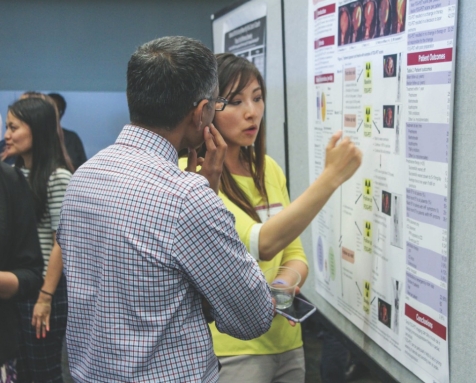
MAGGIE NING, MD, presents her work to SHRIRAM NALLAMSHETTY, MD.

Conference Showcases Residency Research

Wearing a black Stanford Medicine fleece over his blue scrubs, third-year internal medicine resident Gilad Jaffe, MD, stood in front of a poster that described his research on screening rates for primary aldosteronism in patients with resistant hypertension.

He shared the specifics of his findings with a roomful of attendees at the first-ever Stanford Medicine Residency Research Symposium.

Jaffe was one of 49 residents who participated in the event, which was designed to “highlight the remarkable things our residents are doing,” says Angela Rogers, MD, an assistant professor of pulmonary and critical care medicine and the associate program director of the Stanford Internal Medicine Residency Program, who oversaw the symposium.

“More than 80 percent of Stanford residents take a dedicated research month during their time here,” she explains, “and they are amazingly productive. The amount of work and research that they do on their nights and weekends is worth celebrating.”

Resident Jimmy Tooley, MD, one of the leaders of the Stanford Internal Medicine Research Interest Group who helped organize the event, agreed with Rogers, adding: “There is a lot of great mentorship and research going on. I am so impressed and inspired by all the amazing work being done by my peers.”

During the event, faculty judges, mentors, and fellow residents walked up and down several aisles of poster boards, pausing to ask questions, give insights and feedback, and take notes.

The projects on display spanned disciplines, fields, and diseases — investigating topics ranging from advanced care planning to complications of cirrhosis. “Essentially every specialty within medicine was represented,” recalls Rogers. “It was an opportunity for residents to show each other their work, and there aren’t a lot of avenues for that.”

It was also an opportunity to highlight the important role that mentorship and guidance play throughout the Stanford residency experience. “The projects that were presented involved 25 mentors — it’s a testament to how many faculty give their time,” says Rogers. “This type of long-term relationship with a single mentor can be instrumental, and it’s something we pride ourselves on.”

Jaffe has seen the benefits of this long-term mentorship firsthand. He’s been working alongside his mentor, Vivek Bhalla, MD, an assistant professor of nephrology, since the start of his intern year in 2016. “Dr. Bhalla is an outstanding teacher, mentor, and physician,” Jaffe explains. “He is extremely supportive of me and my goals. He worked with me closely and guided me through the process, but also gave me room to spread my wings and figure out the research landscape. He always made time for our research, even if it meant talking to him on his personal time at home.”

At the end of the event, the judges picked 10 winners who received small monetary prizes, but it was clear from the palpable energy and excitement in the room that it was a valuable experience for all involved. “It was spectacularly successful, and we plan to host it every year,” Rogers confirms. “The enthusiastic response from residents and faculty made the event celebratory and supportive.”
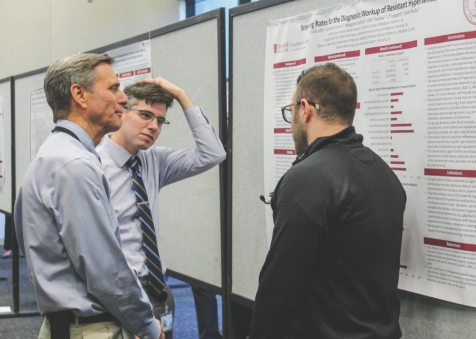
From left: DAVID MARON, MD, and ALEXANDER PERINO, MD, ask GILAD JAFFE, MD, about his research poster

Wearing a black Stanford Medicine fleece over his blue scrubs, third-year internal medicine resident Gilad Jaffe, MD, stood in front of a poster that described his research on screening rates for primary aldosteronism in patients with resistant hypertension.

He shared the specifics of his findings with a roomful of attendees at the first-ever Stanford Medicine Residency Research Symposium.

Jaffe was one of 49 residents who participated in the event, which was designed to “highlight the remarkable things our residents are doing,” says Angela Rogers, MD, an assistant professor of pulmonary and critical care medicine and the associate program director of the Stanford Internal Medicine Residency Program, who oversaw the symposium.

“More than 80 percent of Stanford residents take a dedicated research month during their time here,” she explains, “and they are amazingly productive. The amount of work and research that they do on their nights and weekends is worth celebrating.”

Resident Jimmy Tooley, MD, one of the leaders of the Stanford Internal Medicine Research Interest Group who helped organize the event, agreed with Rogers, adding: “There is a lot of great mentorship and research going on. I am so impressed and inspired by all the amazing work being done by my peers.”

During the event, faculty judges, mentors, and fellow residents walked up and down several aisles of poster boards, pausing to ask questions, give insights and feedback, and take notes.

From left: DAVID MARON, MD, and ALEXANDER PERINO, MD, ask GILAD JAFFE, MD, about his research poster

The projects on display spanned disciplines, fields, and diseases — investigating topics ranging from advanced care planning to complications of cirrhosis. “Essentially every specialty within medicine was represented,” recalls Rogers. “It was an opportunity for residents to show each other their work, and there aren’t a lot of avenues for that.”

It was also an opportunity to highlight the important role that mentorship and guidance play throughout the Stanford residency experience. “The projects that were presented involved 25 mentors — it’s a testament to how many faculty give their time,” says Rogers. “This type of long-term relationship with a single mentor can be instrumental, and it’s something we pride ourselves on.”

Jaffe has seen the benefits of this long-term mentorship firsthand. He’s been working alongside his mentor, Vivek Bhalla, MD, an assistant professor of nephrology, since the start of his intern year in 2016. “Dr. Bhalla is an outstanding teacher, mentor, and physician,” Jaffe explains. “He is extremely supportive of me and my goals. He worked with me closely and guided me through the process, but also gave me room to spread my wings and figure out the research landscape. He always made time for our research, even if it meant talking to him on his personal time at home.”

At the end of the event, the judges picked 10 winners who received small monetary prizes, but it was clear from the palpable energy and excitement in the room that it was a valuable experience for all involved. “It was spectacularly successful, and we plan to host it every year,” Rogers confirms. “The enthusiastic response from residents and faculty made the event celebratory and supportive.”
A Portfolio to Capture Faculty’s Inventive Side

Baldeep Singh, MD, with staff at Samaritan House

A Portfolio to Capture Faculty’s Inventive Side

A Portfolio to Capture Faculty’s Inventive Side

As faculty members are being considered for promotion, they compile their CVs, including their publications and lists of professional activities, to paint a holistic picture of their academic achievements. But for some Stanford faculty, who live and work in the heart of Silicon Valley amid its booming tech industry, those quotidian check boxes don’t capture their whole story. That’s why a group of professors in the Department of Medicine are developing an “innovator’s portfolio,” much like an artist’s portfolio, which showcases technologies that a faculty member has piloted.

Ryan Van Wert, MD, clinical assistant professor of pulmonary and critical care medicine, was one of the first faculty members to try filling in the innovator’s portfolio. His portfolio includes Vynca, a company he founded to manage advance directive documentation [see sidebar].

Van Wert credits Paul J. Wang, MD, professor of cardiovascular medicine, with the success of the innovator’s portfolio.

“There was a recognized need for an environment and training pathway for faculty to become innovators,” Wang says.

“It was equally recognized that innovation as an endeavor is different than typical academic pursuits. But we wanted to go deeper than just encouraging faculty to say ‘I patented X,’” Wang adds.

The innovator’s portfolio is intended to capture what the impact of that patent is — for example, how many patients are affected by the technology, how it’s related to new diagnoses and treatments, whether it decreases health care costs, and if it generates additional intellectual property.

As faculty members are being considered for promotion, they compile their CVs, including their publications and lists of professional activities, to paint a holistic picture of their academic achievements. But for some Stanford faculty, who live and work in the heart of Silicon Valley amid its booming tech industry, those quotidian check boxes don’t capture their whole story. That’s why a group of professors in the Department of Medicine are developing an “innovator’s portfolio,” much like an artist’s portfolio, which showcases technologies that a faculty member has piloted.

Ryan Van Wert, MD, clinical assistant professor of pulmonary and critical care medicine, was one of the first faculty members to try filling in the innovator’s portfolio. His portfolio includes Vynca, a company he founded to manage advance directive documentation [see sidebar].

Van Wert credits Paul J. Wang, MD, professor of cardiovascular medicine, with the success of the innovator’s portfolio.

“There was a recognized need for an environment and training pathway for faculty to become innovators,” Wang says.

“It was equally recognized that innovation as an endeavor is different than typical academic pursuits. But we wanted to go deeper than just encouraging faculty to say ‘I patented X,’” Wang adds.

The innovator’s portfolio is intended to capture what the impact of that patent is — for example, how many patients are affected by the technology, how it’s related to new diagnoses and treatments, whether it decreases health care costs, and if it generates additional intellectual property.

Wang and Van Wert are collaborating with Robert Harrington, MD, professor of medicine and chair of the department, and Paul Yock, MD, professor of medicine, of bioengineering, and, by courtesy, of mechanical engineering. They all presented the innovator’s portfolio as a pilot program at the 2018 Faculty Forum on Clinical Research in the department.

Andrew Hoffman, MD, professor of endocrinology and vice chair for academic affairs in the department, is supportive of the idea and intends to incorporate it into faculty evaluations soon. “As faculty, we don’t have a mechanism to present ourselves this way, and Andy said that promotion committees don’t have a means of interpreting it,” Wang says. “So we’re creating that common language.”

Ultimately, Van Wert wants his colleagues’ innovator’s portfolio concept to persist along the entire span of a clinician’s promotion cycle. “It’s designed to be relevant from assistant to associate to full professor,” he says. “The portfolio will recognize a career of innovation during which the bar appropriately rises at every level.”

Vynca Encompasses the Spirit of Silicon Valley
In 2013, Ryan Van Wert, MD, was an innovation fellow in the Stanford Biodesign Program, now the Stanford Byers Center for Biodesign. His time in the program spurred him to help create Vynca, a company that uses cloud-based technology to aggregate and corroborate documentation and care instructions for families of terminally ill patients.

Vynca manages 420,000 advance care planning documents for patients at 60 hospitals using cloud-based technology. It not only helps patients understand their different choices (like power of attorney or do-not-resuscitate forms), but it can also share those documents between hospitals and nursing homes, while reconciling different copies of the same document signed in different locations. “We aggregate them in single source of truth in the cloud,” Van Wert says.

The company facilitates a reduction in unwanted hospitalizations and intensive care utilization — reducing the stress on health care providers and improving patients’ quality of care. “We’re helping families and clinicians to go through the very complicated process of reflecting on values and then developing goals of care that fit within certain clinical contexts,” says Van Wert.

Wang and Van Wert are collaborating with Robert Harrington, MD, professor of medicine and chair of the department, and Paul Yock, MD, professor of medicine, of bioengineering, and, by courtesy, of mechanical engineering. They all presented the innovator’s portfolio as a pilot program at the 2018 Faculty Forum on Clinical Research in the department.

Andrew Hoffman, MD, professor of endocrinology and vice chair for academic affairs in the department, is supportive of the idea and intends to incorporate it into faculty evaluations soon. “As faculty, we don’t have a mechanism to present ourselves this way, and Andy said that promotion committees don’t have a means of interpreting it,” Wang says. “So we’re creating that common language.”

Ultimately, Van Wert wants his colleagues’ innovator’s portfolio concept to persist along the entire span of a clinician’s promotion cycle. “It’s designed to be relevant from assistant to associate to full professor,” he says. “The portfolio will recognize a career of innovation during which the bar appropriately rises at every level.”

Vynca Encompasses the Spirit of Silicon Valley
In 2013, Ryan Van Wert, MD, was an innovation fellow in the Stanford Biodesign Program, now the Stanford Byers Center for Biodesign. His time in the program spurred him to help create Vynca, a company that uses cloud-based technology to aggregate and corroborate documentation and care instructions for families of terminally ill patients.

Vynca manages 420,000 advance care planning documents for patients at 60 hospitals using cloud-based technology. It not only helps patients understand their different choices (like power of attorney or do-not-resuscitate forms), but it can also share those documents between hospitals and nursing homes, while reconciling different copies of the same document signed in different locations. “We aggregate them in single source of truth in the cloud,” Van Wert says.

The company facilitates a reduction in unwanted hospitalizations and intensive care utilization — reducing the stress on health care providers and improving patients’ quality of care. “We’re helping families and clinicians to go through the very complicated process of reflecting on values and then developing goals of care that fit within certain clinical contexts,” says Van Wert.