Showing a Commitment to Cost Savings and High-Value Patient Care

Baldeep Singh, MD, with staff at Samaritan House

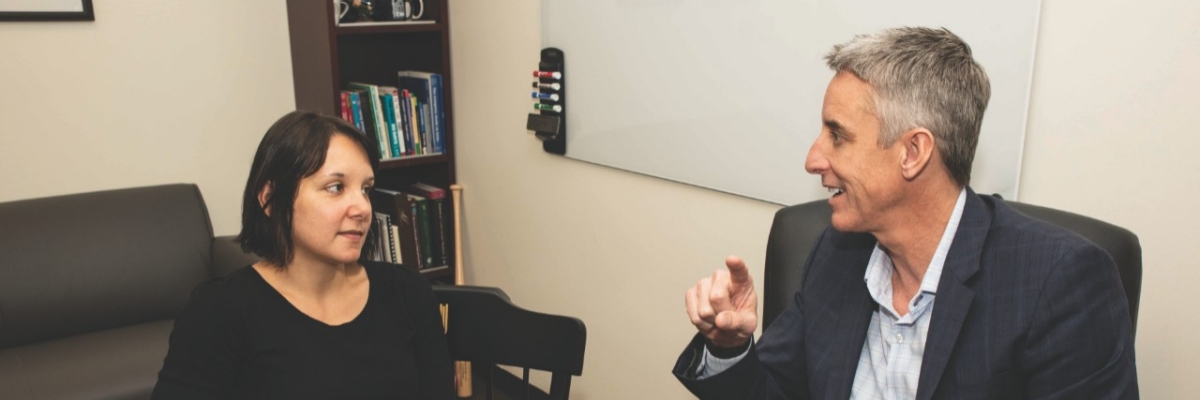
Staff meet to discuss the appropriate use of accommodations project. From left: ARPITA PATEL, RN; ROSDY PAMATIAN, RN; LISA SHIEH, MD, PHDDAVID SVEC, MD, MBAPAUL GEORGANTES, MSN, RN, CNL.

Showing a Commitment to Cost Savings and High-Value Patient Care
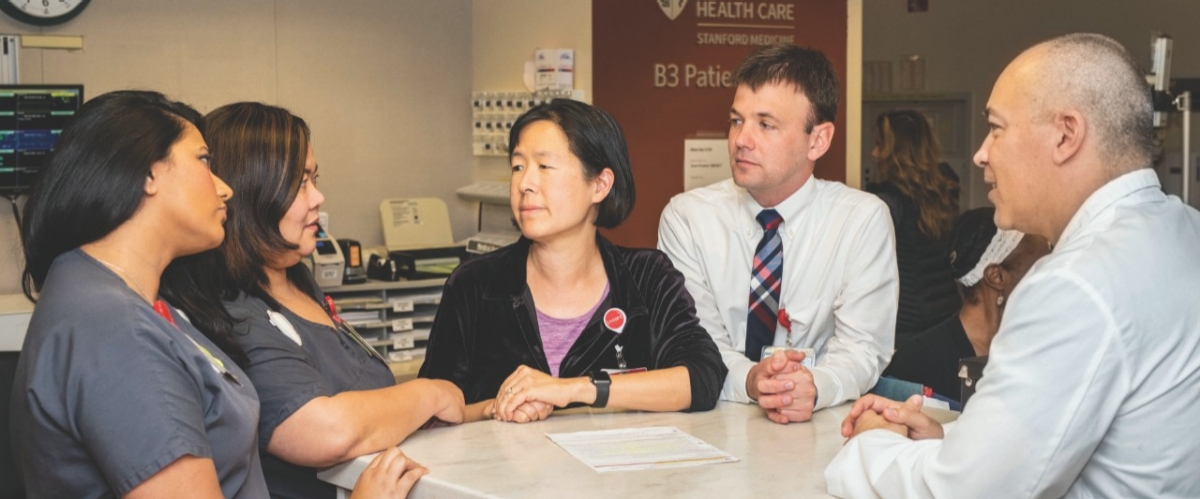
Staff meet to discuss the appropriate use of accommodations project. From left: ARPITA PATEL, RN; ROSDY PAMATIAN, RN; LISA SHIEH, MD, PHDDAVID SVEC, MD, MBAPAUL GEORGANTES, MSN, RN, CNL.

Showing a Commitment to Cost Savings and High-Value Patient Care

As Stanford Health Care strives to be increasingly innovative and efficient, front-line providers develop and implement collaborative initiatives aimed at saving money and increasing high-value care. Two such programs illustrate those efforts.

The Cost Savings Reinvestment Program
Leaders at Stanford Hospital expend a fair amount of time and energy figuring out how to improve the delivery of high-value care and patient outcomes and, when possible, to reduce costs. One such effort is the Cost Savings Reinvestment Program (CSRP), which Paul Heidenreich, MD, professor of cardiovascular medicine and vice chair for quality in the Department of Medicine, describes as a “Stanford Health Care–led initiative which asks faculty to come up with a cost-saving idea or intervention, and if it is approved and put in place, rewards those who carry it out with a 25 to 50 percent share of the savings in the first year.”

The funds cannot be used as any form of salary support or compensation for physicians, but they can be used at the discretion of the departments for supplies, research-related expenses, and continuing education.

The Appropriate Use of Accommodations Project
One project under the CSRP addressed a significant source of inpatient costs: the level of in-hospital care to which patients are assigned. A patient occupying an intensive care unit bed who does not require specialized personnel and equipment associated with such accommodations is mismatched. Lisa Shieh, MD, PhD, clinical professor of hospital medicine, and David Svec, MD, MBA, assistant professor of hospital medicine, saw mismatching as expensive and wasteful. Besides simply saving money, says Svec, “We believed that using these extremely expensive resources appropriately would improve the value of the care patients receive.”

After exhaustively gathering data about accommodation costs and the distribution of patients in different levels of accommodation, Shieh and Svec estimated that assigning patients to more intensive levels of care than necessary was costing Stanford Hospital millions every year. They designed a project that would ensure appropriate levels of care for all patients by engaging physicians responsible for patients’ levels of care.

To effect meaningful change, they first had to get buy-in from all departments that assign accommodations, which meant meeting with the chairpeople of those departments and convincing them to delegate a faculty member to drive their part of the project.

Shieh and Svec’s next step was to create a set of alerts to increase awareness about levels of care.

The first alert they created asks — every day — whether a patient who is on cardiac monitoring still needs it. A response from a caregiver is required, causing that caregiver to think about whether the use is appropriate according to Stanford and national guidelines. A second alert reminds caregivers that their patient’s level of care is the intermediate intensive care unit, a fact sometimes missed because rooms on different levels look the same.

The results are positive so far. The CSRP project is likely to save the millions Shieh and Svec estimated, and they look forward to working on additional projects to provide higher value care for Stanford patients.

The Improvement Capability Development Program
The Improvement Capability Development Program (ICDP) is a joint venture between the Department of Quality for Stanford Health Care and the School of Medicine. Its premise: Stanford Health Care commits to returning 1 to 2 percent of a department’s clinical revenue to help develop and execute far-reaching quality improvement (QI) projects, depending on its level of commitment and outcomes or deliverables. Although these funds cannot be distributed as a bonus to department faculty, they can support faculty conducting improvement work, including research and education related to quality.

As Stanford Health Care strives to be increasingly innovative and efficient, front-line providers develop and implement collaborative initiatives aimed at saving money and increasing high-value care. Two such programs illustrate those efforts.

The Cost Savings Reinvestment Program
Leaders at Stanford Hospital expend a fair amount of time and energy figuring out how to improve the delivery of high-value care and patient outcomes and, when possible, to reduce costs. One such effort is the Cost Savings Reinvestment Program (CSRP), which Paul Heidenreich, MD, professor of cardiovascular medicine and vice chair for quality in the Department of Medicine, describes as a “Stanford Health Care–led initiative which asks faculty to come up with a cost-saving idea or intervention, and if it is approved and put in place, rewards those who carry it out with a 25 to 50 percent share of the savings in the first year.”

The funds cannot be used as any form of salary support or compensation for physicians, but they can be used at the discretion of the departments for supplies, research-related expenses, and continuing education.

The Appropriate Use of Accommodations Project
One project under the CSRP addressed a significant source of inpatient costs: the level of in-hospital care to which patients are assigned. A patient occupying an intensive care unit bed who does not require specialized personnel and equipment associated with such accommodations is mismatched. Lisa Shieh, MD, PhD, clinical professor of hospital medicine, and David Svec, MD, MBA, assistant professor of hospital medicine, saw mismatching as expensive and wasteful. Besides simply saving money, says Svec, “We believed that using these extremely expensive resources appropriately would improve the value of the care patients receive.”

After exhaustively gathering data about accommodation costs and the distribution of patients in different levels of accommodation, Shieh and Svec estimated that assigning patients to more intensive levels of care than necessary was costing Stanford Hospital millions every year. They designed a project that would ensure appropriate levels of care for all patients by engaging physicians responsible for patients’ levels of care.

To effect meaningful change, they first had to get buy-in from all departments that assign accommodations, which meant meeting with the chairpeople of those departments and convincing them to delegate a faculty member to drive their part of the project.

Shieh and Svec’s next step was to create a set of alerts to increase awareness about levels of care. The first alert they created asks — every day — whether a patient who is on cardiac monitoring still needs it. A response from a caregiver is required, causing that caregiver to think about whether the use is appropriate according to Stanford and national guidelines. A second alert reminds caregivers that their patient’s level of care is the intermediate intensive care unit, a fact sometimes missed because rooms on different levels look the same.

The results are positive so far. The CSRP project is likely to save the millions Shieh and Svec estimated, and they look forward to working on additional projects to provide higher value care for Stanford patients.

The Improvement Capability Development Program
The Improvement Capability Development Program (ICDP) is a joint venture between the Department of Quality for Stanford Health Care and the School of Medicine. Its premise: Stanford Health Care commits to returning 1 to 2 percent of a department’s clinical revenue to help develop and execute far-reaching quality improvement (QI) projects, depending on its level of commitment and outcomes or deliverables. Although these funds cannot be distributed as a bonus to department faculty, they can support faculty conducting improvement work, including research and education related to quality.

According to Stephanie Harman, MD, clinical associate professor of primary care and population health, it has been a challenge for clinical departments to fund QI initiatives “because clinicians are bootstrapping projects with unfunded time and no project management support. With ICDP, Stanford Health Care is funding the time and project management it takes to lift up a new project that aims to improve the care we give.”
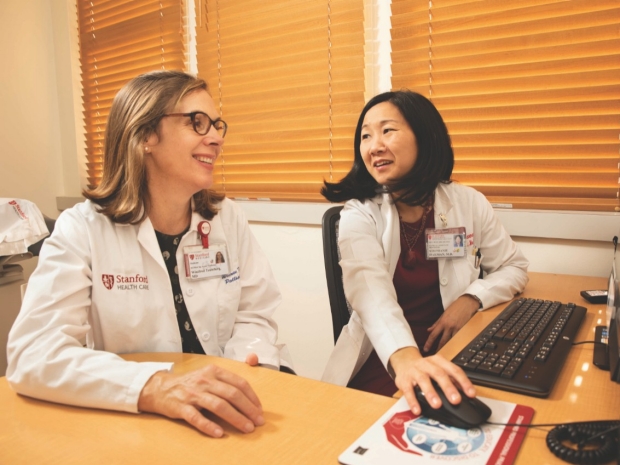
WINNIE TEUTEBERG, MD (left), and STEPHANIE HARMAN, MD, discuss the difficult conversations project.

According to Stephanie Harman, MD, clinical associate professor of primary care and population health, it has been a challenge for clinical departments to fund QI initiatives “because clinicians are bootstrapping projects with unfunded time and no project management support. With ICDP, Stanford Health Care is funding the time and project management it takes to lift up a new project that aims to improve the care we give.”

Difficult Conversations with Seriously Ill Patients
One ICDP project has to do with seriously ill patients. After learning that there are many patients with serious illness who have no advanced directives or other documentation of what matters most to them, Harman realized that important conversations with patients were not happening. “These are conversations that many physicians see as challenging and time-intensive, but the system wasn’t built for them to happen in busy clinic settings,” she says. The serious illness conversation project was developed to bring advance care planning to more patients and families and to integrate it into the standard work of the clinic.

To get the project off the ground, its leaders entered into a partnership with Ariadne Labs — a joint health system innovation center of Brigham & Women’s Hospital and the Harvard T. H. Chan School of Public Health — founded by Atul Gawande, MD, to help with training and workflow redesign. Harman explains the need for such help: “Left to our own devices, we would have been reinventing the wheel. We didn’t know what resources it would take to carry out the project on a large scale, for instance. The ICDP project funding has paid a fee to join, which covers team training and coaching, the implementation of workflow redesign, and our membership in a collaborative national group. Those funds also support part of a physician leader’s time as well as true project management support.”

Difficult Conversations with Seriously Ill Patients
One ICDP project has to do with seriously ill patients. After learning that there are many patients with serious illness who have no advanced directives or other documentation of what matters most to them, Harman realized that important conversations with patients were not happening. “These are conversations that many physicians see as challenging and time-intensive, but the system wasn’t built for them to happen in busy clinic settings,” she says. The serious illness conversation project was developed to bring advance care planning to more patients and families and to integrate it into the standard work of the clinic.

To get the project off the ground, its leaders entered into a partnership with Ariadne Labs — a joint health system innovation center of Brigham & Women’s Hospital and the Harvard T. H. Chan School of Public Health — founded by Atul Gawande, MD, to help with training and workflow redesign. Harman explains the need for such help: “Left to our own devices, we would have been reinventing the wheel. We didn’t know what resources it would take to carry out the project on a large scale, for instance. The ICDP project funding has paid a fee to join, which covers team training and coaching, the implementation of workflow redesign, and our membership in a collaborative national group. Those funds also support part of a physician leader’s time as well as true project management support.”

Harman says that while the program is still in the early stages, “it’s going well. The emphasis on implementation and workflow redesign ensures that physicians aren’t the sole holders of these conversations and ensures that they happen. Everything else we do in the clinic is team-based, and so should this be. The feedback from several groups of physicians, nurses, social workers, and clinic managers who underwent training is that they are 100 percent likely to recommend it.”

The physician leader of the project is Winnie Teuteberg, MD, clinical associate professor of primary care and population health. Her responsibility entails partnering with the project manager to implement the program. The hardest part, she believes, “is selling the program. We’re asking doctors to change a part of their job that deals with an emotionally-charged subject.”

The project uses a guide developed by Ariadne Labs, which Teuteberg describes as “having a list of about 10 questions that go through information sharing and patient preferences. It includes ways for providers to share a prognosis if that’s appropriate. Then it talks about hopes and goals, fears and worries. The ultimate wrap-up is the physician pulling the information together and making a recommendation about where to go next.”

Ann Weinacker, MD, senior vice chair of medicine for clinical affairs, reflects on the fundamental value of programs such as the CSRP and ICDP: “What is really exciting about these programs is that they actively engage physicians and School of Medicine clinical departments in improvement work that aligns with the goals of Stanford Medicine, an alliance between the School of Medicine and the hospitals. The development of ICDP and CSRP was born of the recognition that the commitment of physicians to this work is essential to increasing the value of the care we deliver.”
The group stops for a photo in fron to fthe dish satellite structure

Harman says that while the program is still in the early stages, “it’s going well. The emphasis on implementation and workflow redesign ensures that physicians aren’t the sole holders of these conversations and ensures that they happen. Everything else we do in the clinic is team-based, and so should this be. The feedback from several groups of physicians, nurses, social workers, and clinic managers who underwent training is that they are 100 percent likely to recommend it.”

The physician leader of the project is Winnie Teuteberg, MD, clinical associate professor of primary care and population health. Her responsibility entails partnering with the project manager to implement the program. The hardest part, she believes, “is selling the program. We’re asking doctors to change a part of their job that deals with an emotionally-charged subject.”

The project uses a guide developed by Ariadne Labs, which Teuteberg describes as “having a list of about 10 questions that go through information sharing and patient preferences. It includes ways for providers to share a prognosis if that’s appropriate. Then it talks about hopes and goals, fears and worries. The ultimate wrap-up is the physician pulling the information together and making a recommendation about where to go next.”

Ann Weinacker, MD, senior vice chair of medicine for clinical affairs, reflects on the fundamental value of programs such as the CSRP and ICDP: “What is really exciting about these programs is that they actively engage physicians and School of Medicine clinical departments in improvement work that aligns with the goals of Stanford Medicine, an alliance between the School of Medicine and the hospitals. The development of ICDP and CSRP was born of the recognition that the commitment of physicians to this work is essential to increasing the value of the care we deliver.”
Stanford Center for Clinical Research: The Engine That’s Powering Clinical Research

Baldeep Singh, MD, with staff at Samaritan House

KEN MAHAFFEY, MD (right), discusses site-based research with REBECCA MCCUE.

Stanford Center for Clinical Research: The Engine That’s Powering Clinical Research

KEN MAHAFFEY, MD (right), discusses site-based research with REBECCA MCCUE.

Stanford Center for Clinical Research: The Engine That’s Powering Clinical Research

The Stanford Center for Clinical Research (SCCR) is the “operational engine” that enables many faculty throughout Stanford to drive robust clinical research enterprises, according to Kenneth Mahaffey, MD, professor of cardiovascular medicine, vice chair of clinical research in the Department of Medicine, and director of SCCR.

Since its inception in late 2014, SCCR has grown to 70 staff and partnered with more than 50 faculty and 25 fellows on 82 research projects.

SCCR has three foundational enterprises:

  1. A site-based research program led by Rebecca McCue to support projects in which Stanford researchers enroll Stanford patients in clinical trials.
  2. A coordinating center led by Amol Rajmane, MD, to help design and conduct multicenter registries, trials, and outcome programs.
  3. An educational component led by Kiera Larsen, RN, which has created preceptorships and a large portfolio of educational opportunities — including scientific seminars and Good Clinical Practice workshops for research staff — and educational events for industry.

Supporting Faculty across the School of Medicine for Site-Based Research
SCCR works with faculty to understand research interests and then develop their research portfolios to support the desired vision. SCCR hires, trains, manages, and mentors research staff to navigate complex processes, letting faculty focus on their scientific and clinical care activities.

“SCCR doesn’t remove the faculty member from the key relationship with research coordinators, but we take on a lot of the administrative burden,” McCue, the associate director for SCCR’s site-based research projects, points out.

In just a few years, SCCR’s partnership with the division of gastroenterology and hepatology has helped the division’s research portfolio grow from 10 studies to more than 50. The SCCR team works with 22 principal investigators and 11 dedicated research staff in the division.

Key achievements for the division include: collaboration with the Research Management Group to determine the appropriate funding for studies, a streamlined budgeting and contract process that has led to earlier initiation of studies, improved financial metrics, the adoption of a central Institutional Review Board process, and a culture of collaboration and efficiency.

SCCR teams support many types of research — drug, medical device, and mobile/digital technology trials; investigator-initiated studies; and multisite registries. Investigators collaborate across divisions and departments in the School of Medicine, with groups such as neurosurgery; vascular surgery; radiology; biodesign; athletics; infectious diseases; and Spectrum, the Stanford Center for Clinical and Translational Research and Education — furthering a holistic and multidisciplinary approach.

Sanjiv (Sam) Gambhir, MD, PhD, professor and chairman of radiology, helped launch Project Baseline, one of the largest projects that SCCR works on. Project Baseline is a collaborative effort among Stanford Medicine, Duke University School of Medicine, Verily, and Google. The researchers plan to enroll approximately 10,000 participants with an extraordinarily detailed evaluation of each participant; the idea is to characterize what it means to be healthy and to capture changes during a transition to disease.

“A large part of Project Baseline deals with trying to understand the transition from health to disease on a personal level, which integrates precision medicine, preventive health, and mobile and digital technologies,” Mahaffey says.

To help with study recruitment, SCCR leaders launched a Community Advisory Board for Clinical Research in 2015, which allows faculty to engage community members as partners. The aim of the advisory board is to bridge the gap between researchers and the community to enhance clinical research.

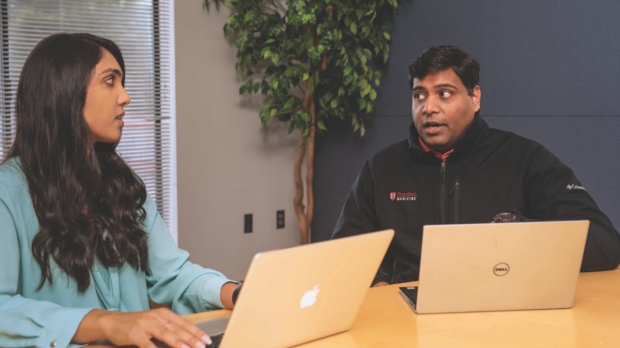
Apple Heart Study Project Manager NISHA TALATI, MBA (left), reviews data with AMOL RAJMANE, MD.

The Stanford Center for Clinical Research (SCCR) is the “operational engine” that enables many faculty throughout Stanford to drive robust clinical research enterprises, according to Kenneth Mahaffey, MD, professor of cardiovascular medicine, vice chair of clinical research in the Department of Medicine, and director of SCCR.

Since its inception in late 2014, SCCR has grown to 70 staff and partnered with more than 50 faculty and 25 fellows on 82 research projects.

SCCR has three foundational enterprises:

  1. A site-based research program led by Rebecca McCue to support projects in which Stanford researchers enroll Stanford patients in clinical trials.
  2. A coordinating center led by Amol Rajmane, MD, to help design and conduct multicenter registries, trials, and outcome programs.
  3. An educational component led by Kiera Larsen, RN, which has created preceptorships and a large portfolio of educational opportunities — including scientific seminars and Good Clinical Practice workshops for research staff — and educational events for industry.

Supporting Faculty across the School of Medicine for Site-Based Research
SCCR works with faculty to understand research interests and then develop their research portfolios to support the desired vision. SCCR hires, trains, manages, and mentors research staff to navigate complex processes, letting faculty focus on their scientific and clinical care activities.

“SCCR doesn’t remove the faculty member from the key relationship with research coordinators, but we take on a lot of the administrative burden,” McCue, the associate director for SCCR’s site-based research projects, points out.

In just a few years, SCCR’s partnership with the division of gastroenterology and hepatology has helped the division’s research portfolio grow from 10 studies to more than 50. The SCCR team works with 22 principal investigators and 11 dedicated research staff in the division. Key achievements for the division include: collaboration with the Research Management Group to determine the appropriate funding for studies, a streamlined budgeting and contract process that has led to earlier initiation of studies, improved financial metrics, the adoption of a central Institutional Review Board process, and a culture of collaboration and efficiency.

SCCR teams support many types of research — drug, medical device, and mobile/digital technology trials; investigator-initiated studies; and multisite registries. Investigators collaborate across divisions and departments in the School of Medicine, with groups such as neurosurgery; vascular surgery; radiology; biodesign; athletics; infectious diseases; and Spectrum, the Stanford Center for Clinical and Translational Research and Education — furthering a holistic and multidisciplinary approach.

Sanjiv (Sam) Gambhir, MD, PhD, professor and chairman of radiology, helped launch Project Baseline, one of the largest projects that SCCR works on. Project Baseline is a collaborative effort among Stanford Medicine, Duke University School of Medicine, Verily, and Google. The researchers plan to enroll approximately 10,000 participants with an extraordinarily detailed evaluation of each participant; the idea is to characterize what it means to be healthy and to capture changes during a transition to disease.

“A large part of Project Baseline deals with trying to understand the transition from health to disease on a personal level, which integrates precision medicine, preventive health, and mobile and digital technologies,” Mahaffey says.

To help with study recruitment, SCCR leaders launched a Community Advisory Board for Clinical Research in 2015, which allows faculty to engage community members as partners. The aim of the advisory board is to bridge the gap between researchers and the community to enhance clinical research.

Apple Heart Study Project Manager NISHA TALATI, MBA (left), reviews data with AMOL RAJMANE, MD.

Multisite Research Project Coordination
SCCR’s Coordinating Center helps faculty design and run multisite research projects, as its project managers provide input on protocols, assist with FDA and Institutional Review Board submissions, shape sustainable study budgets, and manage sites. It also offers core lab administration, safety desk work, event adjudication, and data safety monitoring committee management.

The Apple Heart Study, conducted to learn if an app can use data from the Apple Watch to identify irregular heart rhythms, is one example of how SCCR works with Stanford researchers and sponsors to leverage technology and innovation to rigorously test drugs, devices, and other interventions.

“We have a portfolio of five studies relating to mobile and digital technologies created in part by an intense interest in these technologies by many Stanford faculty and by a strategic partnership with the Center for Digital Health,” says Rajmane, SCCR’s associate director for the Coordinating Center.

The Coordinating Center is also managing the research operations for a study evaluating concussions using an innovative mouth guard with local high school football programs. Partners include leading concussion experts from Stanford: bioengineer David Camarillo, PhD; neurosurgeon Gerald Grant, MD; and neuroradiologist Michael Zeineh, MD, PhD.

Every clinical research project involves tasks like project management, site start-up and initiation, oversight for recruitment and retention, data collection, core lab activities, safety event reporting, and quality and compliance oversight. For faculty who want to lead multicenter clinical research projects, SCCR eliminates the need to outsource those tasks.

“Faculty can lead these large projects without worrying about the operational administration and coordination, and as the activities are performed by a Stanford team and not by an outside entity, it’s easy for them to coordinate and work with the team. Faculty can have a much higher profile in these projects because all the research activities are being done here at Stanford,” Mahaffey says.

David Maron, MD, a clinical professor of cardiovascular medicine, notes how SCCR is readily available to round out his research team by helping complete proposals. He recalls an instance when a research application required detailed information about a committee to adjudicate clinical events and notes how “SCCR provided a description of the organization, the budget, and the personnel that was required in the application.”

Partnerships and Team Science
Mahaffey describes the importance of having SCCR collaborate with institutional resources like the Research Management Group, the Institutional Review Board, and the Privacy Office.

“We work with these resources to understand how to oversee new types of research protocols to make sure processes are appropriate. We want them to adhere not only to institution policies and standards, but also to external requirements from the FDA and NIH,” he says.

On the subject of partnership, Mintu Turakhia, MD, associate professor of cardiovascular medicine and director of the Center for Digital Health, describes his relationship with SCCR.

“Working with SCCR has been seminal to my career progression. I’ve had the privilege of working with Ken [Mahaffey] and his outstanding team for over four years now on a series of clinical trials that range from traditional small, single-center trials all the way to the Apple Heart Study, a massive virtual clinical trial. In the early days of SCCR, it was a handful of us working together — much like a startup — to get the job done. Now the group has about 70 people and is a remarkably well-oiled machine,” Turakhia says.

SCCR is involved with faculty who are experts in a variety of therapeutic subjects and areas of practice. “We have projects that really epitomize team science, with faculty from multiple disciplines and research staff from multiple areas, including data scientists, project managers, information technology experts, biostatisticians, and bioinformaticians,” Mahaffey says.

He describes how SCCR’s activities over the past four years speak to its mission of “conducting and promoting high-impact, innovative clinical research to improve human health.”

Multisite Research Project Coordination
SCCR’s Coordinating Center helps faculty design and run multisite research projects, as its project managers provide input on protocols, assist with FDA and Institutional Review Board submissions, shape sustainable study budgets, and manage sites. It also offers core lab administration, safety desk work, event adjudication, and data safety monitoring committee management.

The Apple Heart Study, conducted to learn if an app can use data from the Apple Watch to identify irregular heart rhythms, is one example of how SCCR works with Stanford researchers and sponsors to leverage technology and innovation to rigorously test drugs, devices, and other interventions.

“We have a portfolio of five studies relating to mobile and digital technologies created in part by an intense interest in these technologies by many Stanford faculty and by a strategic partnership with the Center for Digital Health,” says Rajmane, SCCR’s associate director for the Coordinating Center.

The Coordinating Center is also managing the research operations for a study evaluating concussions using an innovative mouth guard with local high school football programs. Partners include leading concussion experts from Stanford: bioengineer David Camarillo, PhD; neurosurgeon Gerald Grant, MD; and neuroradiologist Michael Zeineh, MD, PhD.

Every clinical research project involves tasks like project management, site start-up and initiation, oversight for recruitment and retention, data collection, core lab activities, safety event reporting, and quality and compliance oversight. For faculty who want to lead multicenter clinical research projects, SCCR eliminates the need to outsource those tasks.

“Faculty can lead these large projects without worrying about the operational administration and coordination, and as the activities are performed by a Stanford team and not by an outside entity, it’s easy for them to coordinate and work with the team. Faculty can have a much higher profile in these projects because all the research activities are being done here at Stanford,” Mahaffey says.

David Maron, MD, a clinical professor of cardiovascular medicine, notes how SCCR is readily available to round out his research team by helping complete proposals. He recalls an instance when a research application required detailed information about a committee to adjudicate clinical events and notes how “SCCR provided a description of the organization, the budget, and the personnel that was required in the application.”

Partnerships and Team Science
Mahaffey describes the importance of having SCCR collaborate with institutional resources like the Research Management Group, the Institutional Review Board, and the Privacy Office.

“We work with these resources to understand how to oversee new types of research protocols to make sure processes are appropriate. We want them to adhere not only to institution policies and standards, but also to external requirements from the FDA and NIH,” he says.

On the subject of partnership, Mintu Turakhia, MD, associate professor of cardiovascular medicine and director of the Center for Digital Health, describes his relationship with SCCR.

“Working with SCCR has been seminal to my career progression. I’ve had the privilege of working with Ken [Mahaffey] and his outstanding team for over four years now on a series of clinical trials that range from traditional small, single-center trials all the way to the Apple Heart Study, a massive virtual clinical trial. In the early days of SCCR, it was a handful of us working together — much like a startup — to get the job done. Now the group has about 70 people and is a remarkably well-oiled machine,” Turakhia says.

SCCR is involved with faculty who are experts in a variety of therapeutic subjects and areas of practice. “We have projects that really epitomize team science, with faculty from multiple disciplines and research staff from multiple areas, including data scientists, project managers, information technology experts, biostatisticians, and bioinformaticians,” Mahaffey says.

He describes how SCCR’s activities over the past four years speak to its mission of “conducting and promoting high-impact, innovative clinical research to improve human health.”

Conference Showcases Residency Research

Baldeep Singh, MD, with staff at Samaritan House

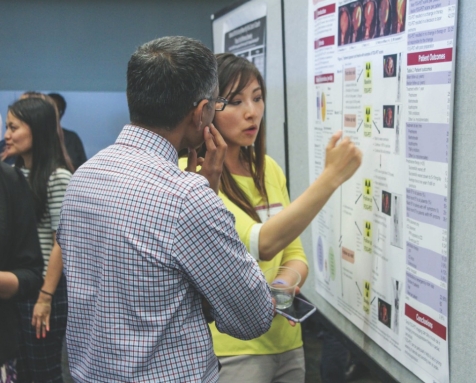
MAGGIE NING, MD, presents her work to SHRIRAM NALLAMSHETTY, MD.

Conference Showcases Residency Research

MAGGIE NING, MD, presents her work to SHRIRAM NALLAMSHETTY, MD.

Conference Showcases Residency Research

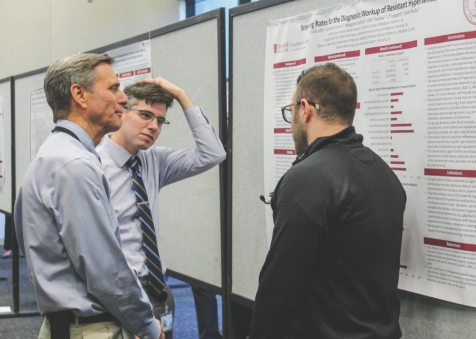
Wearing a black Stanford Medicine fleece over his blue scrubs, third-year internal medicine resident Gilad Jaffe, MD, stood in front of a poster that described his research on screening rates for primary aldosteronism in patients with resistant hypertension.

He shared the specifics of his findings with a roomful of attendees at the first-ever Stanford Medicine Residency Research Symposium.

Jaffe was one of 49 residents who participated in the event, which was designed to “highlight the remarkable things our residents are doing,” says Angela Rogers, MD, an assistant professor of pulmonary and critical care medicine and the associate program director of the Stanford Internal Medicine Residency Program, who oversaw the symposium.

“More than 80 percent of Stanford residents take a dedicated research month during their time here,” she explains, “and they are amazingly productive. The amount of work and research that they do on their nights and weekends is worth celebrating.”

Resident Jimmy Tooley, MD, one of the leaders of the Stanford Internal Medicine Research Interest Group who helped organize the event, agreed with Rogers, adding: “There is a lot of great mentorship and research going on. I am so impressed and inspired by all the amazing work being done by my peers.”

During the event, faculty judges, mentors, and fellow residents walked up and down several aisles of poster boards, pausing to ask questions, give insights and feedback, and take notes.

The projects on display spanned disciplines, fields, and diseases — investigating topics ranging from advanced care planning to complications of cirrhosis. “Essentially every specialty within medicine was represented,” recalls Rogers. “It was an opportunity for residents to show each other their work, and there aren’t a lot of avenues for that.”

It was also an opportunity to highlight the important role that mentorship and guidance play throughout the Stanford residency experience. “The projects that were presented involved 25 mentors — it’s a testament to how many faculty give their time,” says Rogers. “This type of long-term relationship with a single mentor can be instrumental, and it’s something we pride ourselves on.”

Jaffe has seen the benefits of this long-term mentorship firsthand. He’s been working alongside his mentor, Vivek Bhalla, MD, an assistant professor of nephrology, since the start of his intern year in 2016. “Dr. Bhalla is an outstanding teacher, mentor, and physician,” Jaffe explains. “He is extremely supportive of me and my goals. He worked with me closely and guided me through the process, but also gave me room to spread my wings and figure out the research landscape. He always made time for our research, even if it meant talking to him on his personal time at home.”

At the end of the event, the judges picked 10 winners who received small monetary prizes, but it was clear from the palpable energy and excitement in the room that it was a valuable experience for all involved. “It was spectacularly successful, and we plan to host it every year,” Rogers confirms. “The enthusiastic response from residents and faculty made the event celebratory and supportive.”

From left: DAVID MARON, MD, and ALEXANDER PERINO, MD, ask GILAD JAFFE, MD, about his research poster

Wearing a black Stanford Medicine fleece over his blue scrubs, third-year internal medicine resident Gilad Jaffe, MD, stood in front of a poster that described his research on screening rates for primary aldosteronism in patients with resistant hypertension.

He shared the specifics of his findings with a roomful of attendees at the first-ever Stanford Medicine Residency Research Symposium.

Jaffe was one of 49 residents who participated in the event, which was designed to “highlight the remarkable things our residents are doing,” says Angela Rogers, MD, an assistant professor of pulmonary and critical care medicine and the associate program director of the Stanford Internal Medicine Residency Program, who oversaw the symposium.

“More than 80 percent of Stanford residents take a dedicated research month during their time here,” she explains, “and they are amazingly productive. The amount of work and research that they do on their nights and weekends is worth celebrating.”

Resident Jimmy Tooley, MD, one of the leaders of the Stanford Internal Medicine Research Interest Group who helped organize the event, agreed with Rogers, adding: “There is a lot of great mentorship and research going on. I am so impressed and inspired by all the amazing work being done by my peers.”

During the event, faculty judges, mentors, and fellow residents walked up and down several aisles of poster boards, pausing to ask questions, give insights and feedback, and take notes.

From left: DAVID MARON, MD, and ALEXANDER PERINO, MD, ask GILAD JAFFE, MD, about his research poster

The projects on display spanned disciplines, fields, and diseases — investigating topics ranging from advanced care planning to complications of cirrhosis. “Essentially every specialty within medicine was represented,” recalls Rogers. “It was an opportunity for residents to show each other their work, and there aren’t a lot of avenues for that.”

It was also an opportunity to highlight the important role that mentorship and guidance play throughout the Stanford residency experience. “The projects that were presented involved 25 mentors — it’s a testament to how many faculty give their time,” says Rogers. “This type of long-term relationship with a single mentor can be instrumental, and it’s something we pride ourselves on.”

Jaffe has seen the benefits of this long-term mentorship firsthand. He’s been working alongside his mentor, Vivek Bhalla, MD, an assistant professor of nephrology, since the start of his intern year in 2016. “Dr. Bhalla is an outstanding teacher, mentor, and physician,” Jaffe explains. “He is extremely supportive of me and my goals. He worked with me closely and guided me through the process, but also gave me room to spread my wings and figure out the research landscape. He always made time for our research, even if it meant talking to him on his personal time at home.”

At the end of the event, the judges picked 10 winners who received small monetary prizes, but it was clear from the palpable energy and excitement in the room that it was a valuable experience for all involved. “It was spectacularly successful, and we plan to host it every year,” Rogers confirms. “The enthusiastic response from residents and faculty made the event celebratory and supportive.”

A Portfolio to Capture Faculty’s Inventive Side

Baldeep Singh, MD, with staff at Samaritan House

A Portfolio to Capture Faculty’s Inventive Side

A Portfolio to Capture Faculty’s Inventive Side

As faculty members are being considered for promotion, they compile their CVs, including their publications and lists of professional activities, to paint a holistic picture of their academic achievements. But for some Stanford faculty, who live and work in the heart of Silicon Valley amid its booming tech industry, those quotidian check boxes don’t capture their whole story. That’s why a group of professors in the Department of Medicine are developing an “innovator’s portfolio,” much like an artist’s portfolio, which showcases technologies that a faculty member has piloted.

Ryan Van Wert, MD, clinical assistant professor of pulmonary and critical care medicine, was one of the first faculty members to try filling in the innovator’s portfolio. His portfolio includes Vynca, a company he founded to manage advance directive documentation [see sidebar].

Van Wert credits Paul J. Wang, MD, professor of cardiovascular medicine, with the success of the innovator’s portfolio.

“There was a recognized need for an environment and training pathway for faculty to become innovators,” Wang says.

“It was equally recognized that innovation as an endeavor is different than typical academic pursuits. But we wanted to go deeper than just encouraging faculty to say ‘I patented X,’” Wang adds.

The innovator’s portfolio is intended to capture what the impact of that patent is — for example, how many patients are affected by the technology, how it’s related to new diagnoses and treatments, whether it decreases health care costs, and if it generates additional intellectual property.

As faculty members are being considered for promotion, they compile their CVs, including their publications and lists of professional activities, to paint a holistic picture of their academic achievements. But for some Stanford faculty, who live and work in the heart of Silicon Valley amid its booming tech industry, those quotidian check boxes don’t capture their whole story. That’s why a group of professors in the Department of Medicine are developing an “innovator’s portfolio,” much like an artist’s portfolio, which showcases technologies that a faculty member has piloted.

Ryan Van Wert, MD, clinical assistant professor of pulmonary and critical care medicine, was one of the first faculty members to try filling in the innovator’s portfolio. His portfolio includes Vynca, a company he founded to manage advance directive documentation [see sidebar].

Van Wert credits Paul J. Wang, MD, professor of cardiovascular medicine, with the success of the innovator’s portfolio.

“There was a recognized need for an environment and training pathway for faculty to become innovators,” Wang says.

“It was equally recognized that innovation as an endeavor is different than typical academic pursuits. But we wanted to go deeper than just encouraging faculty to say ‘I patented X,’” Wang adds.

The innovator’s portfolio is intended to capture what the impact of that patent is — for example, how many patients are affected by the technology, how it’s related to new diagnoses and treatments, whether it decreases health care costs, and if it generates additional intellectual property.

Wang and Van Wert are collaborating with Robert Harrington, MD, professor of medicine and chair of the department, and Paul Yock, MD, professor of medicine, of bioengineering, and, by courtesy, of mechanical engineering. They all presented the innovator’s portfolio as a pilot program at the 2018 Faculty Forum on Clinical Research in the department.

Andrew Hoffman, MD, professor of endocrinology and vice chair for academic affairs in the department, is supportive of the idea and intends to incorporate it into faculty evaluations soon. “As faculty, we don’t have a mechanism to present ourselves this way, and Andy said that promotion committees don’t have a means of interpreting it,” Wang says. “So we’re creating that common language.”

Ultimately, Van Wert wants his colleagues’ innovator’s portfolio concept to persist along the entire span of a clinician’s promotion cycle. “It’s designed to be relevant from assistant to associate to full professor,” he says. “The portfolio will recognize a career of innovation during which the bar appropriately rises at every level.”

Vynca Encompasses the Spirit of Silicon Valley
In 2013, Ryan Van Wert, MD, was an innovation fellow in the Stanford Biodesign Program, now the Stanford Byers Center for Biodesign. His time in the program spurred him to help create Vynca, a company that uses cloud-based technology to aggregate and corroborate documentation and care instructions for families of terminally ill patients.

Vynca manages 420,000 advance care planning documents for patients at 60 hospitals using cloud-based technology. It not only helps patients understand their different choices (like power of attorney or do-not-resuscitate forms), but it can also share those documents between hospitals and nursing homes, while reconciling different copies of the same document signed in different locations. “We aggregate them in single source of truth in the cloud,” Van Wert says.

The company facilitates a reduction in unwanted hospitalizations and intensive care utilization — reducing the stress on health care providers and improving patients’ quality of care. “We’re helping families and clinicians to go through the very complicated process of reflecting on values and then developing goals of care that fit within certain clinical contexts,” says Van Wert.

Wang and Van Wert are collaborating with Robert Harrington, MD, professor of medicine and chair of the department, and Paul Yock, MD, professor of medicine, of bioengineering, and, by courtesy, of mechanical engineering. They all presented the innovator’s portfolio as a pilot program at the 2018 Faculty Forum on Clinical Research in the department.

Andrew Hoffman, MD, professor of endocrinology and vice chair for academic affairs in the department, is supportive of the idea and intends to incorporate it into faculty evaluations soon. “As faculty, we don’t have a mechanism to present ourselves this way, and Andy said that promotion committees don’t have a means of interpreting it,” Wang says. “So we’re creating that common language.”

Ultimately, Van Wert wants his colleagues’ innovator’s portfolio concept to persist along the entire span of a clinician’s promotion cycle. “It’s designed to be relevant from assistant to associate to full professor,” he says. “The portfolio will recognize a career of innovation during which the bar appropriately rises at every level.”

Vynca Encompasses the Spirit of Silicon Valley
In 2013, Ryan Van Wert, MD, was an innovation fellow in the Stanford Biodesign Program, now the Stanford Byers Center for Biodesign. His time in the program spurred him to help create Vynca, a company that uses cloud-based technology to aggregate and corroborate documentation and care instructions for families of terminally ill patients.

Vynca manages 420,000 advance care planning documents for patients at 60 hospitals using cloud-based technology. It not only helps patients understand their different choices (like power of attorney or do-not-resuscitate forms), but it can also share those documents between hospitals and nursing homes, while reconciling different copies of the same document signed in different locations. “We aggregate them in single source of truth in the cloud,” Van Wert says.

The company facilitates a reduction in unwanted hospitalizations and intensive care utilization — reducing the stress on health care providers and improving patients’ quality of care. “We’re helping families and clinicians to go through the very complicated process of reflecting on values and then developing goals of care that fit within certain clinical contexts,” says Van Wert.


Stanford Community Outreach Partnership Efforts (SCOPE)

Baldeep Singh, MD, with staff at Samaritan House

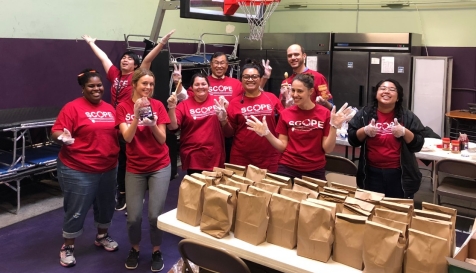
KRISTIN BARKLUNDKIMYA STIDUMMARGARET WEIPERMSUK LAMPRASITIPONANTHONY DUONG, AMANDA PECORARO, LOTO REEDELSIE WANG.

Stanford Community Outreach Partnership Efforts (SCOPE)

KRISTIN BARKLUNDKIMYA STIDUMMARGARET WEIPERMSUK LAMPRASITIPONANTHONY DUONG, AMANDA PECORARO, LOTO REEDELSIE WANG.

Stanford Community Outreach Partnership Efforts (SCOPE)

Loto Reed, associate coordinator in the division of primary care and population health, went into her annual review armed with an idea: a staff community service program to build motivation and togetherness in the division. Probably no one, including her, could have imagined how quickly and successfully the program would come together.

Her division chief, Sang-ick Chang, MD, MPH, clinical professor of primary care and population health, was very receptive to the idea. And when Chang brought it up at the next division staff meeting, a handful of staff members were immediately interested. By February 2018 Stanford Community Outreach Partnership Efforts (SCOPE) had begun, and in March the group hosted its first event at an East Palo Alto homeless shelter, ProjectWEHOPE, with 10 volunteers including Chang and Jonathan Shaw, MD, clinical assistant professor of primary care and population health.

Chang has already noticed how SCOPE has affected his staff. Since the group started, he says, “There’s a palpable sense of shared mission, fun and pride, with more interaction and support among the staff.”

A Local Effort
The group is well-organized: 10 core members rotate responsibilities, and each month a different member is responsible for choosing a volunteer organization and coordinating the effort. Events are often in the evenings, to accommodate staff work schedules.

SCOPE has also partnered with three core organizations: ProjectWEHOPE in East Palo Alto, Hope’s Corner in Mountain View, and HealthTrust in San Jose. Events are varied, ranging from packing lunches at a homeless shelter to preparing boxes and helping clean the kitchen at San Jose Health Trust.

Reed says that these partnerships are about making a difference where you live. “As a team, we decided to focus on building a strong relationship with our community partners so we can have an impact, and we wanted to keep it as local as possible,” she explains. “We have communities right in our backyard that can really use the support. There’s so much we can do to help our community,” she adds. “It’s just nice for our neighbors to know that Stanford cares.”

The partnerships also allow for progress over time. “We’re hoping to show volunteers how their efforts are improving the lives of the less fortunate,” Reed explains. “And it’s really helping everyone — not just the people that receive the help, but also our volunteers in SCOPE, because they get a real idea of what’s going on in our communities.”

Faculty are getting involved as well. “Everyone’s so excited and it’s actually increased the interest for the faculty to do some collaborative work with the staff. These events have really built a bridge between the faculty and staff,” Reed states.

Chang agrees: “People, both faculty and staff, come to Stanford to be part of a noble cause, and that nobility extends not just to academic and clinical contribution, but to social and community contribution as well.”

One of their major efforts this year was a supplies drive for the Ravenswood after-school program in East Palo Alto. SCOPE members Amanda Pecoraro, administrative associate for primary care and population health, and Tayler Kiss-Lane, fellowship program coordinator for primary care and population health, created an Amazon wish list based on Ravenswood’s needs. Faculty and staff went online and picked items to donate, which enabled SCOPE to collect over $2,000 worth of supplies.

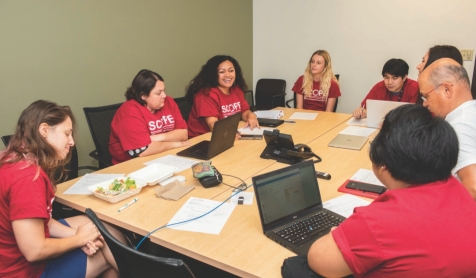
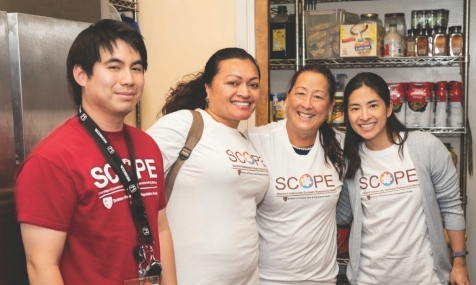
SCOPE team members and division chief SANG-ICK CHANG.

From left: DANI ZIONTS, AMANDA PECORAROLOTO REEDTAYLER KISS-LANEANTHONY DUONGNADIA SAFAEINILIAMIR SHAGHAFIMAE VERANO.

Loto Reed, associate coordinator in the division of primary care and population health, went into her annual review armed with an idea: a staff community service program to build motivation and togetherness in the division. Probably no one, including her, could have imagined how quickly and successfully the program would come together.

Her division chief, Sang-ick Chang, MD, MPH, clinical professor of primary care and population health, was very receptive to the idea. And when Chang brought it up at the next division staff meeting, a handful of staff members were immediately interested. By February 2018 Stanford Community Outreach Partnership Efforts (SCOPE) had begun, and in March the group hosted its first event at an East Palo Alto homeless shelter, ProjectWEHOPE, with 10 volunteers including Chang and Jonathan Shaw, MD, clinical assistant professor of primary care and population health.

Chang has already noticed how SCOPE has affected his staff. Since the group started, he says, “There’s a palpable sense of shared mission, fun and pride, with more interaction and support among the staff.”

A Local Effort
The group is well-organized: 10 core members rotate responsibilities, and each month a different member is responsible for choosing a volunteer organization and coordinating the effort. Events are often in the evenings, to accommodate staff work schedules.

SCOPE has also partnered with three core organizations: ProjectWEHOPE in East Palo Alto, Hope’s Corner in Mountain View, and HealthTrust in San Jose. Events are varied, ranging from packing lunches at a homeless shelter to preparing boxes and helping clean the kitchen at San Jose Health Trust.

Reed says that these partnerships are about making a difference where you live. “As a team, we decided to focus on building a strong relationship with our community partners so we can have an impact, and we wanted to keep it as local as possible,” she explains. “We have communities right in our backyard that can really use the support. There’s so much we can do to help our community,” she adds. “It’s just nice for our neighbors to know that Stanford cares.”

The partnerships also allow for progress over time. “We’re hoping to show volunteers how their efforts are improving the lives of the less fortunate,” Reed explains. “And it’s really helping everyone — not just the people that receive the help, but also our volunteers in SCOPE, because they get a real idea of what’s going on in our communities.”

Faculty are getting involved as well. “Everyone’s so excited and it’s actually increased the interest for the faculty to do some collaborative work with the staff. These events have really built a bridge between the faculty and staff,” Reed states.

Chang agrees: “People, both faculty and staff, come to Stanford to be part of a noble cause, and that nobility extends not just to academic and clinical contribution, but to social and community contribution as well.”

One of their major efforts this year was a supplies drive for the Ravenswood after-school program in East Palo Alto. SCOPE members Amanda Pecoraro, administrative associate for primary care and population health, and Tayler Kiss-Lane, fellowship program coordinator for primary care and population health, created an Amazon wish list based on Ravenswood’s needs. Faculty and staff went online and picked items to donate, which enabled SCOPE to collect over $2,000 worth of supplies.

SCOPE team members and division chief SANG-ICK CHANG.

From left: DANI ZIONTS, AMANDA PECORAROLOTO REEDTAYLER KISS-LANEANTHONY DUONGNADIA SAFAEINILIAMIR SHAGHAFIMAE VERANO.

A Vision for the Future
SCOPE members also wanted a concrete way of tracking their contributions. They set a goal of 200 volunteer hours for 2018, and as of September, they had already completed 167 hours. The group ran events through the end of 2018, including a winter care package drive with packages of clothing and other necessities to help keep the less fortunate warm during the winter season as well as “an uplifting message to keep their hearts warm,” according to Reed.

2019 will be a year for strategic planning to determine what the group will look like moving forward. Monthly lunch meetings help everyone prioritize. The majority of the volunteers are from primary care and population health, although they have also worked side by side with staff from other divisions. “We’re hoping this can spark interest for other staff members to collaborate and share ideas and events so that we as a Department of Medicine community can come together and give support where it’s most needed,” Reed says.

Chang shares her sense of purpose: “My hope is that SCOPE will add weight to long-standing community partnership efforts around the campus,” he says, “to tip the scales for Stanford Medicine to become known in our local community not just as an international scientific entity, but one that truly cares about the health and well-being of our local community.”

SCOPE and other staff-led initiatives like it are a new way of looking at wellness: By helping others, we also help ourselves.

Learn more about SCOPE.

From left: ANTHONY DUONGLOTO REEDKRISTI WENG, ELSIE WANG.

A Vision for the Future
SCOPE members also wanted a concrete way of tracking their contributions. They set a goal of 200 volunteer hours for 2018, and as of September, they had already completed 167 hours. The group ran events through the end of 2018, including a winter care package drive with packages of clothing and other necessities to help keep the less fortunate warm during the winter season as well as “an uplifting message to keep their hearts warm,” according to Reed.

2019 will be a year for strategic planning to determine what the group will look like moving forward. Monthly lunch meetings help everyone prioritize. The majority of the volunteers are from primary care and population health, although they have also worked side by side with staff from other divisions. “We’re hoping this can spark interest for other staff members to collaborate and share ideas and events so that we as a Department of Medicine community can come together and give support where it’s most needed,” Reed says.

Chang shares her sense of purpose: “My hope is that SCOPE will add weight to long-standing community partnership efforts around the campus,” he says, “to tip the scales for Stanford Medicine to become known in our local community not just as an international scientific entity, but one that truly cares about the health and well-being of our local community.”

SCOPE and other staff-led initiatives like it are a new way of looking at wellness: By helping others, we also help ourselves.

Learn more about SCOPE.

Compassion into Action
Team members of the Primary Care and Population Health division are passionate about SCOPE and the values that led them to community service in the first place. They’ve adopted the motto “Putting Compassion into Action.” Here’s what they have to say:

Margaret Wei, finance manager, calls the SCOPE events “very uplifting,” adding that they give her “a sense of joy, hope, optimism, faith and relief.”

Tayler Kiss-Lane, fellowship program coordinator, called volunteering for SCOPE “extremely rewarding and fulfilling, in addition to being incredibly important.” She adds, “I believe it’s our social responsibility to help our neighbors and fellow human beings in need.”

Kimya Stidum, education program coordinator, calls service “a core value.” “If I profess to love my neighbors yet do not offer what I can to support them when they find themselves in need of support, then my values and actions are not in alignment and that is a problem for me,” she states.

Amanda Pecoraro, administrative associate, grew up with grandparents who did charitable works and encouraged their grandchildren to do the same. “I guess they rubbed off on me,” she concludes. “I’ve always tried to volunteer around the holidays or at different events. I currently sit on a board in my neighborhood that fosters opportunities for our low-income residents. So when Loto asked if it was something I would be interested in, there was no question about it.”

Anthony Duong, program coordinator, appreciates the sense of power and community that SCOPE brings: “I love how we empower other faculty and staff members to make them realize they have the capacity to make a difference in people’s lives.”

Nadia Safaeinili, qualitative researcher and project manager, says SCOPE “gives the division the opportunity to practice our mission in a very personal and real way.” She adds, “SCOPE could not exist as it does without Loto’s thoughtful leadership, organization and warmth. She cares so deeply about serving others and that makes our group shine!”

Sang-ick Chang, MD, PhD, clinical professor in primary care and population health, is deeply impressed by the work SCOPE has done: “The competence, diligence, and idealism with which the participants approached this project is a window into how high-performing and idealistic our staff really are,” he says. “I have been truly impressed with their passion and successes, and it makes me realize how lucky we are to have such a talented team.”

From left: ANTHONY DUONGLOTO REEDKRISTI WENG, ELSIE WANG.

Compassion into Action
Team members of the Primary Care and Population Health division are passionate about SCOPE and the values that led them to community service in the first place. They’ve adopted the motto “Putting Compassion into Action.” Here’s what they have to say:

Margaret Wei, finance manager, calls the SCOPE events “very uplifting,” adding that they give her “a sense of joy, hope, optimism, faith and relief.”

Tayler Kiss-Lane, fellowship program coordinator, called volunteering for SCOPE “extremely rewarding and fulfilling, in addition to being incredibly important.” She adds, “I believe it’s our social responsibility to help our neighbors and fellow human beings in need.”

Kimya Stidum, education program coordinator, calls service “a core value.” “If I profess to love my neighbors yet do not offer what I can to support them when they find themselves in need of support, then my values and actions are not in alignment and that is a problem for me,” she states.

Amanda Pecoraro, administrative associate, grew up with grandparents who did charitable works and encouraged their grandchildren to do the same. “I guess they rubbed off on me,” she concludes. “I’ve always tried to volunteer around the holidays or at different events. I currently sit on a board in my neighborhood that fosters opportunities for our low-income residents. So when Loto asked if it was something I would be interested in, there was no question about it.”

Anthony Duong, program coordinator, appreciates the sense of power and community that SCOPE brings: “I love how we empower other faculty and staff members to make them realize they have the capacity to make a difference in people’s lives.”

Nadia Safaeinili, qualitative researcher and project manager, says SCOPE “gives the division the opportunity to practice our mission in a very personal and real way.” She adds, “SCOPE could not exist as it does without Loto’s thoughtful leadership, organization and warmth. She cares so deeply about serving others and that makes our group shine!”

Sang-ick Chang, MD, PhD, clinical professor in primary care and population health, is deeply impressed by the work SCOPE has done: “The competence, diligence, and idealism with which the participants approached this project is a window into how high-performing and idealistic our staff really are,” he says. “I have been truly impressed with their passion and successes, and it makes me realize how lucky we are to have such a talented team.”


A Project to Reduce Rape of Young Kenyans

Baldeep Singh, MD, with staff at Samaritan House

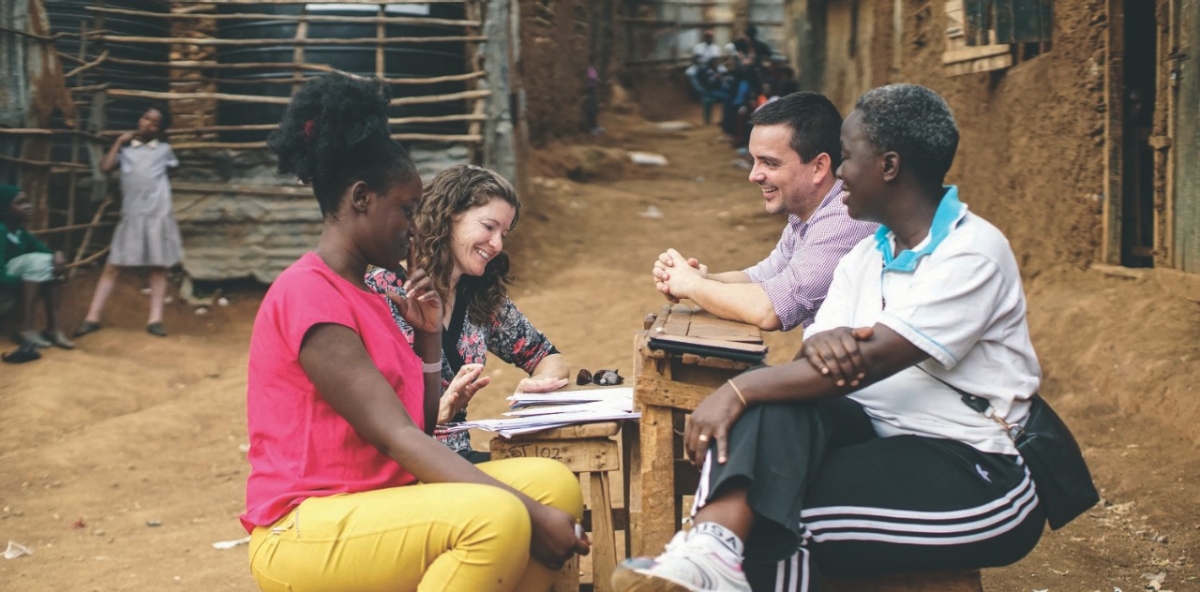
Stanford researchers CLEA SARNQUIST and MICHAEL BAIOCCHI, PHD (center left and right), work with Kenyan researchers and data colletors to refine their latest survey.

A Project to Reduce Rape of Young Kenyans

Stanford researchers CLEA SARNQUIST and MICHAEL BAIOCCHI, PHD (center left and right), work with Kenyan researchers and data colletors to refine their latest survey.

A Project to Reduce Rape of Young Kenyans

The topic is daunting, even unbelievable in our world, and the complexities that surround it are hard to grasp. How do you teach girls aged 12 to 14 to fight off a sexual assault — in Kenya — in slums where regular meals and clean water are not assured? Moreover, almost as important, how can you know whether the lessons actually worked?

Reliable survey data indicate that as many as 46 percent of Kenyan women experience sexual assault as children. For the most part, these girls do not report rapes or assaults, even to their parents, as the risks are too great.

The nonprofit group No Means No Worldwide, founded by Lee Paiva from San Francisco, has been working to reduce the incidence of rape in young girls and women in Kenya since 2010. Anecdotal reports about the prevention program have been positive, with the girls being inspired by an educational intervention that increases their self-esteem and teaches them defensive tactics.

The reports of the girls successfully avoiding attempted rapes and sexual assaults have been rewarding to those involved in the program. But objective data had been missing, leaving them to wonder if the time and money being spent are having the desired result. To gather those data, Stanford researchers, led by Michael Baiocchi, PhD, tackled the challenging job of designing a randomized controlled trial that compares the rate of rape in trained girls with that in untrained girls.

The Intervention
The intervention is taught in school by local women and introduces four pathways to preventing sexual assault. The girls are introduced to situational awareness, where they learn to recognize dangerous situations and to look around for who or what can help them. They are taught that their own thoughts and feelings are valued and thus they learn to be empowered to make themselves heard in dangerous situations.

They learn what to say — to shout — in such a situation. And they learn physical skills for defending themselves. Not only do they learn to fight off an attack, often by family members or boyfriends, but they also learn how to report those attacks so the situation can be improved.

Challenges of Randomization
The team decided that the most ethical way to learn the relative effectiveness of the intervention and, critically, to collect objective data on outcomes is to use a delayed-treatment study design. Girls would be randomized into two groups: one taught the intervention immediately, the other taught the intervention later. The two groups complete surveys at three time points, measuring the difference in the number of rapes in both groups of girls over two years.

Baiocchi, assistant professor of medicine in the Stanford Prevention Research Center, is the principal investigator of the trial.

Although randomized controlled trials are considered the gold standard for measuring differences between two groups, as a statistician Baiocchi immediately recognized issues that might compromise the results of the trial and devised ways to either avoid or account for them.

Problems and Solutions
Having learned about some specific problems from their earlier, smaller study of girls in 28 schools, Baiocchi and his colleagues — statistics PhD students Rina Friedberg and Evan Rosenman — created statistical tools that would let them avoid a false-negative result. A study with a false-negative result, which would incorrectly show no benefit from an intervention that really does work, can be devastating as it can cripple an otherwise valuable line of research.

The first statistical problem was spillover, which is a major problem for behavioral interventions. In Nairobi the schools the girls attended were close enough to one another that girls who were taught the intervention might share what they learned with friends who were in the delayed intervention group. After several months of such sharing, the trial could have 500 trained girls in the intervention group, another 100 trained girls in the supposedly ‘untrained’ group, and only 400 truly untrained girls. This spillover between trained and untrained groups could jeopardize the result. “Even if your intervention is working and it’s doing a really good job,” explains Baiocchi, “if it spills over in ways that you’re not anticipating you get a fake null result.”

The topic is daunting, even unbelievable in our world, and the complexities that surround it are hard to grasp. How do you teach girls aged 12 to 14 to fight off a sexual assault — in Kenya — in slums where regular meals and clean water are not assured? Moreover, almost as important, how can you know whether the lessons actually worked?

Reliable survey data indicate that as many as 46 percent of Kenyan women experience sexual assault as children. For the most part, these girls do not report rapes or assaults, even to their parents, as the risks are too great.

The nonprofit group No Means No Worldwide, founded by Lee Paiva from San Francisco, has been working to reduce the incidence of rape in young girls and women in Kenya since 2010. Anecdotal reports about the prevention program have been positive, with the girls being inspired by an educational intervention that increases their self-esteem and teaches them defensive tactics.

The reports of the girls successfully avoiding attempted rapes and sexual assaults have been rewarding to those involved in the program. But objective data had been missing, leaving them to wonder if the time and money being spent are having the desired result. To gather those data, Stanford researchers, led by Michael Baiocchi, PhD, tackled the challenging job of designing a randomized controlled trial that compares the rate of rape in trained girls with that in untrained girls.

The Intervention
The intervention is taught in school by local women and introduces four pathways to preventing sexual assault. The girls are introduced to situational awareness, where they learn to recognize dangerous situations and to look around for who or what can help them. They are taught that their own thoughts and feelings are valued and thus they learn to be empowered to make themselves heard in dangerous situations. They learn what to say — to shout — in such a situation. And they learn physical skills for defending themselves. Not only do they learn to fight off an attack, often by family members or boyfriends, but they also learn how to report those attacks so the situation can be improved.

Challenges of Randomization
The team decided that the most ethical way to learn the relative effectiveness of the intervention and, critically, to collect objective data on outcomes is to use a delayed-treatment study design. Girls would be randomized into two groups: one taught the intervention immediately, the other taught the intervention later. The two groups complete surveys at three time points, measuring the difference in the number of rapes in both groups of girls over two years.

Baiocchi, assistant professor of medicine in the Stanford Prevention Research Center, is the principal investigator of the trial. Although randomized controlled trials are considered the gold standard for measuring differences between two groups, as a statistician Baiocchi immediately recognized issues that might compromise the results of the trial and devised ways to either avoid or account for them.

Problems and Solutions
Having learned about some specific problems from their earlier, smaller study of girls in 28 schools, Baiocchi and his colleagues — statistics PhD students Rina Friedberg and Evan Rosenman — created statistical tools that would let them avoid a false-negative result. A study with a false-negative result, which would incorrectly show no benefit from an intervention that really does work, can be devastating as it can cripple an otherwise valuable line of research.

The first statistical problem was spillover, which is a major problem for behavioral interventions. In Nairobi the schools the girls attended were close enough to one another that girls who were taught the intervention might share what they learned with friends who were in the delayed intervention group. After several months of such sharing, the trial could have 500 trained girls in the intervention group, another 100 trained girls in the supposedly ‘untrained’ group, and only 400 truly untrained girls. This spillover between trained and untrained groups could jeopardize the result. “Even if your intervention is working and it’s doing a really good job,” explains Baiocchi, “if it spills over in ways that you’re not anticipating you get a fake null result.”

The fix for this problem, says Baiocchi, was to develop a framework for “weighted-design randomized trials where you can either create a lot of spillover or no spillover at all. For interventions that have a social component, such as the Kenyan girls playing together, the framework is useful for defining indirect effects.”

The second problem was imbalances between the arms of randomized trials. Statistically, a randomized trial with 5,000 flips of a coin is very likely to have groups that are similar, whereas a trial with 28 flips of a coin is quite likely to have imbalances. In their initial trial of 28 schools, imbalance hit the study hard. One of the two groups had a rape rate of 11 percent at baseline while the other had a rape rate of 7 percent; such an imbalance at baseline can challenge drawing strong results from the trial. “To overcome this,” says Baiocchi, “we developed a sensitivity analysis that asks how imbalanced arms of the trial have to be before your conclusions are suspect. Our framework helps researchers who use cluster-randomized trials understand how much imbalance is too much imbalance. This framework is a win for public health randomized trials.”

Adapting the New Trial
The current trial includes girls in 94 schools: Girls in 48 of the schools receive the training immediately while 46 schools will have the intervention at a later date. The researchers have been careful to put schools with tight social bonds in the same cohort, therefore avoiding having the intervention spill over from trained to untrained girls. Friedberg explains that “just dividing everyone geographically might result in two populations that are materially different, and then you have another problem.”

Baiocchi adds that to avoid both the spillover and imbalance problems “we selected schools that were far enough apart that we didn’t believe the girls would form friendship bonds but close enough that the schools looked very similar.”

An Unexpected Study
Baiocchi and his graduate students have an opportunity to measure the impact of their training in a completely unanticipated study. Rosenman describes a new project with political beginnings. “Because of Kenya’s disputed presidential election in 2017 and the wave of violence that ensued, our data collection was disrupted for months. That gave us the opportunity to think about how political violence relates to sexual violence, and so we are comparing two cohorts, one from before the election and one after.”

Baiocchi further explains how this study will help them: “We would expect to see an uptick of violence against vulnerable populations during this period. Now we have a chance to learn whether our intervention performed better or worse during those months.” This project may provide useful, empirical evidence for developing interventions to reduce rates of sexual assault in active conflict zones — the topic of the 2018 Nobel Peace Prize.

The fix for this problem, says Baiocchi, was to develop a framework for “weighted-design randomized trials where you can either create a lot of spillover or no spillover at all. For interventions that have a social component, such as the Kenyan girls playing together, the framework is useful for defining indirect effects.”

The second problem was imbalances between the arms of randomized trials. Statistically, a randomized trial with 5,000 flips of a coin is very likely to have groups that are similar, whereas a trial with 28 flips of a coin is quite likely to have imbalances. In their initial trial of 28 schools, imbalance hit the study hard. One of the two groups had a rape rate of 11 percent at baseline while the other had a rape rate of 7 percent; such an imbalance at baseline can challenge drawing strong results from the trial. “To overcome this,” says Baiocchi, “we developed a sensitivity analysis that asks how imbalanced arms of the trial have to be before your conclusions are suspect. Our framework helps researchers who use cluster-randomized trials understand how much imbalance is too much imbalance. This framework is a win for public health randomized trials.”

Adapting the New Trial
The current trial includes girls in 94 schools: Girls in 48 of the schools receive the training immediately while 46 schools will have the intervention at a later date. The researchers have been careful to put schools with tight social bonds in the same cohort, therefore avoiding having the intervention spill over from trained to untrained girls. Friedberg explains that “just dividing everyone geographically might result in two populations that are materially different, and then you have another problem.”

Baiocchi adds that to avoid both the spillover and imbalance problems “we selected schools that were far enough apart that we didn’t believe the girls would form friendship bonds but close enough that the schools looked very similar.”

An Unexpected Study
Baiocchi and his graduate students have an opportunity to measure the impact of their training in a completely unanticipated study. Rosenman describes a new project with political beginnings. “Because of Kenya’s disputed presidential election in 2017 and the wave of violence that ensued, our data collection was disrupted for months. That gave us the opportunity to think about how political violence relates to sexual violence, and so we are comparing two cohorts, one from before the election and one after.”

Baiocchi further explains how this study will help them: “We would expect to see an uptick of violence against vulnerable populations during this period. Now we have a chance to learn whether our intervention performed better or worse during those months.” This project may provide useful, empirical evidence for developing interventions to reduce rates of sexual assault in active conflict zones — the topic of the 2018 Nobel Peace Prize.