• Home
  • 2024 Annual Report
  • 2023 Annual Report
  • 2022 Annual Report
  • 2021 Annual Report
  • 2020 Annual Report
  • 2019 Annual Report
  • 2018 Annual Report
  • 2017 Annual Report
  • 2016 Annual Report
DoM Annual Reports

Taking Veteran Care on the Road
by emli1120 | Feb 26, 2024 | 2020, Diverse Faces of Medicine 2020

Baldeep Singh, MD, with staff at Samaritan House

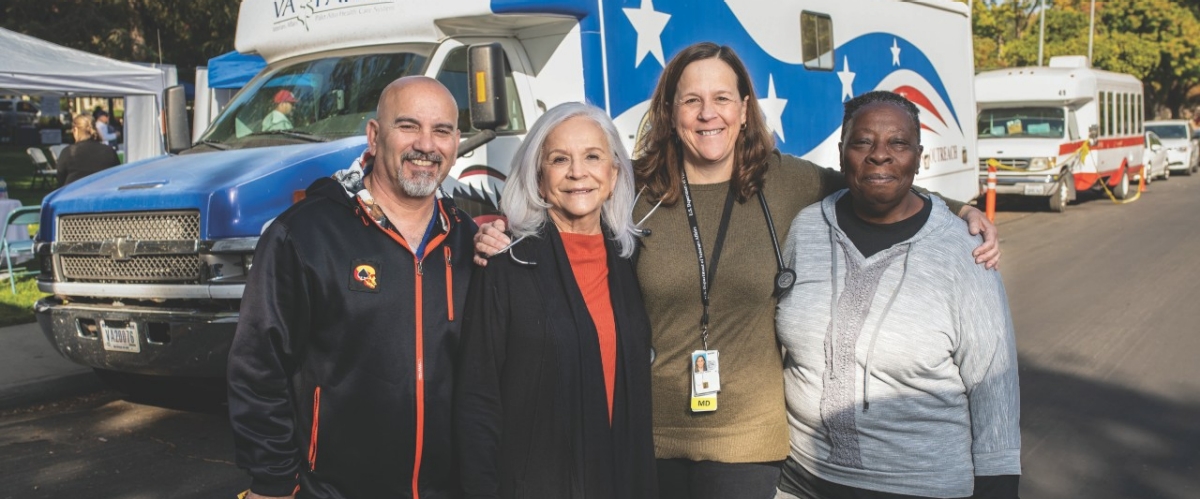
From left: Danny Molina, Doral Gonzales, Jean Lighthall, MD, and Anna Coulter.

Taking Veteran Care on the Road

From left: Danny Molina, Doral Gonzales, Jean Lighthall, MD, and Anna Coulter.

Taking Veteran Care on the Road

THE WOMEN IN MEDICINE GROUP IS CREATING COMMUNITY AND AMPLIFYING RESIDENTS’ VOICES.

They travel roughly 400 times a year, to sites as far-flung as Sonora, King City, and the edge of the Yosemite Valley, serving eight counties and parts of two others. They visit Santa Cruz once a week, working with homeless veterans and supplying medical needs for countless veterans each year. And they just got a new van.

They are the VA Palo Alto’s Mobile Medical Outreach team. Led by Jean Lighthall, MD, clinical assistant professor of primary care and population health, the team of eight has traveled to various sites around their catchment area, helping provide veterans with medical care for the past 12 years.

As Lighthall explains, the group—two part-time physicians, two registered nurse practitioners, two health techs, a business outreach specialist, and an outreach coordinator—has two goals. The first is simple: Get health care to veterans who need it. Some veterans don’t even know they’re eligible. “It’s a great thing to offer someone,” she says. Team members often see patients for an initial visit, which includes taking their history, giving a basic physical exam, and offering appropriate medication and referrals. With very few exceptions, the patients are walk-ins. As Lighthall puts it, “You can just stop in and get the services.”

The other goal is to improve access for veterans already enrolled in the system who have difficulty seeing doctors for various reasons including distance, homelessness, lack of transportation, and substance abuse. By coming directly to them, the Mobile Medical Outreach team can address these problems.

Lighthall says it may be more than physical access problems that stop veterans from getting the care they need. “One thing that we see a lot is that there are veterans, particularly of the Vietnam era, who weren’t treated as well as they could have been when they first came back and went to the VA,” she says.

They travel roughly 400 times a year, to sites as far-flung as Sonora, King City, and the edge of the Yosemite Valley, serving eight counties and parts of two others. They visit Santa Cruz once a week, working with homeless veterans and supplying medical needs for countless veterans each year. And they just got a new van.

They are the VA Palo Alto’s Mobile Medical Outreach team. Led by Jean Lighthall, MD, clinical assistant professor of primary care and population health, the team of eight has traveled to various sites around their catchment area, helping provide veterans with medical care for the past 12 years.

As Lighthall explains, the group—two part-time physicians, two registered nurse practitioners, two health techs, a business outreach specialist, and an outreach coordinator—has two goals. The first is simple: Get health care to veterans who need it. Some veterans don’t even know they’re eligible. “It’s a great thing to offer someone,” she says. Team members often see patients for an initial visit, which includes taking their history, giving a basic physical exam, and offering appropriate medication and referrals. With very few exceptions, the patients are walk-ins. As Lighthall puts it, “You can just stop in and get the services.”

The other goal is to improve access for veterans already enrolled in the system who have difficulty seeing doctors for various reasons including distance, homelessness, lack of transportation, and substance abuse. By coming directly to them, the Mobile Medical Outreach team can address these problems.

Lighthall says it may be more than physical access problems that stop veterans from getting the care they need. “One thing that we see a lot is that there are veterans, particularly of the Vietnam era, who weren’t treated as well as they could have been when they first came back and went to the VA,” she says. “Or just because their whole homecoming was so bad, many didn’t want to have anything to do with the VA or any type of veteran’s benefits.” But the Mobile Medical Outreach is addressing this problem, too. As Lighthall puts it, “We may be a little more welcoming than the big huge concrete structures like the Palo Alto VA. We’re just out there with our van.”

To that end, the Mobile Medical Outreach team travels—a lot. They split up and go everywhere: to colleges to see younger veterans, halls for veterans of foreign wars and American Legions, libraries, senior centers, veteran resource centers, and Native American pow-wows, including the Stanford and Stockton pow-wows. They make 30 to 40 site visits a month, often covering several events a day, with two vans and help from host sites when exam rooms are available. At each site, they see patients, sometimes up to 10 or more. In 2018 they served 870 veterans, and 149 of them were homeless, almost 20% of the total.

Jean Lightall, MD, works with a veteran patient.

Their work is often more focused on same-day and urgent care, but they also provide stopgaps for struggling communities.  Stockton and Modesto are working on providing additional medical providers; therefore the Mobile Medical Unit is a great asset to support veterans in the area.   Their services include referrals to specialists, mental health care, physical therapy, ordering labs, prescriptions, and giving vaccines for diseases including influenza and hepatitis A (especially important considering the recent hepatitis A outbreak among the homeless).

The team, which is the only VA medical mobile outreach program of its kind in the Bay Area, is small for such a large project. But it’s clearly a labor of love for Lighthall and her colleagues. Lighthall, who got involved with the VA in what she calls the “second half” of her career, worked for the VA while in medical school and “loved the veterans.” When she wanted a change from “the traditional internal medicine practice,” she turned to the VA. She’d been interested in working with the homeless population for a long time, and she’s been with the outreach team in one form or another since 2008. She was named section chief for outreach in 2013.

The program has grown in its 12 years, and the team has adjusted, traveling to new sites and discontinuing visits to old ones when they seemed unnecessary. Still, the number of sites and the area they cover has grown exponentially. “We’re always looking to find areas of need,” Lighthall says.

As for the future? Lighthall isn’t opposed to further expansion, but she also has high hopes for telehealth. Their new van is now equipped with telehealth capabilities, which could mean a further expansion into specialty care. “We could go out there with a nurse practitioner or with a health tech and then a patient could come to the van and we could loop them into dermatology or cardiology without having them drive all the way into Palo Alto,” Lighthall explains.

It’s clear that the team works incredibly hard, but they see their rewards in the community. They work tirelessly to get veterans care on their own terms. Lighthall’s pride in the program is as apparent as it is earned. As she adds, “I think we’ve been able to bring in veterans who have been very reluctant to receive care and they’re happy that they’re now able to get that care.”

We’ve been able to bring in veterans who have been very reluctant to receive care.

A Vet Provides Outreach
Doral Gonzales, a nurse practitioner who works with the team, is a veteran herself. She retired from the army in 2012 at the rank of lieutenant colonel after a 22-year career that included deployments to Afghanistan and Iraq. She’s worked with VAPAHCS since 2008 since 2008 (with gaps for her deployments) and earned a midwifery degree at UC–San Francisco as well as a master’s in family nurse practice and a doctor of nursing practice in 2010. During her time in Iraq she served as a trauma nurse in combat support hospitals as part of a triage unit, and in Afghanistan she worked in a Department of Defense detainee facility treating enemy combatants and prisoners of war. She also worked with a clinic with multinational medical providers to provide for women and children who had injuries from exploding mines.

At one point in Iraq a rocket-propelled grenade exploded 20 feet from her, causing a traumatic brain injury as well as post-traumatic stress disorder. Gonzales explains that this background has made her both dedicated to veterans and able to speak their language. “I went through a lot with the VA,” she explains, “so I figured I might as well work there. And then I wanted to do outreach because I couldn’t stand being inside a clinic with four walls, so I knew I was going to be out and about, helping veterans who had the same issues with PTSD that I did. Most of us, my health techs and I, are veterans, so the veterans trust us. And we have rapport with them; we connect.

During her time in the program she’s taught others how to interact with their veteran patients. “When we started adding more providers, we trained them on how military speak works and how to relate to the way veterans speak so it was easier for them to connect with the veterans,” she says. “This made the veterans more open, trusting us with their issues. It’s really important to me that we continue with the outreach.
Jean Lightall, MD, works with a veteran patient.

“Or just because their whole homecoming was so bad, many didn’t want to have anything to do with the VA or any type of veteran’s benefits.” But the Mobile Medical Outreach is addressing this problem, too. As Lighthall puts it, “We may be a little more welcoming than the big huge concrete structures like the Palo Alto VA. We’re just out there with our van.”

To that end, the Mobile Medical Outreach team travels—a lot. They split up and go everywhere: to colleges to see younger veterans, halls for veterans of foreign wars and American Legions, libraries, senior centers, veteran resource centers, and Native American pow-wows, including the Stanford and Stockton pow-wows. They make 30 to 40 site visits a month, often covering several events a day, with two vans and help from host sites when exam rooms are available. At each site, they see patients, sometimes up to 10 or more. In 2018 they served 870 veterans, and 149 of them were homeless, almost 20% of the total.

Their work is often more focused on same-day and urgent care, but they also provide stopgaps for struggling communities.  Stockton and Modesto are working on providing additional medical providers; therefore the Mobile Medical Unit is a great asset to support veterans in the area.   Their services include referrals to specialists, mental health care, physical therapy, ordering labs, prescriptions, and giving vaccines for diseases including influenza and hepatitis A (especially important considering the recent hepatitis A outbreak among the homeless).

The team, which is the only VA medical mobile outreach program of its kind in the Bay Area, is small for such a large project. But it’s clearly a labor of love for Lighthall and her colleagues. Lighthall, who got involved with the VA in what she calls the “second half” of her career, worked for the VA while in medical school and “loved the veterans.” When she wanted a change from “the traditional internal medicine practice,” she turned to the VA. She’d been interested in working with the homeless population for a long time, and she’s been with the outreach team in one form or another since 2008. She was named section chief for outreach in 2013.

The program has grown in its 12 years, and the team has adjusted, traveling to new sites and discontinuing visits to old ones when they seemed unnecessary. Still, the number of sites and the area they cover has grown exponentially. “We’re always looking to find areas of need,” Lighthall says.

As for the future? Lighthall isn’t opposed to further expansion, but she also has high hopes for telehealth. Their new van is now equipped with telehealth capabilities, which could mean a further expansion into specialty care. “We could go out there with a nurse practitioner or with a health tech and then a patient could come to the van and we could loop them into dermatology or cardiology without having them drive all the way into Palo Alto,” Lighthall explains.

It’s clear that the team works incredibly hard, but they see their rewards in the community. They work tirelessly to get veterans care on their own terms. Lighthall’s pride in the program is as apparent as it is earned. As she adds, “I think we’ve been able to bring in veterans who have been very reluctant to receive care and they’re happy that they’re now able to get that care.”

We’ve been able to bring in veterans who have been very reluctant to receive care.

A Vet Provides Outreach
Doral Gonzales, a nurse practitioner who works with the team, is a veteran herself. She retired from the army in 2012 at the rank of lieutenant colonel after a 22-year career that included deployments to Afghanistan and Iraq. She’s worked with VAPAHCS since 2008 since 2008 (with gaps for her deployments) and earned a midwifery degree at UC–San Francisco as well as a master’s in family nurse practice and a doctor of nursing practice in 2010. During her time in Iraq she served as a trauma nurse in combat support hospitals as part of a triage unit, and in Afghanistan she worked in a Department of Defense detainee facility treating enemy combatants and prisoners of war. She also worked with a clinic with multinational medical providers to provide for women and children who had injuries from exploding mines.

At one point in Iraq a rocket-propelled grenade exploded 20 feet from her, causing a traumatic brain injury as well as post-traumatic stress disorder. Gonzales explains that this background has made her both dedicated to veterans and able to speak their language. “I went through a lot with the VA,” she explains, “so I figured I might as well work there. And then I wanted to do outreach because I couldn’t stand being inside a clinic with four walls, so I knew I was going to be out and about, helping veterans who had the same issues with PTSD that I did. Most of us, my health techs and I, are veterans, so the veterans trust us. And we have rapport with them; we connect.

During her time in the program she’s taught others how to interact with their veteran patients. “When we started adding more providers, we trained them on how military speak works and how to relate to the way veterans speak so it was easier for them to connect with the veterans,” she says. “This made the veterans more open, trusting us with their issues. It’s really important to me that we continue with the outreach.
A Patient’s Last Wish

by emli1120 | Feb 26, 2024 | 2020, Diverse Faces of Medicine 2020

Baldeep Singh, MD, with staff at Samaritan House

Minh-Chi Tran, MD (left) and Betts Cravotto are granting wishes to bring comfort to the dying.

A Patient’s Last Wish

Minh-Chi Tran, MD (left) and Betts Cravotto are granting wishes to bring comfort to the dying.

A Patient’s Last Wish

A BOWL OF ICE CREAM. A MARIACHI BAND. A WORD CLOUD.

When patients in end-of-life care were asked if there was one wish they’d like to have fulfilled, those were some of the simple requests that came forth.

“It makes you reflect on what becomes important to people at the end of their life,” notes Minh-Chi Tran, MD, clinical assistant professor of medicine and director of the Wish Project at Stanford Health Care–ValleyCare.

In 2018 Tran launched the Wish Project to bring comfort to the dying by celebrating their lives and passions and to ease grief for families.

“We do this by granting wishes to those who have little time left with us and hope our small acts are able to leave a lasting and memorable impact on all those involved,” she says.

The germ for the idea was an article in the Aug. 18, 2015 issue of Annals of Internal Medicine.

That article described the 3 Wishes Project at St. Joseph’s Healthcare in Hamilton, Ontario, Canada. The project tried to bring peace to the final days of critically ill patients and to ease the grieving process by eliciting and implementing a set of wishes identified by patients, families, clinicians, or the project team.

Tran received funding from the ValleyCare Charitable Foundation to start a similar program at Stanford Health Care–ValleyCare Medical Center, where she is one of 13 hospitalists on staff.

“It was very low key at first, and I just started doing the projects with my patients on occasion here and there. Then I opened the program to my fellow hospitalists, and now the program has expanded to the whole hospital after we received a grant from the ValleyCare Foundation. What’s great is that everyone’s been so excited about it, especially the ancillary staff and hospital volunteers,” she explains.

A BOWL OF ICE CREAM. A MARIACHI BAND. A WORD CLOUD.

When patients in end-of-life care were asked if there was one wish they’d like to have fulfilled, those were some of the simple requests that came forth.

“It makes you reflect on what becomes important to people at the end of their life,” notes Minh-Chi Tran, MD, clinical assistant professor of medicine and director of the Wish Project at Stanford Health Care–ValleyCare.

In 2018 Tran launched the Wish Project to bring comfort to the dying by celebrating their lives and passions and to ease grief for families.

“We do this by granting wishes to those who have little time left with us and hope our small acts are able to leave a lasting and memorable impact on all those involved,” she says.

The germ for the idea was an article in the Aug. 18, 2015 issue of Annals of Internal Medicine.

That article described the 3 Wishes Project at St. Joseph’s Healthcare in Hamilton, Ontario, Canada. The project tried to bring peace to the final days of critically ill patients and to ease the grieving process by eliciting and implementing a set of wishes identified by patients, families, clinicians, or the project team.

Tran received funding from the ValleyCare Charitable Foundation to start a similar program at Stanford Health Care–ValleyCare Medical Center, where she is one of 13 hospitalists on staff.

“It was very low key at first, and I just started doing the projects with my patients on occasion here and there. Then I opened the program to my fellow hospitalists, and now the program has expanded to the whole hospital after we received a grant from the ValleyCare Foundation. What’s great is that everyone’s been so excited about it, especially the ancillary staff and hospital volunteers,” she explains.

While Tran has no formal goals for expanding the program, during the fall of 2019 she started building a component for high school student volunteers so they can become more involved in this aspect of medicine and health care.

How Does the Program Work?
When staff members in the hospital have a patient they think is nearing the end of life, they can refer the patient to Tran or her fellow clinical assistant professors of medicine Silvia Loica-Mersa, MD, and Kathleen Jia, MD. One of those three hospitalists then works with a Wish List program volunteer to pair them with the patient.

“What makes the program work so well is our 10 volunteers—especially Betts Cravotto, our lead volunteer. She generally spends an hour or two at a time with the family, just talking to them. And I think that the time she spends with them is probably more important than the wish itself,” Tran says.

“It’s an honor when families trust me and allow me into this very personal time, this sacred part of their lives,” Cravotto says.

One wish she granted was setting up a romantic dinner for a couple whose wedding anniversary was a month away—too long to wait when the husband was only days away from the end of his life.

It’s an honor when families trust me and allow me into this very personal time, this sacred part of their lives

“The wife brought nice clothes from home for her husband to wear, and she dressed beautifully. The nurses brought flowers and decorated the table, which made for a charming setting for their special dinner. That was just such a blessing to them, but what moved me the most was hearing the wife say that we gave them something to be happy and excited about amid all the negative and depressing things they had been living with for months,” Cravotto says.

In the program’s first 15 months, 26 wishes had been granted, with most wishes costing less than $30.

The wish from the program’s first patient was for a copy of his favorite movie, “The Graduate.” Volunteers acquired a copy of the film, and the patient watched it after being transported home. He was also given CDs with mixed compilations of his favorite music, which were played in his hospital room with a sound system donated by a volunteer.

One patient asked for a glass of root beer as his last wish. In that instance Betts provided a variety of brands of root beer. Because the patient had a difficult time swallowing, she and hospital staff saw that a thickener was added to the root beer to prevent choking. A family member later thanked Betts and the staff, saying that “it was the first time [my] father had eaten in days, and it made the event a special and memorable day.”

On two occasions, families held brainstorming meetings with a volunteer and developed “word clouds” that used typography to create artwork composed of words the families use to describe the patient based on their reflections and memories.

Then there was a patient’s request for a mariachi band, which volunteers arranged in April 2019, when the patient was on comfort care.

A Lasting Impact
Despite many advancements in medicine, all patients and their care teams must face death as an eventual reality. While the medical profession often turns to facts, science, and evidence before making decisions and taking action, the Wish Project is based on something else.

“I guess in terms of the actual science of it, it’s kind of hard to quantify,” Tran confesses.

This is an aspect of medicine that is tough for all those involved—family, friends, providers, staff, and the patient.

“What appealed to me, and why I found the project so rewarding, is that there’s a lot less science to it. It’s more humanistic, and just about caregiving. Something I found surprising about the project is that it takes very little to give families and people the feeling of being heard,” says Tran.

“I feel like we’re always running around trying to follow the latest guidelines in medicine and making sure we’re giving everyone the most up-to-date care. But often what people really want is just a feeling that someone cares and that someone knows a little bit more about them,” she says.

“It’s providing something surprisingly simple yet meaningful that honors or memorializes their loved one,” adds Cravotto.

“It makes me learn a lot about my patients on a personal level that we don’t usually get into as their doctor on a busy day,” says Tran. “But I like the pause that it makes us take by just asking what they care about, and what they want to have at the end of their life.”

It’s an honor when families trust me and allow me into this very personal time, this sacred part of their lives

While Tran has no formal goals for expanding the program, during the fall of 2019 she started building a component for high school student volunteers so they can become more involved in this aspect of medicine and health care.

How Does the Program Work?
When staff members in the hospital have a patient they think is nearing the end of life, they can refer the patient to Tran or her fellow clinical assistant professors of medicine Silvia Loica-Mersa, MD, and Kathleen Jia, MD. One of those three hospitalists then works with a Wish List program volunteer to pair them with the patient.

“What makes the program work so well is our 10 volunteers—especially Betts Cravotto, our lead volunteer. She generally spends an hour or two at a time with the family, just talking to them. And I think that the time she spends with them is probably more important than the wish itself,” Tran says.

“It’s an honor when families trust me and allow me into this very personal time, this sacred part of their lives,” Cravotto says.

One wish she granted was setting up a romantic dinner for a couple whose wedding anniversary was a month away—too long to wait when the husband was only days away from the end of his life.

“The wife brought nice clothes from home for her husband to wear, and she dressed beautifully. The nurses brought flowers and decorated the table, which made for a charming setting for their special dinner. That was just such a blessing to them, but what moved me the most was hearing the wife say that we gave them something to be happy and excited about amid all the negative and depressing things they had been living with for months,” Cravotto says.

In the program’s first 15 months, 26 wishes had been granted, with most wishes costing less than $30.

The wish from the program’s first patient was for a copy of his favorite movie, “The Graduate.” Volunteers acquired a copy of the film, and the patient watched it after being transported home. He was also given CDs with mixed compilations of his favorite music, which were played in his hospital room with a sound system donated by a volunteer.

One patient asked for a glass of root beer as his last wish. In that instance Betts provided a variety of brands of root beer. Because the patient had a difficult time swallowing, she and hospital staff saw that a thickener was added to the root beer to prevent choking. A family member later thanked Betts and the staff, saying that “it was the first time [my] father had eaten in days, and it made the event a special and memorable day.”

On two occasions, families held brainstorming meetings with a volunteer and developed “word clouds” that used typography to create artwork composed of words the families use to describe the patient based on their reflections and memories.

Then there was a patient’s request for a mariachi band, which volunteers arranged in April 2019, when the patient was on comfort care.

A Lasting Impact
Despite many advancements in medicine, all patients and their care teams must face death as an eventual reality. While the medical profession often turns to facts, science, and evidence before making decisions and taking action, the Wish Project is based on something else.

“I guess in terms of the actual science of it, it’s kind of hard to quantify,” Tran confesses.

This is an aspect of medicine that is tough for all those involved—family, friends, providers, staff, and the patient.

“What appealed to me, and why I found the project so rewarding, is that there’s a lot less science to it. It’s more humanistic, and just about caregiving. Something I found surprising about the project is that it takes very little to give families and people the feeling of being heard,” says Tran.

“I feel like we’re always running around trying to follow the latest guidelines in medicine and making sure we’re giving everyone the most up-to-date care. But often what people really want is just a feeling that someone cares and that someone knows a little bit more about them,” she says.

“It’s providing something surprisingly simple yet meaningful that honors or memorializes their loved one,” adds Cravotto.

“It makes me learn a lot about my patients on a personal level that we don’t usually get into as their doctor on a busy day,” says Tran. “But I like the pause that it makes us take by just asking what they care about, and what they want to have at the end of their life.”

Taking PRIDE in Their Work

by emli1120 | Feb 26, 2024 | 2020, Diverse Faces of Medicine 2020

Baldeep Singh, MD, with staff at Samaritan House

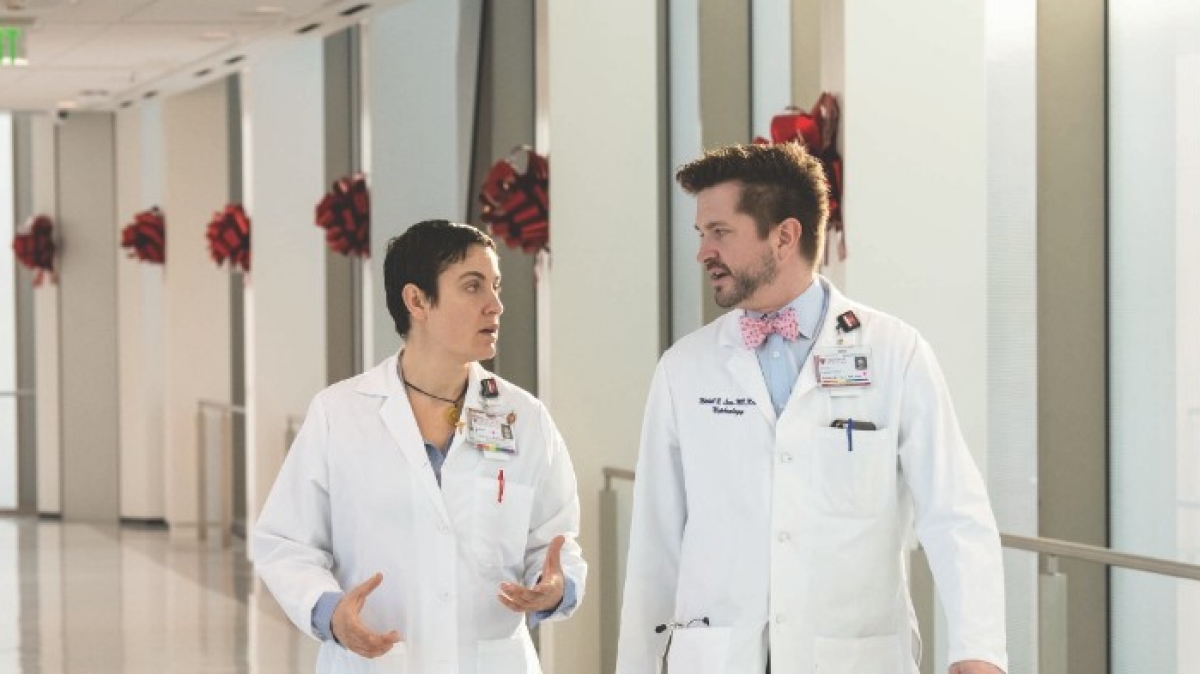
Juno Obedin-Maliver, MD, MPH, MAS (left), and Mitchell R. Lunn, MD, MAS, want to understand how identifying as a sexual and gender minority person affects one’s health—physically, mentally, and socially.

Taking PRIDE in Their Work

Juno Obedin-Maliver, MD, MPH, MAS (left), and Mitchell R. Lunn, MD, MAS, want to understand how identifying as a sexual and gender minority person affects one’s health—physically, mentally, and socially.

Taking PRIDE in Their Work

IN OCTOBER 2016, THE NATIONAL INSTITUTES OF HEALTH MADE A BOLD PROCLAMATION:
Mounting evidence indicates that sexual and gender minority (SGM) populations have less access to health care and higher burdens of certain diseases, such as depression, cancer, and HIV/AIDS. But the extent and causes of health disparities are not fully understood, and research on how to close these gaps is lacking.

That statement reinforced what two young physicians—Mitchell R. Lunn, MD, MAS, and Juno Obedin-Maliver, MD, MPH, MAS—already knew. They understood that the largest threat to describing the health status and health-related needs of LGBT people was the lack of population-based data.

“The data didn’t exist because common collection techniques like the U.S. census and medical forms don’t typically ask patients about their sexual orientation or gender identity,” says Lunn, assistant professor of nephrology.

To overcome the deficit, Lunn teamed with Obedin-Maliver (now assistant professor of obstetrics and gynecology) in 2015. They set out to collect the data through a national, longitudinal, dynamic, cohort study. That is, they wanted to gather information from the same individuals within the United States repeatedly over a period of time.

Their overarching goal was to understand how identifying as an SGM person affects one’s health—physically, mentally, and socially.

“We view health in a very holistic way,” Lunn says. “Social health includes things like your experiences of stigma and discrimination in society, but also the things that make you happy: your support system, the things that make you resilient, the things that bring you joy, how your families are structured, for example.”

In the Beginning
The story really began in 2015 when, as research fellows at UC-San Francisco, Lunn and Obedin-Maliver launched a pilot of The Population Research in Identity and Disparities for Equality (PRIDE) Study using an iPhone app. They believe that was the first time a mobile app had been used to specifically recruit large numbers of an underrepresented population for clinical research.

Armed with data from 1,000 participants nationwide who had completed online demographic and health surveys during the pilot, Lunn and Obedin-Maliver launched a web-based platform in 2017 to reach a more diverse pool of participants that now exceeds 16,000 people.

They brought their work to Stanford in early 2019, largely for the opportunity to work collegially with Obedin-Maliver’s mentor, Leslee L. Subak, MD, department chair of obstetrics and gynecology.

IN OCTOBER 2016, THE NATIONAL INSTITUTES OF HEALTH MADE A BOLD PROCLAMATION:
Mounting evidence indicates that sexual and gender minority (SGM) populations have less access to health care and higher burdens of certain diseases, such as depression, cancer, and HIV/AIDS. But the extent and causes of health disparities are not fully understood, and research on how to close these gaps is lacking.

That statement reinforced what two young physicians—Mitchell R. Lunn, MD, MAS, and Juno Obedin-Maliver, MD, MPH, MAS—already knew. They understood that the largest threat to describing the health status and health-related needs of LGBT people was the lack of population-based data.

“The data didn’t exist because common collection techniques like the U.S. census and medical forms don’t typically ask patients about their sexual orientation or gender identity,” says Lunn, assistant professor of nephrology.

To overcome the deficit, Lunn teamed with Obedin-Maliver (now assistant professor of obstetrics and gynecology) in 2015. They set out to collect the data through a national, longitudinal, dynamic, cohort study. That is, they wanted to gather information from the same individuals within the United States repeatedly over a period of time.

Their overarching goal was to understand how identifying as an SGM person affects one’s health—physically, mentally, and socially.

“We view health in a very holistic way,” Lunn says. “Social health includes things like your experiences of stigma and discrimination in society, but also the things that make you happy: your support system, the things that make you resilient, the things that bring you joy, how your families are structured, for example.”

In the Beginning
The story really began in 2015 when, as research fellows at UC-San Francisco, Lunn and Obedin-Maliver launched a pilot of The Population Research in Identity and Disparities for Equality (PRIDE) Study using an iPhone app. They believe that was the first time a mobile app had been used to specifically recruit large numbers of an underrepresented population for clinical research.

Armed with data from 1,000 participants nationwide who had completed online demographic and health surveys during the pilot, Lunn and Obedin-Maliver launched a web-based platform in 2017 to reach a more diverse pool of participants that now exceeds 16,000 people.

They brought their work to Stanford in early 2019, largely for the opportunity to work collegially with Obedin-Maliver’s mentor, Leslee L. Subak, MD, department chair of obstetrics and gynecology. Subak was starting an SGM program at Stanford that was backed by Stanford School of Medicine Dean Lloyd Minor, MD, and Department of Medicine Chair Robert Harrington, MD.

Between 2019 and early 2020, 10 papers were published, in press, or under review. They address such topics as substance use, eating disorders, survey design, and optimal ways to ask about sexual orientation and gender identity for research purposes.

Campus-wide Collaboration
Now others at Stanford are working in conjunction with The PRIDE Study.

One is Eleni Linos, MD, MPH, DrPH, professor of dermatology, who had a paper published in the Oct. 4, 2019 issue of JAMA Open Network. A finding in that paper suggests the possibility that the tanning industry may be targeting gay and bisexual men, who are six times more likely than heterosexual men to tan indoors during their lifetimes and about twice as likely to suffer from skin cancer. Linos’ research team hopes to partner with The PRIDE Study to investigate the marketing and advertising efforts of the tanning industry.

In another project, Amy Dobberfuhl, MD, MS, an instructor of urology, is working with Obedin-Maliver to look at urinary voiding among transgender people.

“You can imagine that if you feel discriminated against about which bathroom you’re going to use, then you may ‘hold it’ and not pee until you feel safe. And over time that can result in dysfunction of how you empty your bladder,” says Lunn.

Community Engagement
A key component of The PRIDE Study is community engagement.

“Juno and I are not the ones deciding research questions,” Lunn explains. “Every study that we do, every paper that we write, every collaboration that we do with investigators at Stanford, or outside of Stanford, gets reviewed by a scientific committee as well as an advisory committee of 11 people from across the country who are SGM advocates and bring various perspectives. They have equal weight in deciding if a study that we do moves forward.”

Lunn and Obedin-Maliver don’t want the study’s research to live and die in medical journals. Instead, they want it to get back to the communities they are hoping to serve.

“We really want to be partners with folks and make sure that they’re involved not only in the research itself, but also in receiving results of the research in ways that are accessible for them,” Lunn says.

That’s why they oversee the creation of community-friendly summaries that translate scholarly research into descriptions of the research and its outcomes that are easy for all members of SGM communities to understand.

Eventually they intend to expand those activities to include short videos, infographics, and other communications that will be easy to share via social media.

Far-reaching Effects
Lunn and Obedin-Maliver would not have embarked on this work without the hope of changing clinical practice.

As an example, The PRIDE Study is involved in an examination of how people are screened for problematic or harmful alcohol use.

“Conventionally, those types of analyses are based on somebody’s sex assigned at birth. A survey might look at what happens if you have more than five drinks at a time if you’re male versus having four drinks at a time if you’re female,” says Lunn. “But how does that work for gender minority people? What if you’re a transgender person who’s been on hormones for 20 years? Which one of those is the appropriate answer? So we have studies like that, which we hope will influence screening guidelines.”

The researchers also think about using the study to move beyond medicine and into “social health” and public policy.

“If we can show that people who have had many traumatic experiences on the basis of their gender identity or sexual orientation have certain health outcomes, then that can provide some evidence to actually change policy and laws,” he says.

“I hope that the long-ranging effects of this study are that SGM people get more competent and appropriate care based on their sexual orientation and gender identity. And that society changes to make life better for them. And by making life better for them, it can improve their health,” he adds.

Many other longitudinal cohort studies, like the famous Framingham Heart Study, go on for generations. As to how long The PRIDE Study will continue, Lunn says, “we’ll keep this going for decades—or until we’re no longer needed.”

Subak was starting an SGM program at Stanford that was backed by Stanford School of Medicine Dean Lloyd Minor, MD, and Department of Medicine Chair Robert Harrington, MD.

Between 2019 and early 2020, 10 papers were published, in press, or under review. They address such topics as substance use, eating disorders, survey design, and optimal ways to ask about sexual orientation and gender identity for research purposes.

Campus-wide Collaboration
Now others at Stanford are working in conjunction with The PRIDE Study.

One is Eleni Linos, MD, MPH, DrPH, professor of dermatology, who had a paper published in the Oct. 4, 2019 issue of JAMA Open Network. A finding in that paper suggests the possibility that the tanning industry may be targeting gay and bisexual men, who are six times more likely than heterosexual men to tan indoors during their lifetimes and about twice as likely to suffer from skin cancer. Linos’ research team hopes to partner with The PRIDE Study to investigate the marketing and advertising efforts of the tanning industry.

In another project, Amy Dobberfuhl, MD, MS, an instructor of urology, is working with Obedin-Maliver to look at urinary voiding among transgender people.

“You can imagine that if you feel discriminated against about which bathroom you’re going to use, then you may ‘hold it’ and not pee until you feel safe. And over time that can result in dysfunction of how you empty your bladder,” says Lunn.

Community Engagement
A key component of The PRIDE Study is community engagement.

“Juno and I are not the ones deciding research questions,” Lunn explains. “Every study that we do, every paper that we write, every collaboration that we do with investigators at Stanford, or outside of Stanford, gets reviewed by a scientific committee as well as an advisory committee of 11 people from across the country who are SGM advocates and bring various perspectives. They have equal weight in deciding if a study that we do moves forward.”

Lunn and Obedin-Maliver don’t want the study’s research to live and die in medical journals. Instead, they want it to get back to the communities they are hoping to serve.

“We really want to be partners with folks and make sure that they’re involved not only in the research itself, but also in receiving results of the research in ways that are accessible for them,” Lunn says.

That’s why they oversee the creation of community-friendly summaries that translate scholarly research into descriptions of the research and its outcomes that are easy for all members of SGM communities to understand.

Eventually they intend to expand those activities to include short videos, infographics, and other communications that will be easy to share via social media.

Far-reaching Effects
Lunn and Obedin-Maliver would not have embarked on this work without the hope of changing clinical practice.

As an example, The PRIDE Study is involved in an examination of how people are screened for problematic or harmful alcohol use.

“Conventionally, those types of analyses are based on somebody’s sex assigned at birth. A survey might look at what happens if you have more than five drinks at a time if you’re male versus having four drinks at a time if you’re female,” says Lunn. “But how does that work for gender minority people? What if you’re a transgender person who’s been on hormones for 20 years? Which one of those is the appropriate answer? So we have studies like that, which we hope will influence screening guidelines.”

The researchers also think about using the study to move beyond medicine and into “social health” and public policy.

“If we can show that people who have had many traumatic experiences on the basis of their gender identity or sexual orientation have certain health outcomes, then that can provide some evidence to actually change policy and laws,” he says.

“I hope that the long-ranging effects of this study are that SGM people get more competent and appropriate care based on their sexual orientation and gender identity. And that society changes to make life better for them. And by making life better for them, it can improve their health,” he adds.

Many other longitudinal cohort studies, like the famous Framingham Heart Study, go on for generations. As to how long The PRIDE Study will continue, Lunn says, “we’ll keep this going for decades—or until we’re no longer needed.”

Practitioner Liability

by emli1120 | Feb 26, 2024 | 2020, Diverse Faces of Medicine 2020

Baldeep Singh, MD, with staff at Samaritan House

“Whatever lies behind these shifts, it is problematic. From a patient safety standpoint, this is the study’s most troubling finding.” — David Studdert, LLB, ScD, MPH

Practitioner Liability

“Whatever lies behind these shifts, it is problematic. From a patient safety standpoint, this is the study’s most troubling finding.” — David Studdert, LLB, ScD, MPH

Practitioner Liability

PHYSICIANS WITH MULTIPLE MALPRACTICE CLAIMS DON’T SKIP TOWN; THEY STOP PRACTICING OR GO SOLO.

Stanford researchers analyzed more than a decade’s worth of data about nearly half a million physicians and found that those who were sued repeatedly were no more likely to move their clinical practices to new states or regions than colleagues who had no legal claims against them.

But physicians who accrued multiple claims were more likely to cease practice, shift into smaller practice settings, or go solo.

Stanford Health Policy’s David Studdert, LLB, ScD, MPH, and Michelle Mello, PhD, JD—both professors of medicine and of law—published their findings in the Mar. 28, 2019 issue of The New England Journal of Medicine.

The researchers studied 480,894 physicians and nearly 69,000 malpractice claims. They found that claims were grossly maldistributed, with nearly 90% of the physicians experiencing no claims over a 10-year period, 9% experiencing one claim, and 2% experiencing multiple claims. The multi-claim physicians accounted for nearly 40% of all claims paid over a decade.

“There is an emerging awareness that a small group of ‘frequent flyers’ accounts for an impressively large share of all malpractice lawsuits,” says Studdert. “This study confirms that and, for the first time, begins to shed light on the professional trajectories of these practitioners.”

Geographic relocation was a key focus of the study. The researchers used data from the National Practitioner Data Bank, which was established by Congress in the early 1990s.

The data bank was created partly in response to widespread concerns that patients were endangered by practitioners who accumulated troubling track records of malpractice claims and disciplinary problems, then moved to another state for a fresh start.

“Many of the laws and institutions that govern health professionals are at the state level,” says Studdert. “It’s possible to take advantage of that fragmentation to avoid oversight, and this is what the data bank was set up to stop.”

When a malpractice claim is paid on behalf of a health practitioner, or the practitioner is subjected to certain forms of disciplinary action, the information must be reported to the data bank. And before a hospital may credential a physician, it is required to query the data bank to examine the physician’s history.

PHYSICIANS WITH MULTIPLE MALPRACTICE CLAIMS DON’T SKIP TOWN; THEY STOP PRACTICING OR GO SOLO.

researchers analyzed more than a decade’s worth of data about nearly half a million physicians and found that those who were sued repeatedly were no more likely to move their clinical practices to new states or regions than colleagues who had no legal claims against them.

But physicians who accrued multiple claims were more likely to cease practice, shift into smaller practice settings, or go solo.

Stanford Health Policy’s David Studdert, LLB, ScD, MPH, and Michelle Mello, PhD, JD—both professors of medicine and of law—published their findings in the Mar. 28, 2019 issue of The New England Journal of Medicine.

The researchers studied 480,894 physicians and nearly 69,000 malpractice claims. They found that claims were grossly maldistributed, with nearly 90% of the physicians experiencing no claims over a 10-year period, 9% experiencing one claim, and 2% experiencing multiple claims. The multi-claim physicians accounted for nearly 40% of all claims paid over a decade.

“There is an emerging awareness that a small group of ‘frequent flyers’ accounts for an impressively large share of all malpractice lawsuits,” says Studdert. “This study confirms that and, for the first time, begins to shed light on the professional trajectories of these practitioners.”

Geographic relocation was a key focus of the study. The researchers used data from the National Practitioner Data Bank, which was established by Congress in the early 1990s. The data bank was created partly in response to widespread concerns that patients were endangered by practitioners who accumulated troubling track records of malpractice claims and disciplinary problems, then moved to another state for a fresh start.

“Many of the laws and institutions that govern health professionals are at the state level,” says Studdert. “It’s possible to take advantage of that fragmentation to avoid oversight, and this is what the data bank was set up to stop.”

When a malpractice claim is paid on behalf of a health practitioner, or the practitioner is subjected to certain forms of disciplinary action, the information must be reported to the data bank. And before a hospital may credential a physician, it is required to query the data bank to examine the physician’s history. Medical groups, health plans, and professional societies are encouraged to make such queries as well, but they are not required to do so.

“Contrary to popular wisdom, we do not see evidence of unusual geographic movement among frequent fliers,” says Mello. “They are no more likely than other physicians to relocate.”

There is an emerging awareness that a small group of ‘frequent flyers’ accounts for an impressively large share of all malpractice lawsuits

While this finding may be interpreted as evidence that the data bank is doing its job, the study was not designed to test it, and the authors were hesitant to draw that conclusion.

But not all of the study’s findings were so reassuring. As physicians accrued malpractice claims, their likelihood of shifting into small medical groups or solo practice increased sharply. For example, the study found that physicians who had accrued two to four claims were 50% to 60% more likely to enter solo practice than physicians with no claims, and physicians with five or more claims were nearly 2.5 times more likely to enter solo practice.

The study goes on to consider why these shifts to smaller practice occur, suggesting that “it may become necessary if a hospital or practice group severs its ties with a claim-prone physician or imposes burdensome remedial actions as a condition of recredentialing. Physicians may also seek a new practice setting if they perceive that their reputation among their colleagues has become tarnished.”

“Whatever lies behind these shifts,” says Studdert, “it is problematic. From a patient safety standpoint, this is the study’s most troubling finding.”

The study reviews aspects of small group and solo practice settings that are likely to amplify the risks claim-prone physicians pose for patients. “In small and solo practice there tends to be less oversight by administrators and peers,” Studdert says. It is also hard for physicians in these settings to adopt infrastructure improvements, implement processes to improve care, and access advice and information from peers and support staff.”

Although the finding that frequent fliers were significantly more likely to cease practice appeared to be reassuring, the authors sounded a cautionary note here, too.

“You would hope and expect that many of these practitioners will be de-credentialed and perhaps leave medicine, and those outcomes are indeed more likely,” says Mello. “But the fact is that the vast majority of physicians who have had multiple malpractice claims paid against them continue to deliver care and treat about as many patients as their colleagues do.”

Liability insurers may be in the best position to monitor multiple-claims physicians, according to Studdert, but may not be doing so.

“Someone is continuing to provide insurance for these physicians despite their poor liability records,” he says. “It’s not clear how much those liability insurers know about these physicians’ histories, or what if anything they are doing to address the risk.”

The researchers formed the study cohort by linking data on physicians who billed Medicare between 2008 and 2015 with malpractice payment reports in the data bank over the same period.

Other co-authors of the study included Matthew J. Spittal from the Melbourne School of Population and Global Health, University of Melbourne; Yifan Zhang from Stanford’s Center for Health Policy; and Derek S. Wilkinson and Harnam Singh from the Health Resources and Services Administration in the U.S. Department of Health and Human Services.

There is an emerging awareness that a small group of ‘frequent flyers’ accounts for an impressively large share of all malpractice lawsuits

Medical groups, health plans, and professional societies are encouraged to make such queries as well, but they are not required to do so.

“Contrary to popular wisdom, we do not see evidence of unusual geographic movement among frequent fliers,” says Mello. “They are no more likely than other physicians to relocate.”

While this finding may be interpreted as evidence that the data bank is doing its job, the study was not designed to test it, and the authors were hesitant to draw that conclusion.

But not all of the study’s findings were so reassuring. As physicians accrued malpractice claims, their likelihood of shifting into small medical groups or solo practice increased sharply. For example, the study found that physicians who had accrued two to four claims were 50% to 60% more likely to enter solo practice than physicians with no claims, and physicians with five or more claims were nearly 2.5 times more likely to enter solo practice.

The study goes on to consider why these shifts to smaller practice occur, suggesting that “it may become necessary if a hospital or practice group severs its ties with a claim-prone physician or imposes burdensome remedial actions as a condition of recredentialing. Physicians may also seek a new practice setting if they perceive that their reputation among their colleagues has become tarnished.”

“Whatever lies behind these shifts,” says Studdert, “it is problematic. From a patient safety standpoint, this is the study’s most troubling finding.”

The study reviews aspects of small group and solo practice settings that are likely to amplify the risks claim-prone physicians pose for patients. “In small and solo practice there tends to be less oversight by administrators and peers,” Studdert says. It is also hard for physicians in these settings to adopt infrastructure improvements, implement processes to improve care, and access advice and information from peers and support staff.”

Although the finding that frequent fliers were significantly more likely to cease practice appeared to be reassuring, the authors sounded a cautionary note here, too.

“You would hope and expect that many of these practitioners will be de-credentialed and perhaps leave medicine, and those outcomes are indeed more likely,” says Mello. “But the fact is that the vast majority of physicians who have had multiple malpractice claims paid against them continue to deliver care and treat about as many patients as their colleagues do.”

Liability insurers may be in the best position to monitor multiple-claims physicians, according to Studdert, but may not be doing so.

“Someone is continuing to provide insurance for these physicians despite their poor liability records,” he says. “It’s not clear how much those liability insurers know about these physicians’ histories, or what if anything they are doing to address the risk.”

The researchers formed the study cohort by linking data on physicians who billed Medicare between 2008 and 2015 with malpractice payment reports in the data bank over the same period.

Other co-authors of the study included Matthew J. Spittal from the Melbourne School of Population and Global Health, University of Melbourne; Yifan Zhang from Stanford’s Center for Health Policy; and Derek S. Wilkinson and Harnam Singh from the Health Resources and Services Administration in the U.S. Department of Health and Human Services.

The Power of Connection

by emli1120 | Feb 26, 2024 | 2020, Diverse Faces of Medicine 2020

Baldeep Singh, MD, with staff at Samaritan House

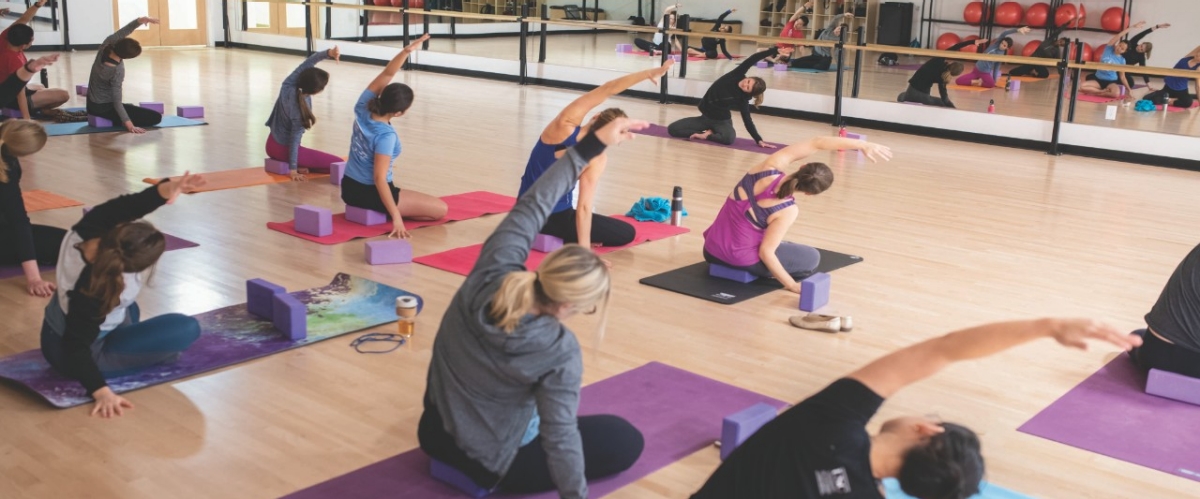
Residents stretch during a Women in Medicine-sponsored yoga class

The Power of Connection

Residents stretch during a Women in Medicine-sponsored yoga class

The Power of Connection

THE WOMEN IN MEDICINE GROUP IS CREATING COMMUNITY AND AMPLIFYING RESIDENTS’ VOICES.

In 2010, Cybele Renault, MD, a clinical associate professor of infectious diseases, sat down at her desk to draft a grant proposal. The resulting four-page document read like a manifesto, with an outline for a new seminar series tailored exclusively to women in medicine along with space devoted to personal reflection: She recounted, among other memories, a sinking moment early in her career when she realized that, out of three trainees performing the same work under the same mentor at the same county hospital, only the male trainee was being paid.

The series, Renault imagined, would combat experiences like hers, and provide space for students, residents, and fellows to connect and share wisdom with each other and learn critical skills about how to navigate the academic landscape, identify bias, challenge sexism, and not burn out along the way.

She submitted the grant and awaited an official response. Months later, she heard the news: Her proposal had been denied. She applied again but received the same result.

Undaunted, Renault scheduled a meeting with Larry Katznelson, MD, professor of endocrinology and neurosurgery and associate dean for graduate medical education, to discuss her ideas. “I shared my grant proposal and told him ‘I want to do this!’” Her enthusiasm was met with instantaneous support: “He said, ‘I’ll secure funding from Graduate Medical Education. Tell me what you need.’ He gave me free rein—there was trust and recognition of my passion and the need for something like this at our institution.”

THE WOMEN IN MEDICINE GROUP IS CREATING COMMUNITY AND AMPLIFYING RESIDENTS’ VOICES.

In 2010, Cybele Renault, MD, a clinical associate professor of infectious diseases, sat down at her desk to draft a grant proposal. The resulting four-page document read like a manifesto, with an outline for a new seminar series tailored exclusively to women in medicine along with space devoted to personal reflection: She recounted, among other memories, a sinking moment early in her career when she realized that, out of three trainees performing the same work under the same mentor at the same county hospital, only the male trainee was being paid.

The series, Renault imagined, would combat experiences like hers, and provide space for students, residents, and fellows to connect and share wisdom with each other and learn critical skills about how to navigate the academic landscape, identify bias, challenge sexism, and not burn out along the way.

She submitted the grant and awaited an official response. Months later, she heard the news: Her proposal had been denied. She applied again but received the same result.

Undaunted, Renault scheduled a meeting with Larry Katznelson, MD, professor of endocrinology and neurosurgery and associate dean for graduate medical education, to discuss her ideas. “I shared my grant proposal and told him ‘I want to do this!’” Her enthusiasm was met with instantaneous support: “He said, ‘I’ll secure funding from Graduate Medical Education. Tell me what you need.’ He gave me free rein—there was trust and recognition of my passion and the need for something like this at our institution.”

Renault now had funding, a name (Women in Medicine, or WIM) and a sense of purpose. She just needed to form a community. She reached out to all the residency program directors at Stanford and asked them to appoint a female resident to join the fledgling group’s leadership council. “I wanted to establish a core council of representatives so we could figure out the next steps—what topics to focus on, which issues we should address, how we should prioritize time and funds.”

From left: Becca Tisdale, MD, Cybele Renault, MD, and Brooke Gabster, MD

Hearing the Call
Partway through her four-year neurology residency, Rebecca Miller-Kuhlmann, MD, clinical assistant professor of neurology and neurological sciences, hit “pause” to have a baby. She spent her maternity leave adjusting to the rhythms and changes that come with a new arrival, but she also found time to read Sheryl Sandberg’s book Lean In, which had been recommended by a friend. “I found the book to be really fascinating and eye opening,” she explains, “and it put a different lens on some of my own experiences.” When she returned to campus and heard about Renault’s newly formed WIM program, she jumped at the chance to participate: “I wanted to be involved immediately.” She reached out and became one of the first to join the new group.

The inaugural meeting took place on campus. Renault had gathered roughly 20 female residents from different specialties in a conference room to discuss the program and its future. Each of them brought different perspectives and a long list of questions. Miller-Kulhmann set the scene: “Cybele got up and just started sharing her reasons for wanting to found this group and the power of community among women, and she discussed the challenges that were unique to women. The tone of the room shifted, everyone began talking and sharing the experiences they’ve had—all of the experiences: the good, the bad, the ugly—it was a powerful meeting.”

We’ve had some events where it’s just the women from the group sitting outside on picnic blankets, eating pizza together and figuring out the challenges of the world.

The group got to work. They organized skills-based trainings on contract negotiation tactics and workshops on implicit bias. They invited influential speakers like Mary Hawn, MD, chair of the Department of Surgery, and groups like the Clayman Institute for Gender Research to share their perspectives. They set up panels of women in leadership roles and scheduled off-campus happy hours. They connected mentors to mentees. They sponsored wellness events and partnered with like-minded groups. They tackled tricky topics: social justice, fertility and maternity concerns, microaggressions, wage gaps. And they took notes along the way, eventually homing in on a set of best practices: host four to six events per year in crowd-pleasing venues, listen to suggestions, and always make space for conversation and authentic connection.

This last piece is what makes WIM so vital, Miller-Kuhlmann says, and it’s the low-octane gatherings that often linger most in her mind. “We’ve had some events where it’s just the women from the group sitting outside on picnic blankets, eating pizza together and figuring out the challenges of the world,” reflects Miller-Kulhmann. “Pizza and meaningful conversation—the great uniters.”

Today’s WIM group is entirely resident-led, with Renault and Miller-Kulhmann acting as co-faculty advisors. It’s just what Renault intended when she submitted her proposal almost a decade ago.

“That was always the goal. I’m so inspired by the residents’ momentum and their willingness to share their experiences,” she says. “They’ve designed a program that supports them and improves the broader Stanford community. They’re leaving a legacy—they want things to be better for the women who come after them.”

WIM Group Leadership Council

Katrina Houpis
Mary Ellen Irene Koran
Julia Chandler
Audrey Rose Verde
Mita Hoppenfeld
Julia Anne Armendariz
Anne Kuwabara
Katherine Werbaneth
Anna Janas
Hayley Elizabeth Miller
Adela Wu
Jessica K. Buesing
Lauren Michelle Shapiro
Danielle Helena Rochlin
Jasmyn Kaur Johal

From left: Becca Tisdale, MD, Cybele Renault, MD, and Brooke Gabster, MD

Renault now had funding, a name (Women in Medicine, or WIM) and a sense of purpose. She just needed to form a community. She reached out to all the residency program directors at Stanford and asked them to appoint a female resident to join the fledgling group’s leadership council. “I wanted to establish a core council of representatives so we could figure out the next steps—what topics to focus on, which issues we should address, how we should prioritize time and funds.”

Hearing the Call
Partway through her four-year neurology residency, Rebecca Miller-Kuhlmann, MD, clinical assistant professor of neurology and neurological sciences, hit “pause” to have a baby. She spent her maternity leave adjusting to the rhythms and changes that come with a new arrival, but she also found time to read Sheryl Sandberg’s book Lean In, which had been recommended by a friend. “I found the book to be really fascinating and eye opening,” she explains, “and it put a different lens on some of my own experiences.” When she returned to campus and heard about Renault’s newly formed WIM program, she jumped at the chance to participate: “I wanted to be involved immediately.” She reached out and became one of the first to join the new group.

The inaugural meeting took place on campus. Renault had gathered roughly 20 female residents from different specialties in a conference room to discuss the program and its future. Each of them brought different perspectives and a long list of questions. Miller-Kulhmann set the scene: “Cybele got up and just started sharing her reasons for wanting to found this group and the power of community among women, and she discussed the challenges that were unique to women. The tone of the room shifted, everyone began talking and sharing the experiences they’ve had—all of the experiences: the good, the bad, the ugly—it was a powerful meeting.”

We’ve had some events where it’s just the women from the group sitting outside on picnic blankets, eating pizza together and figuring out the challenges of the world.

The group got to work. They organized skills-based trainings on contract negotiation tactics and workshops on implicit bias. They invited influential speakers like Mary Hawn, MD, chair of the Department of Surgery, and groups like the Clayman Institute for Gender Research to share their perspectives. They set up panels of women in leadership roles and scheduled off-campus happy hours. They connected mentors to mentees. They sponsored wellness events and partnered with like-minded groups. They tackled tricky topics: social justice, fertility and maternity concerns, microaggressions, wage gaps. And they took notes along the way, eventually homing in on a set of best practices: host four to six events per year in crowd-pleasing venues, listen to suggestions, and always make space for conversation and authentic connection.

This last piece is what makes WIM so vital, Miller-Kuhlmann says, and it’s the low-octane gatherings that often linger most in her mind. “We’ve had some events where it’s just the women from the group sitting outside on picnic blankets, eating pizza together and figuring out the challenges of the world,” reflects Miller-Kulhmann. “Pizza and meaningful conversation—the great uniters.”

Today’s WIM group is entirely resident-led, with Renault and Miller-Kulhmann acting as co-faculty advisors. It’s just what Renault intended when she submitted her proposal almost a decade ago.

“That was always the goal. I’m so inspired by the residents’ momentum and their willingness to share their experiences,” she says. “They’ve designed a program that supports them and improves the broader Stanford community. They’re leaving a legacy—they want things to be better for the women who come after them.”

WIM Group Leadership Council

Katrina Houpis
Mary Ellen Irene Koran
Julia Chandler
Audrey Rose Verde
Mita Hoppenfeld
Julia Anne Armendariz
Anne Kuwabara
Katherine Werbaneth
Anna Janas
Hayley Elizabeth Miller
Adela Wu
Jessica K. Buesing
Lauren Michelle Shapiro
Danielle Helena Rochlin
Jasmyn Kaur Johal

A Helping Hand

by emli1120 | Feb 26, 2024 | 2020, Diverse Faces of Medicine 2020

Baldeep Singh, MD, with staff at Samaritan House

From left: Baldeep Singh, MD, Jonathan Glazer Shaw, MD, MS, and Kirsti Weng, MD, MPH.

A Helping Hand

From left: Baldeep Singh, MD, Jonathan Glazer Shaw, MD, MS, and Kirsti Weng, MD, MPH.

A Helping Hand

NEW INITIATIVES ARE SUPPORTING VULNERABLE POPULATIONS IN NEARBY COMMUNITIES.

A few years ago at an annual department retreat, faculty within the division of primary care and population health voted on the activities or initiatives they felt would improve the division. A top priority emerged: community engagement.

“Our faculty were interested in better aligning with our community partners, with the goal of trying to meet their needs in clinical, educational, administrative, and research support; across the board there was interest in everything we asked about,” says Baldeep Singh, MD, professor of medicine and vice chief of academic affairs in the division, who was asked to coordinate the effort. “There was clearly a lot of untapped energy.”

In response, division leaders named Jonathan Shaw, MD, MS, as the new director of community partnership. 

He started reaching out to community organizations that might be in need of doctors’ time and expertise.

Around the same time, Loto Reed—program specialist for community engagement and wellness within the division—proposed the idea of a staff-led community service program. “Lots of the staff were interested in giving back to the community and finding ways to build culture within our staff team,” she says.

By the end of 2018, both faculty and staff suddenly had an overabundance of new opportunities for community engagement. The community partnership effort organized by Shaw offered faculty the chance to serve patients in need. Another program, SCOPE (Stanford Community Outreach Partnership Engagement), the outcome of Reed’s proposal to the division chief, Sang-ick Chang, MD, offered opportunities outside patient care.

A Coordinated Effort
When Shaw started reaching out to local organizations and clinics that provide “safety net” health care—services to low-income and vulnerable populations who lack insurance—they immediately expressed interest in having help from Stanford.

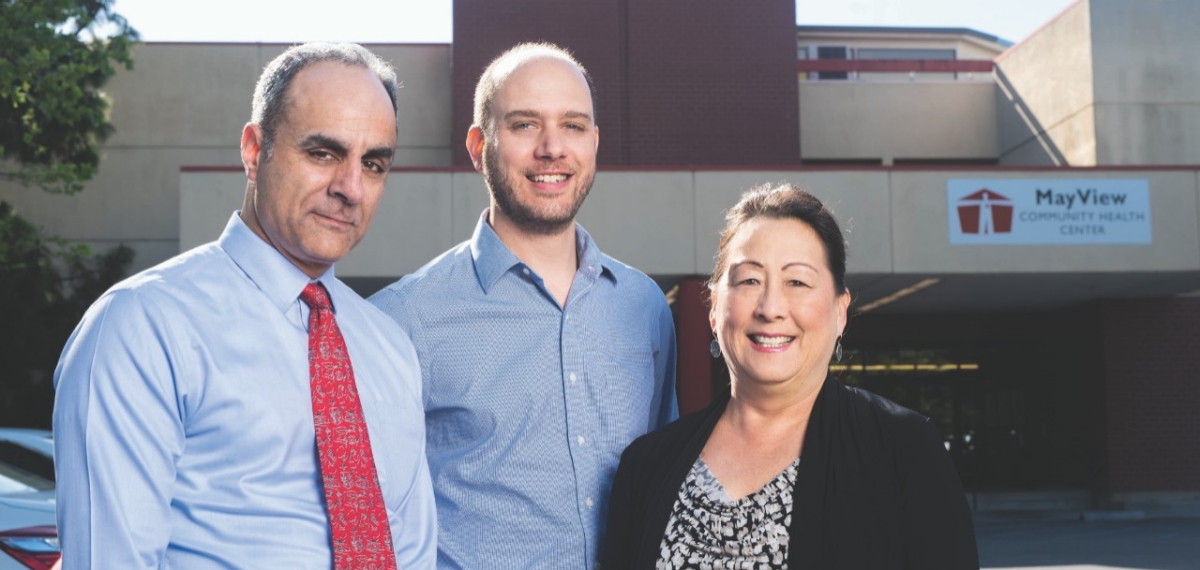
Shaw initially set up a collaboration with Mayview Community Health Center, a nonprofit primary care clinic devoted to providing health care to low-income families. Stanford Hospital generously offered funding to cover faculty support for this effort; the funds were used to support division of primary care and population health physicians in spending some of their clinical time at Mayview.

“These organizations don’t just need clinicians a few hours a week,” says Shaw. “They really need lots of support.” The partnership launched with direct clinical care, but has grown to include non-monetary support via capacity-building, education, and research, he says.

NEW INITIATIVES ARE SUPPORTING VULNERABLE POPULATIONS IN NEARBY COMMUNITIES.

A few years ago at an annual department retreat, faculty within the division of primary care and population health voted on the activities or initiatives they felt would improve the division. A top priority emerged: community engagement.

“Our faculty were interested in better aligning with our community partners, with the goal of trying to meet their needs in clinical, educational, administrative, and research support; across the board there was interest in everything we asked about,” says Baldeep Singh, MD, professor of medicine and vice chief of academic affairs in the division, who was asked to coordinate the effort. “There was clearly a lot of untapped energy.”

In response, division leaders named Jonathan Shaw, MD, MS, as the new director of community partnership. He started reaching out to community organizations that might be in need of doctors’ time and expertise.

Around the same time, Loto Reed—program specialist for community engagement and wellness within the division—proposed the idea of a staff-led community service program. “Lots of the staff were interested in giving back to the community and finding ways to build culture within our staff team,” she says.

By the end of 2018, both faculty and staff suddenly had an overabundance of new opportunities for community engagement. The community partnership effort organized by Shaw offered faculty the chance to serve patients in need. Another program, SCOPE (Stanford Community Outreach Partnership Engagement), the outcome of Reed’s proposal to the division chief, Sang-ick Chang, MD, offered opportunities outside patient care.

A Coordinated Effort
When Shaw started reaching out to local organizations and clinics that provide “safety net” health care—services to low-income and vulnerable populations who lack insurance—they immediately expressed interest in having help from Stanford.

Shaw initially set up a collaboration with Mayview Community Health Center, a nonprofit primary care clinic devoted to providing health care to low-income families. Stanford Hospital generously offered funding to cover faculty support for this effort; the funds were used to support division of primary care and population health physicians in spending some of their clinical time at Mayview.

“These organizations don’t just need clinicians a few hours a week,” says Shaw. “They really need lots of support.” The partnership launched with direct clinical care, but has grown to include non-monetary support via capacity-building, education, and research, he says.


From left: SCOPE team members Meredith Fischer, Catherine Brown Johnson, and Darlene Veruttipong make blankets.

Kirsti Weng, MD, MPH, clinical associate professor of medicine, and Meenadchi Chelvakumar, MD, clinical assistant professor of medicine, are being supported in seeing patients at Mayview. Weng was named medical director there, and another three—Singh, along with Chang and Maria Tiscareno, MD, clinical assistant professor of medicine—have now joined the Mayview board of directors. In addition, the partnership has launched a new student clerkship, which lets Stanford medical students spend time at Mayview during their training.

“It’s really grown into a multi-faceted collaboration,” Shaw says.

In addition, affiliations with two other programs began in 2019. A Stanford physician-fellow in primary care, Kenji Taylor, MD, has begun working at Roots Community Health Center in Oakland.

Closer to Stanford, clinical assistant professors Laura Vaughan, MD, and Tamara Montacute, MD, are now providing rotating clinical time at Peninsula Healthcare Connection, a clinic within Palo Alto’s Opportunity Center. The clinic offers primary care for homeless individuals in Santa Clara County. Clinical associate professor Kathan Vollrath, MD, MPH, is acting as an external quality consultant there, offering her expertise to help improve patient safety and implement program changes.

“We’re still working on building up these relationships with our partners,” says Shaw. “It’s a slow process.”

The division hopes to collaborate with other divisions and departments that have an interest in community engagement. Until now, volunteer efforts throughout Stanford Medicine have been fragmented, Singh says. “Some departments have been doing lots of great work, but the effort remains uncoordinated.”

Singh and Shaw would like to provide subspecialty care to their community partners and help link information with other departments—such as pediatrics and psychiatry—that already have active community programs.

“Traditionally, community engagement was not part of Stanford Medicine’s mission,” says Shaw. “As a vision, we would like to make it part of our mission, and we’d love to see that spread.”

Through SCOPE we found a great outlet to serve and to interact with colleagues outside of work.

An Active Volunteer Net
In early 2018, SCOPE’s initial team of 10 staff members set their motto as “Putting Compassion into Action” and began by partnering with three community organizations that serve low-income and homeless individuals. The SCOPE team helped coordinate at least one event a month, including preparing and serving meals at shelters, sorting through used clothing, volunteering time at food pantries, and making winter care packages to be distributed to community partners.

“Through SCOPE we found a great outlet to serve and to interact with colleagues outside of work,” says Reed. “We started inviting staff from other divisions who we knew might be interested, and it kind of took on a life of its own.”

In 2018 alone, more than 100 people each logged over 200 volunteer hours at events organized by SCOPE. Some could devote only a few hours to volunteering, while others became regulars, spending time in the communities on SCOPE projects and forging new connections with colleagues outside of the usual workday. The central SCOPE team—including Reed—volunteer their time outside of work to coordinate the community partnerships by holding monthly lunch meetings. “The success of SCOPE has truly been a team effort by both the SCOPE team that has been so dedicated and the volunteers who continue to see the value of giving back to the community even in the smallest way,” says Reed.

Like Shaw, Reed also quickly realized that there’s a greater need to coordinate volunteer efforts throughout the Stanford campus.

“We’d like to develop a central volunteer hub so that anyone from Stanford can access volunteer events or inform us of new volunteer events to be posted,” explains Reed. She hopes that a website will make it easier for Stanford staff and faculty to help local communities in need.

From left: SCOPE team members Meredith Fischer, Catherine Brown Johnson, and Darlene Veruttipong make blankets.

Kirsti Weng, MD, MPH, clinical associate professor of medicine, and Meenadchi Chelvakumar, MD, clinical assistant professor of medicine, are being supported in seeing patients at Mayview. Weng was named medical director there, and another three—Singh, along with Chang and Maria Tiscareno, MD, clinical assistant professor of medicine—have now joined the Mayview board of directors. In addition, the partnership has launched a new student clerkship, which lets Stanford medical students spend time at Mayview during their training.

“It’s really grown into a multi-faceted collaboration,” Shaw says.

In addition, affiliations with two other programs began in 2019. A Stanford physician-fellow in primary care, Kenji Taylor, MD, has begun working at Roots Community Health Center in Oakland.

Closer to Stanford, clinical assistant professors Laura Vaughan, MD, and Tamara Montacute, MD, are now providing rotating clinical time at Peninsula Healthcare Connection, a clinic within Palo Alto’s Opportunity Center. The clinic offers primary care for homeless individuals in Santa Clara County. Clinical associate professor Kathan Vollrath, MD, MPH, is acting as an external quality consultant there, offering her expertise to help improve patient safety and implement program changes.

“We’re still working on building up these relationships with our partners,” says Shaw. “It’s a slow process.”

The division hopes to collaborate with other divisions and departments that have an interest in community engagement. Until now, volunteer efforts throughout Stanford Medicine have been fragmented, Singh says. “Some departments have been doing lots of great work, but the effort remains uncoordinated.”

Singh and Shaw would like to provide subspecialty care to their community partners and help link information with other departments—such as pediatrics and psychiatry—that already have active community programs.

“Traditionally, community engagement was not part of Stanford Medicine’s mission,” says Shaw. “As a vision, we would like to make it part of our mission, and we’d love to see that spread.”

Through SCOPE we found a great outlet to serve and to interact with colleagues outside of work.

An Active Volunteer Net
In early 2018, SCOPE’s initial team of 10 staff members set their motto as “Putting Compassion into Action” and began by partnering with three community organizations that serve low-income and homeless individuals. The SCOPE team helped coordinate at least one event a month, including preparing and serving meals at shelters, sorting through used clothing, volunteering time at food pantries, and making winter care packages to be distributed to community partners.

“Through SCOPE we found a great outlet to serve and to interact with colleagues outside of work,” says Reed. “We started inviting staff from other divisions who we knew might be interested, and it kind of took on a life of its own.”

In 2018 alone, more than 100 people each logged over 200 volunteer hours at events organized by SCOPE. Some could devote only a few hours to volunteering, while others became regulars, spending time in the communities on SCOPE projects and forging new connections with colleagues outside of the usual workday. The central SCOPE team—including Reed—volunteer their time outside of work to coordinate the community partnerships by holding monthly lunch meetings. “The success of SCOPE has truly been a team effort by both the SCOPE team that has been so dedicated and the volunteers who continue to see the value of giving back to the community even in the smallest way,” says Reed.

Like Shaw, Reed also quickly realized that there’s a greater need to coordinate volunteer efforts throughout the Stanford campus.

“We’d like to develop a central volunteer hub so that anyone from Stanford can access volunteer events or inform us of new volunteer events to be posted,” explains Reed. She hopes that a website will make it easier for Stanford staff and faculty to help local communities in need.

WIM Group Leadership Council

Katrina Houpis
Mary Ellen Irene Koran
Julia Chandler
Audrey Rose Verde
Mita Hoppenfeld
Julia Anne Armendariz
Anne Kuwabara
Katherine Werbaneth
Anna Janas
Hayley Elizabeth Miller
Adela Wu
Jessica K. Buesing
Lauren Michelle Shapiro
Danielle Helena Rochlin
Jasmyn Kaur Johal

Recent Posts

  • SCCR: The Engine of Innovation
  • The Smoking Cessation Program for Veterans That Doesn’t Quit
  • The Stanford Advantage
  • Limited Sobriety Pathway Saves the Lives of Those With Little Hope
  • Shots on Goal

Recent Comments

No comments to show.

Department of Medicine

About Us Research
Faculty Patient Care
Residency News
Education Events


Stanford School of Medicine

About Basic Science Departments
Contact Clinical Science Departments
Maps & Directions Academic Programs
Careers Vision
Find People
Visit Stanford
Search Clinical Trials
Give a Gift
©2024 Stanford Medicine

    Privacy Policy • Terms of Use • Accessibility

    • Follow
    • Follow