The Enormous Reach of the Stanford Medicine 25

Baldeep Singh, MD, with staff at Samaritan House

Errol Ozdalga, MD (far right), and Abraham Verghese, MD (holding iPhone), demonstrate one of the Stanford 25 physical diagnosis skills to a group of attentive residents.

The Enormous Reach of the Stanford Medicine 25
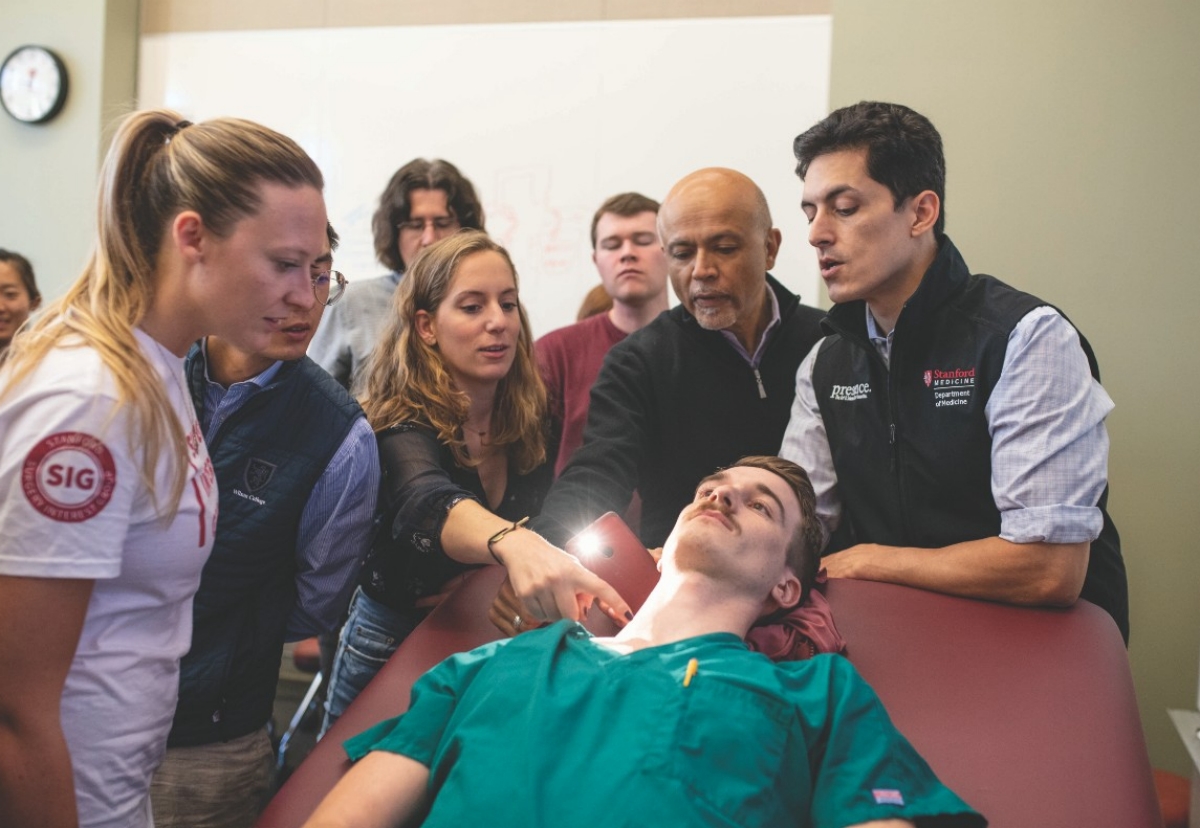
Errol Ozdalga, MD (far right), and Abraham Verghese, MD (holding iPhone), demonstrate one of the Stanford 25 physical diagnosis skills to a group of attentive residents.

The Enormous Reach of the Stanford Medicine 25

ONE THING THAT RONALD WITTELES, MD, ASSOCIATE PROFESSOR OF CARDIOVASCULAR MEDICINE, ENJOYS DOING WHEN HE PARTICIPATES IN AN EXCHANGE WITH ANOTHER RESIDENCY PROGRAM IS JOINING MORNING ROUNDS ON THE CARDIAC CARE UNIT (CCU).

As the residency director for the Department of Medicine, he is interested in noting differences between what Stanford residents do on rounds and what residents at other institutions do. As he is a cardiologist, a CCU is familiar territory.

Visiting Yale not long ago, he showed up at the CCU early one morning, unannounced, and walked down a hall to join a group of residents huddled around a computer. To his surprise—and that of the residents once they turned around and noticed him—he saw himself on the screen. The Yale resident group was using the Stanford Medicine 25 website to review proper procedure for measuring a pulsus paradoxus, a rapid fall in blood pressure during inspiration. Witteles had authored the section of the website and been videotaped demonstrating the correct technique.

How the Stanford Medicine 25 Came About

Such an event was never in the mind of Abraham Verghese, MD, vice chair of medicine; John Kugler, MD, clinical associate professor of hospital medicine; and Brooke Cotter, MD, adjunct clinical assistant professor of primary care and population health. Back in 2008 the three shared their concern that bedside physical diagnosis skills taught in the first and second year of medical school are never revisited much after that, not even in the students’ clinical years. As a result, the new interns at Stanford had varied and generally weak bedside exam skills.

“The body is a text and has a story to tell you,” says Verghese, “but you need to be literate, to be able to read the clues. The physical diagnosis maneuvers described in the textbook can appear straightforward on the page, but at the bedside the theoretical knowledge doesn’t help when the technique is poor. Talking about this with John, we had no appetite to teach the whole physical exam course again to interns, and they had no time. But we both wondered, ‘What if we taught them just a few things that were very technique dependent?

Would it not elevate their technique in general?’ It would be like teaching novice cooks 25 involved dishes—they would no doubt also become more comfortable in the kitchen and better appreciate a culinary expert’s skill.”

They settled on what has become the Stanford 25, a set of physical diagnosis skills best taught one on one at the bedside. In the beginning, they taught one such skill in a special session during morning report, then another during another session two weeks later, and so on. It became quite popular, but its principals felt it needed something more.

Moving to the Ether, Reluctantly

They invited some residents to a focus group dinner in Verghese’s apartment and, he says, “I asked them to free associate about the Stanford 25 and tell us what additional things they wanted. The first thing they said they wanted was a website. That was the last thing I wanted; this is all about hands on! But they convinced us that they needed an online correlation to what they were doing with their hands.”

ONE THING THAT RONALD WITTELES, MD, ASSOCIATE PROFESSOR OF CARDIOVASCULAR MEDICINE, ENJOYS DOING WHEN HE PARTICIPATES IN AN EXCHANGE WITH ANOTHER RESIDENCY PROGRAM IS JOINING MORNING ROUNDS ON THE CARDIAC CARE UNIT (CCU).

As the residency director for the Department of Medicine, he is interested in noting differences between what Stanford residents do on rounds and what residents at other institutions do. As he is a cardiologist, a CCU is familiar territory.

Visiting Yale not long ago, he showed up at the CCU early one morning, unannounced, and walked down a hall to join a group of residents huddled around a computer. To his surprise—and that of the residents once they turned around and noticed him—he saw himself on the screen. The Yale resident group was using the Stanford Medicine 25 website to review proper procedure for measuring a pulsus paradoxus, a rapid fall in blood pressure during inspiration. Witteles had authored the section of the website and been videotaped demonstrating the correct technique.

How the Stanford Medicine 25 Came About

Such an event was never in the mind of Abraham Verghese, MD, vice chair of medicine; John Kugler, MD, clinical associate professor of hospital medicine; and Brooke Cotter, MD, adjunct clinical assistant professor of primary care and population health. Back in 2008 the three shared their concern that bedside physical diagnosis skills taught in the first and second year of medical school are never revisited much after that, not even in the students’ clinical years. As a result, the new interns at Stanford had varied and generally weak bedside exam skills.

“The body is a text and has a story to tell you,” says Verghese, “but you need to be literate, to be able to read the clues. The physical diagnosis maneuvers described in the textbook can appear straightforward on the page, but at the bedside the theoretical knowledge doesn’t help when the technique is poor. Talking about this with John, we had no appetite to teach the whole physical exam course again to interns, and they had no time. But we both wondered, ‘What if we taught them just a few things that were very technique dependent? Would it not elevate their technique in general?’ It would be like teaching novice cooks 25 involved dishes—they would no doubt also become more comfortable in the kitchen and better appreciate a culinary expert’s skill.”

They settled on what has become the Stanford 25, a set of physical diagnosis skills best taught one on one at the bedside. In the beginning, they taught one such skill in a special session during morning report, then another during another session two weeks later, and so on. It became quite popular, but its principals felt it needed something more.

Moving to the Ether, Reluctantly

They invited some residents to a focus group dinner in Verghese’s apartment and, he says, “I asked them to free associate about the Stanford 25 and tell us what additional things they wanted. The first thing they said they wanted was a website. That was the last thing I wanted; this is all about hands on! But they convinced us that they needed an online correlation to what they were doing with their hands.”

Blake Charlton, MD, then a medical student and now an interventional cardiology fellow at UC-San Francisco, put together a website during an elective project based on input from Verghese and research on the specific skills. They made basic videos of themselves performing the 25, which were posted on the site.

What Errol has done is truly miraculous, wedding his love of teaching at the bedside with his love of technology

A Further In-Person Enhancement

As the popularity of the Stanford 25 increased, both inside and outside of Stanford, the “bed-med” team sensed a hunger for this applied skill and decided to put on an annual symposium promoting the culture of bedside medicine, with John Kugler taking the lead. The course, now in its fifth year, promised attendees that they would learn to perform and interpret a competent physical exam and, most importantly, to teach advanced physical exam skills at a patient’s bedside.

The popular symposium aims to train clinician-educators who train others at their institutions. “The bedside is where the patients are,” says Verghese, “and we want to show people the joy and renewal that comes from teaching at the bedside and watching students’ eyes open in wonder when we show them how to read the body.”

Focusing on the Website

In 2011, then-third-year resident Errol Ozdalga, MD, offered to take over the website, correcting some errors, revamping the website, and expanding the topics and content. He also created a blog and used social media and other venues to promote the content online to drive more traffic to the site. “I thought if it looked good and made sense,” he says, “people would learn from it.”

He made sure it was widely accessible, and he created many new videos, first working with professional videographers and later doing it himself, from storyboarding to filming and editing, often with other faculty. He then migrated the videos to a YouTube channel. He also committed to having a Stanford 25 session during morning report every other week—without fail—which, says Verghese, “is a major undertaking by itself. And he hasn’t deviated.”

Ozdalga, currently clinical associate professor of hospital medicine and director of the Stanford Medicine 25, discusses another aspect of the Stanford 25: “We involve other faculty from neurology, dermatology, ob/gyn, and many faculty from our medicine department. We also have faculty from outside Stanford, including outside the U.S., whom I have filmed to capture how they teach specific exams. I’m in debt to them all for volunteering time to help grow the content on the website and YouTube channel.”

During a Stanford 25 session, a real patient—as opposed to an actor playing the role of a patient—is often brought in, and the instructors focus on a single element of the physical exam to teach the residents. Ozdalga recalls being “super nervous about teaching my fellow residents a particular skill during a Stanford 25 session. Of course, that’s how you learn: You get thrown in the deep water.”

Today the Stanford 25 website has 5,000 visitors daily and is second only to Stanford’s news office in hits for a Stanford website. In the first six months of 2019, the Stanford 25 website had over 1 million page views: 1.068 million to be precise.

Verghese says, “What Errol has done is truly miraculous, wedding his love of teaching at the bedside with his love of technology. The Stanford 25 is already a well-known go-to resource the world over, but with more resources and personnel I have no doubt he can make this brand grow and be even more iconic.”
Blake Charlton, MD, then a medical student and now an interventional cardiology fellow at UC-San Francisco, put together a website during an elective project based on input from Verghese and research on the specific skills. They made basic videos of themselves performing the 25, which were posted on the site.

A Further In-Person Enhancement

As the popularity of the Stanford 25 increased, both inside and outside of Stanford, the “bed-med” team sensed a hunger for this applied skill and decided to put on an annual symposium promoting the culture of bedside medicine, with John Kugler taking the lead. The course, now in its fifth year, promised attendees that they would learn to perform and interpret a competent physical exam and, most importantly, to teach advanced physical exam skills at a patient’s bedside.

The popular symposium aims to train clinician-educators who train others at their institutions. “The bedside is where the patients are,” says Verghese, “and we want to show people the joy and renewal that comes from teaching at the bedside and watching students’ eyes open in wonder when we show them how to read the body.”


What Errol has done is truly miraculous, wedding his love of teaching at the bedside with his love of technology

Focusing on the Website

In 2011, then-third-year resident Errol Ozdalga, MD, offered to take over the website, correcting some errors, revamping the website, and expanding the topics and content. He also created a blog and used social media and other venues to promote the content online to drive more traffic to the site. “I thought if it looked good and made sense,” he says, “people would learn from it.”

He made sure it was widely accessible, and he created many new videos, first working with professional videographers and later doing it himself, from storyboarding to filming and editing, often with other faculty. He then migrated the videos to a YouTube channel. He also committed to having a Stanford 25 session during morning report every other week—without fail—which, says Verghese, “is a major undertaking by itself. And he hasn’t deviated.”

Ozdalga, currently clinical associate professor of hospital medicine and director of the Stanford Medicine 25, discusses another aspect of the Stanford 25: “We involve other faculty from neurology, dermatology, ob/gyn, and many faculty from our medicine department. We also have faculty from outside Stanford, including outside the U.S., whom I have filmed to capture how they teach specific exams. I’m in debt to them all for volunteering time to help grow the content on the website and YouTube channel.”

During a Stanford 25 session, a real patient—as opposed to an actor playing the role of a patient—is often brought in, and the instructors focus on a single element of the physical exam to teach the residents. Ozdalga recalls being “super nervous about teaching my fellow residents a particular skill during a Stanford 25 session. Of course, that’s how you learn: You get thrown in the deep water.”

Today the Stanford 25 website has 5,000 visitors daily and is second only to Stanford’s news office in hits for a Stanford website. In the first six months of 2019, the Stanford 25 website had over 1 million page views: 1.068 million to be precise.

Verghese says, “What Errol has done is truly miraculous, wedding his love of teaching at the bedside with his love of technology. The Stanford 25 is already a well-known go-to resource the world over, but with more resources and personnel I have no doubt he can make this brand grow and be even more iconic.”
 

Why Aren’t There More Female Cardiologists?

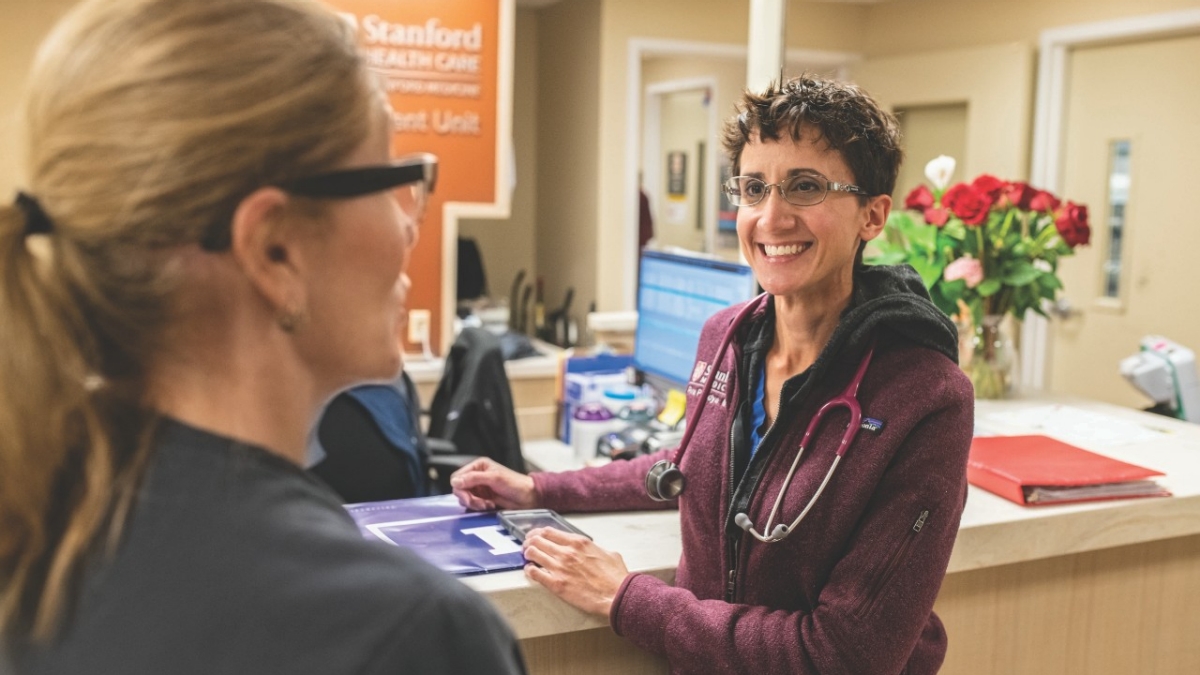
Baldeep Singh, MD, with staff at Samaritan House

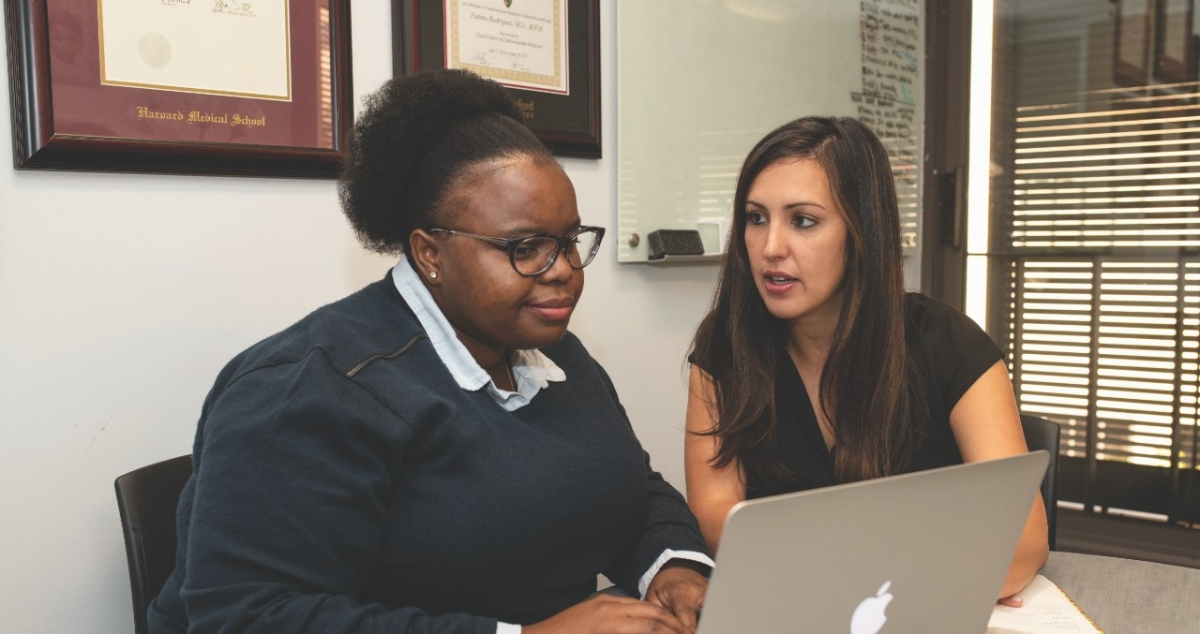
Bongeka Zuma (left), a medical student interested in cardiology, meeting with Fatima Rodriguez, MD, MPH.

Why Aren’t There More Female Cardiologists?

Bongeka Zuma (left), a medical student interested in cardiology, meeting with Fatima Rodriguez, MD, MPH.

Why Aren’t There More Female Cardiologists?

We know that slightly more than half of medical students in the United States are women, as are about half of internal medicine residents. But, as assistant professor of cardiovascular medicine Fatima Rodriguez, MD, MPH, says, “Something happens at the critical transition when people are deciding what specialty fellowship to do.”

Joshua Knowles, MD, PhD, assistant professor of cardiovascular medicine, who directs the general cardiology fellowship program, knows what those numbers look like at Stanford. “Over the last few years, of 450 applications for fellowship we’ve received per year in cardiology, only 20% to 25% have been women,” he says. “The deficit in general cardiology only grows in subspecialties like interventional cardiology and electrophysiology, where only 10% of people doing fellowships are women.”

Celina Yong, MD, MBA, MSc, assistant professor of cardiovascular medicine, became aware abruptly of how few female colleagues she had in interventional cardiology: “I remember going to one of our big national conferences when I was a trainee and sitting in a 1,000-person auditorium, listening to a great lecture that I was passionate about. When I looked around, I realized that I was the only female physician in the room.”

What to Do About Women Not Choosing Cardiology

Work-life balance was the number one concern of internal medicine trainees who responded to a survey, published in the Aug. 2018 issue of JAMA Cardiology, about career preferences and cardiology perceptions. Recognizing the need for a committed and diverse workforce, several professional cardiology societies have undertaken studies and published articles addressing the issue. 

Negative perceptions of cardiology, such as adverse job conditions and interference with family life, often lead women to pursue other subspecialties.

Yong has taken a research approach to increasing the number of women in cardiology. “To better understand the barriers for women and to overcome misperceptions,” she says, “I’ve focused on collecting and analyzing firsthand data on these issues, with hopes that we can use a data-driven approach to enable large-scale institutional change to happen.” Writing in the Journal of the American College of Cardiology, she proposed three recommendations: “changing professional expectations to accommodate young families, providing resources for young mothers in the catheterization lab, and equalizing opportunities for promotion. My hope in putting those ideas forth in publication form, and backing them up with actual data, was to get more wheels turning across the country.”

What Stanford Is Doing

Knowles mentions several efforts to increase the numbers of women in the fellowship program. “We invite as many talented women as we can. We pair them with leaders in the field so that they can see others like them who have made it. And our fellows and faculty established a Women in Cardiology interest group to stimulate interactions outside the office.”

Women in medicine at Stanford do not face the wage inequity often mentioned elsewhere as a drawback to choosing certain specialties. In the Department of Medicine, a thoughtful and logical approach to salaries eliminates inequity. Cathy Garzio, vice chair and director of finance and administration for the department, describes the plan: “In fiscal 2017, we introduced our compensation plan using a methodology where we pay people based on their medical specialty, their rank—assistant or associate or full professor—and their years at that rank. We are super transparent about our methodology and our principles.”

Celina Yong, MD, MBA, MSc, in the catheterization lab at the Palo Alto Veterans Administration Hospital.

We know that slightly more than half of medical students in the United States are women, as are about half of internal medicine residents. But, as assistant professor of cardiovascular medicine Fatima Rodriguez, MD, MPH, says, “Something happens at the critical transition when people are deciding what specialty fellowship to do.”

Joshua Knowles, MD, PhD, assistant professor of cardiovascular medicine, who directs the general cardiology fellowship program, knows what those numbers look like at Stanford. “Over the last few years, of 450 applications for fellowship we’ve received per year in cardiology, only 20% to 25% have been women,” he says. “The deficit in general cardiology only grows in subspecialties like interventional cardiology and electrophysiology, where only 10% of people doing fellowships are women.”

Celina Yong, MD, MBA, MSc, assistant professor of cardiovascular medicine, became aware abruptly of how few female colleagues she had in interventional cardiology: “I remember going to one of our big national conferences when I was a trainee and sitting in a 1,000-person auditorium, listening to a great lecture that I was passionate about. When I looked around, I realized that I was the only female physician in the room.”

What to Do About Women Not Choosing Cardiology

Work-life balance was the number one concern of internal medicine trainees who responded to a survey, published in the Aug. 2018 issue of JAMA Cardiology, about career preferences and cardiology perceptions. Recognizing the need for a committed and diverse workforce, several professional cardiology societies have undertaken studies and published articles addressing the issue. Negative perceptions of cardiology, such as adverse job conditions and interference with family life, often lead women to pursue other subspecialties.

Yong has taken a research approach to increasing the number of women in cardiology. “To better understand the barriers for women and to overcome misperceptions,” she says, “I’ve focused on collecting and analyzing firsthand data on these issues, with hopes that we can use a data-driven approach to enable large-scale institutional change to happen.” Writing in the Journal of the American College of Cardiology, she proposed three recommendations: “changing professional expectations to accommodate young families, providing resources for young mothers in the catheterization lab, and equalizing opportunities for promotion. My hope in putting those ideas forth in publication form, and backing them up with actual data, was to get more wheels turning across the country.”

What Stanford Is Doing

Knowles mentions several efforts to increase the numbers of women in the fellowship program. “We invite as many talented women as we can. We pair them with leaders in the field so that they can see others like them who have made it. And our fellows and faculty established a Women in Cardiology interest group to stimulate interactions outside the office.”

Women in medicine at Stanford do not face the wage inequity often mentioned elsewhere as a drawback to choosing certain specialties. In the Department of Medicine, a thoughtful and logical approach to salaries eliminates inequity. Cathy Garzio, vice chair and director of finance and administration for the department, describes the plan: “In fiscal 2017, we introduced our compensation plan using a methodology where we pay people based on their medical specialty, their rank—assistant or associate or full professor—and their years at that rank. We are super transparent about our methodology and our principles.”

Celina Yong, MD, MBA, MSc, in the catheterization lab at the Palo Alto Veterans Administration Hospital.

What Young Female Faculty Are Doing

Both Rodriguez and Yong feel called to contribute their ideas and efforts to increase the number of women in cardiology. Rodriguez believes one way is through mentorship: “We need to focus upstream—in medical school and residency—to try to attract talented women to cardiology. Many of us make it a point to mentor women interested in careers in cardiology, because one of the reasons they are not choosing cardiology is because they don’t see a lot of role models in this field.”

Yong sees potential in the recently-funded Stanford Advancement of Women in Medicine program. The goal, she says, “is to develop an evidence base for actionable interventions that will improve the representation of women in all specialties and at the highest levels of leadership. By developing a foundation of research to better understand the infrastructure, policy, and cultural barriers to gender equity throughout medicine, we hope to translate those findings into interventions with maximum measurable impact.”

It is clear that two of Stanford’s young female cardiologists will try to reverse the trend of their specialty losing so much talent. With luck, their efforts will encourage women in other specialties to do the same.

What Young Female Faculty Are Doing

Both Rodriguez and Yong feel called to contribute their ideas and efforts to increase the number of women in cardiology. Rodriguez believes one way is through mentorship: “We need to focus upstream—in medical school and residency—to try to attract talented women to cardiology. Many of us make it a point to mentor women interested in careers in cardiology, because one of the reasons they are not choosing cardiology is because they don’t see a lot of role models in this field.”

Yong sees potential in the recently-funded Stanford Advancement of Women in Medicine program. The goal, she says, “is to develop an evidence base for actionable interventions that will improve the representation of women in all specialties and at the highest levels of leadership. By developing a foundation of research to better understand the infrastructure, policy, and cultural barriers to gender equity throughout medicine, we hope to translate those findings into interventions with maximum measurable impact.”

It is clear that two of Stanford’s young female cardiologists will try to reverse the trend of their specialty losing so much talent. With luck, their efforts will encourage women in other specialties to do the same.

All in a Night’s Work

Baldeep Singh, MD, with staff at Samaritan House

Nocturnist Rita Pandya, MD, cares for hospital patients overnight.

All in a Night’s Work

Nocturnist Rita Pandya, MD, cares for hospital patients overnight.

All in a Night’s Work

WHEN DOCTORS LEAVE THE HOSPITAL FOR THE DAY, ANOTHER TEAM OF DOCTORS—NOCTURNISTS—STEP IN.

They begin their shifts under cover of darkness, slipping through the hospital’s doors just as others are getting ready to head home. They do the work of several—often overseeing as many as 30 patients at a time. They’re specialists and generalists wrapped into one, able to shift identities in the blink of an eye. And you never quite know where they’ll turn up: at the bedside, assessing the condition of a heart transplant recipient; in the hallway, advising a resident on treatment plans; seated in the lobby, calming the family of a recently admitted patient.

They aren’t superheroes of the Marvel variety, though they sound like it. They’re nocturnists—shorthand for nocturnal hospitalists—a dedicated, experienced team of physicians who care for hospital inpatients overnight.

The rise of nocturnists is a fairly recent phenomenon, driven in part by the increasing popularity of the hospitalist field, limitations on physician and resident work hours, and a widespread push to improve patient safety. The nocturnist program, which began at Stanford Hospital 11 years ago, has grown exponentially, says Rita Pandya, MD, clinical assistant professor of medicine and the nocturnist group manager, and shows no signs of slowing down. “We currently cover nine services—hematology and oncology; gastroenterology, hepatology, and liver transplant; electrophysiology; pulmonary hypertension; cystic fibrosis; lung transplant; heart transplant; ventricular assistance device; and renal transplant—and we’re continuing to expand.”

“For these services, the nocturnists provide care for about 50% of the patient’s hospital stay,” explains Neera Ahuja, MD, clinical professor and division chief of hospital medicine. “This is not insignificant, and it is a responsibility that our nocturnists take very seriously.”

Each nocturnist shift, which lasts from 7 p.m. to 7 a.m., begins the same way: with sign-out, a critically important information exchange that brings nocturnists up to speed on the health and care plans for patients they will be responsible for, and a chart review. Inpatient work and patient admissions follow.

The rest of the evening is more variable, and it’s this element of surprise that appeals to nocturnists like Vijay Prabhakar, MD, a clinical instructor of medicine who has been on the service since 2018. “During the night, we complete any tasks that the day teams have asked us to follow up on and respond to any nurse pages or changes in patient condition,” Prabhakar explains. “We also interact with many different providers—nurses, residents, fellows, physician assistants, nurse practitioners, and attendings.”

WHEN DOCTORS LEAVE THE HOSPITAL FOR THE DAY, ANOTHER TEAM OF DOCTORS—NOCTURNISTS—STEP IN.

They begin their shifts under cover of darkness, slipping through the hospital’s doors just as others are getting ready to head home. They do the work of several—often overseeing as many as 30 patients at a time. They’re specialists and generalists wrapped into one, able to shift identities in the blink of an eye. And you never quite know where they’ll turn up: at the bedside, assessing the condition of a heart transplant recipient; in the hallway, advising a resident on treatment plans; seated in the lobby, calming the family of a recently admitted patient.

They aren’t superheroes of the Marvel variety, though they sound like it. They’re nocturnists—shorthand for nocturnal hospitalists—a dedicated, experienced team of physicians who care for hospital inpatients overnight.

The rise of nocturnists is a fairly recent phenomenon, driven in part by the increasing popularity of the hospitalist field, limitations on physician and resident work hours, and a widespread push to improve patient safety. The nocturnist program, which began at Stanford Hospital 11 years ago, has grown exponentially, says Rita Pandya, MD, clinical assistant professor of medicine and the nocturnist group manager, and shows no signs of slowing down. “We currently cover nine services—hematology and oncology; gastroenterology, hepatology, and liver transplant; electrophysiology; pulmonary hypertension; cystic fibrosis; lung transplant; heart transplant; ventricular assistance device; and renal transplant—and we’re continuing to expand.”

“For these services, the nocturnists provide care for about 50% of the patient’s hospital stay,” explains Neera Ahuja, MD, clinical professor and division chief of hospital medicine. “This is not insignificant, and it is a responsibility that our nocturnists take very seriously.”

Each nocturnist shift, which lasts from 7 p.m. to 7 a.m., begins the same way: with sign-out, a critically important information exchange that brings nocturnists up to speed on the health and care plans for patients they will be responsible for, and a chart review. Inpatient work and patient admissions follow.

The rest of the evening is more variable, and it’s this element of surprise that appeals to nocturnists like Vijay Prabhakar, MD, a clinical instructor of medicine who has been on the service since 2018. “During the night, we complete any tasks that the day teams have asked us to follow up on and respond to any nurse pages or changes in patient condition,” Prabhakar explains. “We also interact with many different providers—nurses, residents, fellows, physician assistants, nurse practitioners, and attendings.”

Pandya recalls previous shifts that were so fast-paced she “almost felt like an intern again.” She continues, “You’re never quite sure what will come your way. We cover a lot of different specialties so we’re always taking in lots of information. That’s one of the things that makes this work so exciting, though. You’re constantly learning new things.”

Yet there are opportunities for continuity and connection on the night shift, too. “We end up seeing a lot of the same patients, and you get to know them really well,” says Pandya. “We spend time talking to them and get to know more about them each time. Just this past week I was able to take one of my patients’ service dogs out for a walk.”

Prabhakar agrees, describing a memorable night when the nurses of the hematology and oncology unit of the main hospital invited him to a late-night potluck for a departing colleague. “Getting to meet some of the nurses face to face and enjoy the delicious food was definitely something I will not forget.”

Midnight comes and goes, and the nocturnists’ complex shift remains in full swing. “As the sole primary providers in-house for a large number of patients,” Prabhakar says, “you have to be able to astutely assess, diagnose, and treat deteriorating patients and help stabilize them by morning.” During a recent night, Pandya details, there was a resident who needed help with a procedure, an overnight discharge that required paperwork, and a hospice patient who passed away. This work, she explains, “requires an ability to be proactive and a wide knowledge base that helps individuals toggle between various pathologies quickly.”

By 7 a.m., the hospital has awakened in earnest. Sun streams through the lobby windows and physicians and nurses file in, coffee in one hand, phone in the other, to begin their first shift. Meanwhile, the nocturnists complete their charts and sign-offs, wrap up their work, and head home to recharge. But don’t worry—they’ll be back tonight.

Pandya recalls previous shifts that were so fast-paced she “almost felt like an intern again.” She continues, “You’re never quite sure what will come your way. We cover a lot of different specialties so we’re always taking in lots of information. That’s one of the things that makes this work so exciting, though. You’re constantly learning new things.”

Yet there are opportunities for continuity and connection on the night shift, too. “We end up seeing a lot of the same patients, and you get to know them really well,” says Pandya. “We spend time talking to them and get to know more about them each time. Just this past week I was able to take one of my patients’ service dogs out for a walk.”

Prabhakar agrees, describing a memorable night when the nurses of the hematology and oncology unit of the main hospital invited him to a late-night potluck for a departing colleague. “Getting to meet some of the nurses face to face and enjoy the delicious food was definitely something I will not forget.”

Midnight comes and goes, and the nocturnists’ complex shift remains in full swing. “As the sole primary providers in-house for a large number of patients,” Prabhakar says, “you have to be able to astutely assess, diagnose, and treat deteriorating patients and help stabilize them by morning.” During a recent night, Pandya details, there was a resident who needed help with a procedure, an overnight discharge that required paperwork, and a hospice patient who passed away. This work, she explains, “requires an ability to be proactive and a wide knowledge base that helps individuals toggle between various pathologies quickly.”

By 7 a.m., the hospital has awakened in earnest. Sun streams through the lobby windows and physicians and nurses file in, coffee in one hand, phone in the other, to begin their first shift. Meanwhile, the nocturnists complete their charts and sign-offs, wrap up their work, and head home to recharge. But don’t worry—they’ll be back tonight.

Off Hours

Baldeep Singh, MD, with staff at Samaritan House

In their off hours, Stanford staff have a variety of exciting hobbies.

Off Hours

In their off hours, Stanford staff have a variety of exciting hobbies.

Off Hours

EACH TUESDAY AT NOON, HEIDI ELMORE MAKES HER WAY ACROSS CAMPUS TO STANFORD HOSPITAL, WHERE SHE SPENDS THE NEXT HOUR TEACHING PATIENTS AND THEIR CAREGIVERS HOW TO KNIT AND CROCHET. AN EXPERIENCED FIBER ARTIST, ELMORE BELONGS TO A COMMUNITY OF STAFF MEMBERS WHOSE EXTRACURRICULAR EXPLOITS AND PASSIONS INFORM—AND ENHANCE—THEIR IDENTITIES ON AND OFF-CAMPUS.

A Single Thread

Heidi Elmore’s daydreams look a bit different from others’. While some imagine the next vacation they’ll take, Elmore’s mind turns to stitch combinations, elaborate patterns, and color variations for the latest needlepoint project she’s working on—a tapestry of vintage Nintendo characters for her son and his wife.

Elmore’s hands—and mind—are always busy. She’ll meet with a volunteer group to crochet or knit during her lunch break, and will spend evenings poring over YouTube tutorials or attending training classes. “I’m always working on something,” she explains. “I make lace, crochet, knit, weave, and spin yarn.”

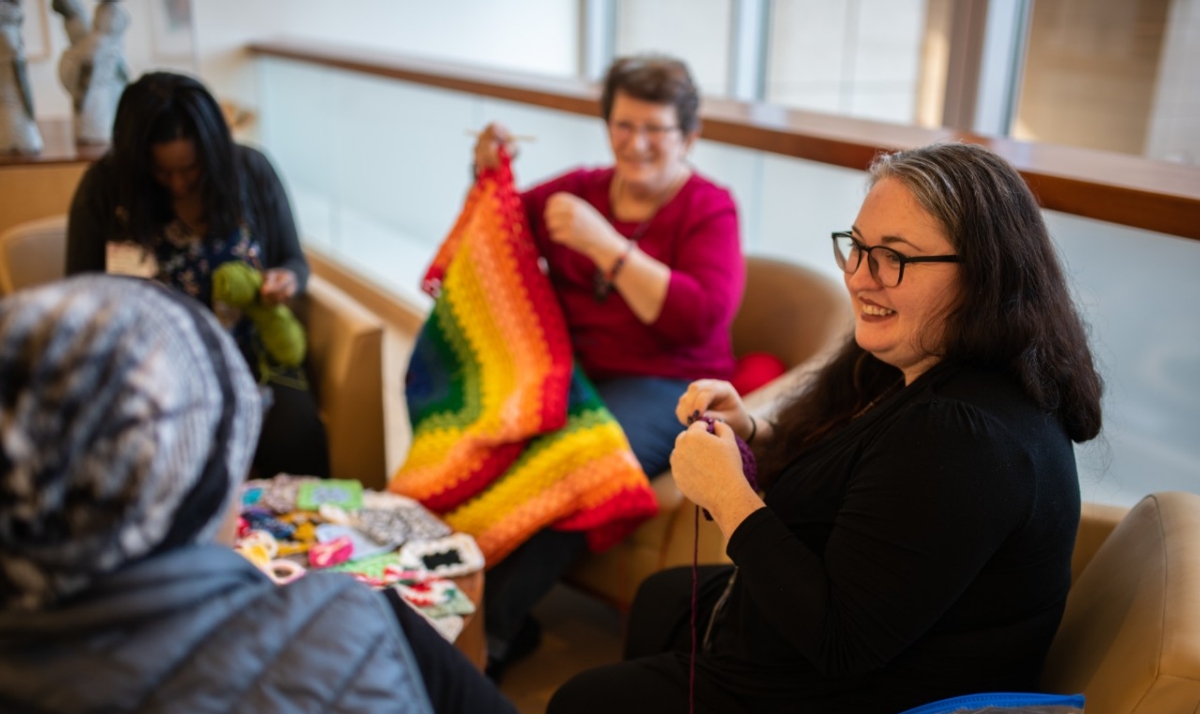
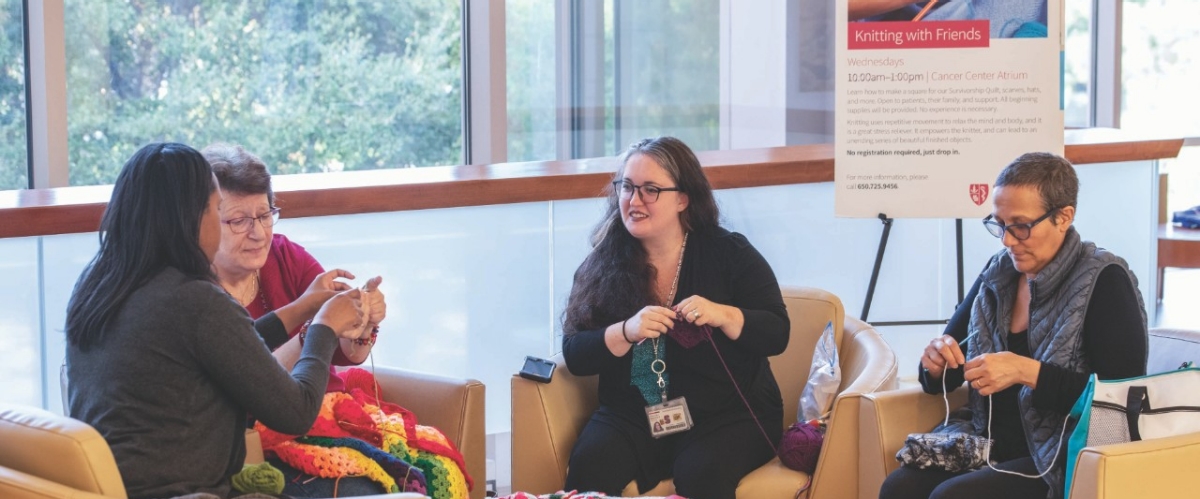
Heidi Elmore (center), demonstrates knitting techniques to patients and caregivers.

Elmore, an administrative associate and cancer center lead worker in oncology, first discovered her talent for fiber arts after her grandmother died. “I found her lace-making materials after she passed. I figured I’d try her hobby, and it stuck.” She still remembers the first project she made with her grandmother’s supplies, a queen-sized bed spread that was “simple, but took a long time.”

Over the years, Elmore has refined her craft and produced countless one-of-a-kind wares. Her portfolio now includes a mask, crocheted Edwardian gloves, and a leather belt she collaborated on with a friend. But one of the most meaningful things Elmore has worked on is Stanford Hospital’s Warm Wishes Survivorship Quilt—an offshoot of the Palliative Care Knitting and Crocheting with Friends program, which meets weekly to teach patients, caregivers, and others how to knit and crochet. The idea behind the quilt, which is still in progress, is to “let patients and staff members stop by to create a square of the quilt and write a warm wish on the small tag,” Elmore explains. “Lauren Briskin, a volunteer, collects the squares and I join every Tuesday to help. We see a steady stream of individuals who want to stop in and learn. We’ve built a great network.”

Elmore often finds that her off-hours hobby informs her work on campus. Whether in her living room moving fabric through her nimble fingers or at her desk managing travel schedules and calendar appointments and processing financial information, she is drawing on the same skill set: patience, attention to detail, and resilience.

“I like taking a single thread, combining it with other things, and making an entirely different product,” she reflects. “That is also a lot like life—whether you’re at work or at home. We take all the little pieces and stitch them together to make something new and wonderful.”

Pitch Perfect

In the California Bach Society rehearsal room, a chord is slowly forming. Thirty voices—a mix of altos, sopranos, tenors, and basses—join together, rising and swelling in response to the conductor’s cues. Everything is unified: They breathe together, pause together, gather volume and fade together.

The result is ethereal and harmonious, a moment “where the total is much more than the sum of its parts,” explains Margaret Wootton, a faculty affairs specialist in the division of oncology who has been singing with the Bach Society, which specializes in Renaissance and baroque music, for over 25 years.

Margaret Wootton (center) sings with the California Bach Society.

Growing up, Wootton, an alto, sang all the time. But her most formative musical experiences were in her family’s church choir, which she joined at age 8. It was then that singing “became a part of my everyday life,” Wootton says. Today, she spends up to six hours a week practicing or performing for her local church and the Bach Society. “The choir community is wonderful, and the mood lift that you get from it is addicting. Plus, I get to sing beautiful music! It’s a privilege for me to do that.”

Wootton lends her voice and her professional skills to the choirs she performs in. She sat on the Bach Society’s board for six years and currently leads its marketing and public relations. “In addition to singing, I’m writing press releases, placing ads, and developing co-marketing campaigns with other local groups.”

These offstage efforts often mirror her work environment in oncology, where she manages the appointments and promotions of roughly 50 faculty members. “I have the opportunity to explore lots of different things. Even if you don’t know how to do it, you have the space to figure it out and determine where the resources are and where to go next.” In a choir and at Stanford, she continues, “It’s a team sport, and each person’s contribution matters.”

Big Cat Advocate

The Santa Cruz Mountains extend from the city of San Francisco to just north of Monterey Bay. The range contains lagoons and marshes, peaks that rise up to 3,806 feet, forests of redwoods, and densely vegetated canyons. It’s an area of unique biodiversity and is particularly well suited to support populations of pumas—more commonly known as mountain lions.

It’s here that Summer Vance, life science research professional for hematology, volunteers with the UC Santa Cruz Puma Project, an 11-year-old endeavor to track and understand the ways that habitat fragmentation influences the physiology and behavior of pumas.

Summer Vance volunteers with the Puma Project.

Animals were always a part of Vance’s childhood. “I had lots of pets growing up and was definitely the little girl who dreamed of being a veterinarian,” she recalls. In high school she discovered a joint love of biology and research. But it took her a while to connect her two passions. A job as a wildlife ranger in Yosemite National Park on the black bear management team opened up a world of possibility. “Discovering the field of wildlife biology was a total enlightenment for me,” she recalls.

Vance spends her weekdays in the Bhatt laboratory, toggling between independent research projects, assisting lab members, and performing general lab housekeeping tasks. On weekends she performs fieldwork for the Puma Project. “Most of the work is setting camera traps, collecting GPS data from remote systems, and performing captures to collar and get samples from pumas,” she explains. “What’s great is that mountain lions are way less prone to habituation than bears in Yosemite. Where in Yosemite we had to monitor bears very closely and mitigate human-bear interactions, pumas keep to themselves, so the team is able to focus on wildlife research rather than wildlife management.”

She’s also found time to foster four house cats that she rescued from a feline infectious peritonitis research lab. “Three years post-adoption, all the cats are doing great,” she reports, although she has encountered some unusual challenges. “With research cats, it’s never guaranteed that they’ll be completely healthy or normal, and it did take them a long time to adjust to non-lab life. For instance, they had never seen hair because all the researchers wore hair nets; they had never met a dog; they didn’t know what sunshine felt like; they had never been outside their colony housing except to be examined by a vet. It has been really exciting and rewarding to see them transform into (relatively) normal cats over the past three years.”

If there is one word that unites Vance’s varied pursuits and interests, it would be perseverance. “Perseverance is huge in any field, and especially sciences. When working with wildlife you may have to wait days or weeks to collect any meaningful data, because the animals don’t function on your schedule. In the lab, even though you can plan your experiments, you can’t control the outcomes, and a huge portion of research is failing, trying to understand what failed, and trying again.”

Giving Back

For the past seven years, Jeanne Simonian has ushered in the beginning of school in the same way: with a shopping spree. But instead of clothing to suit the new season and update her wardrobe, Simonian stockpiles items like pencils, pens, notebooks, anti-bacterial hand soap, coffee gift cards, and technical equipment. That’s because Simonian and her family are a dedicated Adopt-a-Teacher family with the Ravenswood Education Foundation, which was founded 12 years ago to reduce inequity in East Palo Alto schools. “We are making a difference in one teacher’s life and positively impacting the lives of students,” Simonian explains. “And we have been lucky enough to support the same the same second grade teacher, Maria Lucia Perez Murillo, for almost a decade.”

Jeanne Simonian (right) with second grade teacher Maria Lucia Perez Murillo.

Simonian and her family provide holistic assistance throughout the year, touching base with Maria at regular intervals to see what she needs. This help can take many forms: Simonian and her family have purchased fans for overheated rooms, helped organize classroom parties, cleaned and organized supply closets, and even asked their friends for donations to the foundation in lieu of birthday gifts when their children were younger. “We try to make Maria’s life as a teacher a bit less stressful,” says Simonian. “I work behind the scenes to assist in small ways to alleviate the challenges of an educator who is teaching underserved students.”

She employs this same behind the scenes strategy in her role as a fellowship program coordinator in hematology and oncology, where she provides administrative and operational support for residents and clinical fellows. Her job is to ensure a superior fellowship program that adheres to the standards of professional medical organizations, with the goal of sending “competent hematologists and oncologists out into the community and world at large.”

Body of Work

The key to doing well in a bodybuilding competition is not brute strength, but consistent effort. You have to lace your shoes, pack your gym bag before work, and show up to perform your circuit: a rigorous training program that rotates among different body parts (arms on Monday, chest on Tuesday, legs on Wednesday, and so on) every day. You have to say “no” to margaritas, nights out with friends, and your own exhaustion and fear, and “yes” to grueling routines, regular progress checks, and strict diets composed primarily of chicken and broccoli.

Brenda Norrie in the weight room.

This is how Brenda Norrie, fellowship coordinator for infectious diseases, wins awards, and how she mustered the confidence to appear on four bodybuilding stages since she began training in 2013.

Norrie has always been active. She was a casual runner for most of her life, and her parents, both runners, met at a track club. After years of trail running, she started looking for another athletic outlet. She found it in the weight room. “At first,” she explains, “I spent time in the gym when it wasn’t crowded, because it can be intimidating. I took the time and learned how to perform and execute maneuvers and lifts.” Results quickly followed. “I felt really empowered by my improvements and would push myself to see if I could lift even heavier weights each week. In 2014, I began my first bodybuilding competition preparation.”

She took to competition immediately. “I got this huge rush on stage, remembering how much effort I put in and then watching it all come together.” She also felt embraced by—and at home in—the community. “We’re all backstage, together, and we’ve been adhering to such a strict schedule, calculating our protein targets and adjusting our carbs and fat, lifting to create muscle maturity. It felt very emotional.”

Norrie approaches her work at Stanford with the same sense of commitment and discipline. As a fellowship coordinator, she oversees the entire training life cycle for 11 infectious disease fellows, from recruitment to orientation to onboarding and finally, graduation. “Bodybuilding,” she explains, “has instilled work ethic and patience, and has taught me that if I want to achieve something, I just need to feel the fear and do it anyway.”