• Home
  • 2024 Annual Report
  • 2023 Annual Report
  • 2022 Annual Report
  • 2021 Annual Report
  • 2020 Annual Report
  • 2019 Annual Report
  • 2018 Annual Report
  • 2017 Annual Report
  • 2016 Annual Report
DoM Annual Reports

A Push for Biomedical Innovation: Three Chan Zuckerberg Biohub Stories
by emli1120 | Feb 26, 2024 | 2019, caring for our community 2019

Baldeep Singh, MD, with staff at Samaritan House

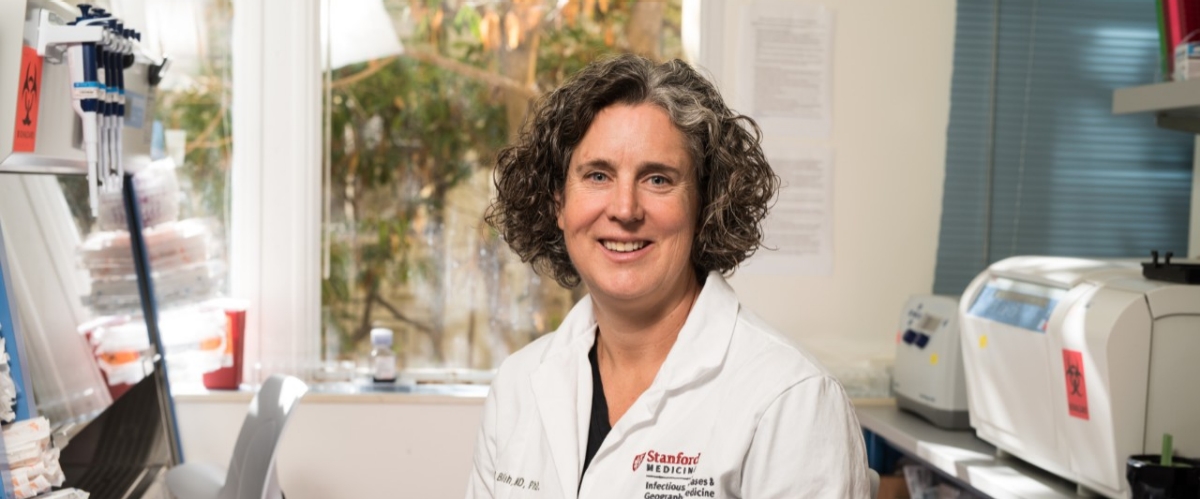
CATHERINE BLISH, MD, PHD

A Push for Biomedical Innovation: Three Chan Zuckerberg Biohub Stories

CATHERINE BLISH, MD, PHD

A Push for Biomedical Innovation: Three Chan Zuckerberg Biohub Stories

The Chan Zuckerberg Biohub Initiative springs from a basic goal: “to make fundamental discoveries and develop new technologies that will enable doctors to cure, prevent, or manage all diseases during our children’s lifetime.” To that end, the Initiative awards money to scientists from three institutions — UC–San Francisco, UC-Berkeley, and Stanford — for leading biomedical research projects. Stanford is always well-represented; Catherine Blish, Euan Ashley, and David Relman are among recent recipients.

Catherine Blish, MD, PhD, is an associate professor of infectious diseases with a research background in immunology. Her project explores how the innate immune system copes with the diversity of viruses it encounters. As she explains, many people study the diversity of the adaptive host-immune response, but there’s also an “underappreciated” diversity within the viruses that infect us.

“So the question is, how does an immune cell recognize a bunch of different viruses?” Blish asks.

“And what features of that recognition are common among viruses? If we know that, we can figure out how to target the responses that will best fight the viruses.”

Blish is looking at the innate immune system (specifically the natural killer cells and the monocytes) and how it recognizes patterns and diverse strains. She aims to figure out how those common recognition patterns can be used to “come up with new, more broadly reactive approaches to vaccination.”

This research, which Blish calls “high risk, high reward,” has an ultimate goal of creating designer vaccines. One major goal is a universal vaccine that protects against all strains of the flu for several years.

The high reward part is clear, but why exactly is this high risk? Blish explains: “We’re studying cells of the innate immune system that one normally doesn’t try to generate vaccines from, so we have a lot of underlying biology to understand before we can actually bring this to the clinic.”

She adds, “But that’s also what makes it more fun; it’s a new approach.”

Her Biohub award is a five-year conceptually oriented grant. Since the award was presented in 2017, Blish has made significant progress. Her team is working on three viruses: HIV, influenza, and dengue; As she puts it, “We’re getting close to understanding the specific receptors on natural killer cells that are required for recognizing HIV-infected cells.” They’ve also “identified a number of mechanisms by which natural killer (or NK) cells recognize influenza-infected cells.” She adds, “Some pathways are similar between the two viruses and some are different. So that’s been exciting.”

She’s optimistic about the results of her work. “We’re learning about fundamental immunologic mechanisms,” she says. “That will help in the future as we think about therapeutics and vaccines.”

Euan Ashley, MBChB, DPhil, professor of cardiovascular medicine and genetics, came to Stanford from the United Kingdom 14 years ago. He’s excited by the possibilities of his Biohub award, which he calls “a really fantastic opportunity” for better understanding the heart. His grant’s ultimate goal is to “understand at a much deeper level how genes and genetic variants interact in heart development, health, and disease.” This understanding, he believes, will “allow us to target disease more precisely.”

Ashley’s grant proposal began as a collaborative effort. He and colleagues like James Priest, MD, assistant professor of pediatric cardiology at Stanford (as well as other investigators at Stanford, UCSF, and UC-Berkeley), tried to figure out “where we could really make an advance that wouldn’t have been possible without this award.” They ended with the goal of better understanding the heart at multiple levels, and in particular how this understanding could be “elevated by the use of new approaches such as artificial intelligence.”

The group, then, will focus on three investigations: The team at UCSF will work together with the Stanford group on deep learning, which is a form of artificial intelligence particularly suitable for interpreting images and videos. It can be trained to recognize areas of the heart from ultrasound and MRI scans and identify abnormalities, some of which might not be visible to the human eye.

EUAN ASHLEY, MBCHB, DPHIL

The Chan Zuckerberg Biohub Initiative springs from a basic goal: “to make fundamental discoveries and develop new technologies that will enable doctors to cure, prevent, or manage all diseases during our children’s lifetime.” To that end, the Initiative awards money to scientists from three institutions — UC–San Francisco, UC-Berkeley, and Stanford — for leading biomedical research projects. Stanford is always well-represented; Catherine Blish, Euan Ashley, and David Relman are among recent recipients.

Catherine Blish, MD, PhD, is an associate professor of infectious diseases with a research background in immunology. Her project explores how the innate immune system copes with the diversity of viruses it encounters. As she explains, many people study the diversity of the adaptive host-immune response, but there’s also an “underappreciated” diversity within the viruses that infect us.

“So the question is, how does an immune cell recognize a bunch of different viruses?” Blish asks. “And what features of that recognition are common among viruses? If we know that, we can figure out how to target the responses that will best fight the viruses.”

Blish is looking at the innate immune system (specifically the natural killer cells and the monocytes) and how it recognizes patterns and diverse strains. She aims to figure out how those common recognition patterns can be used to “come up with new, more broadly reactive approaches to vaccination.”

This research, which Blish calls “high risk, high reward,” has an ultimate goal of creating designer vaccines. One major goal is a universal vaccine that protects against all strains of the flu for several years.

The high reward part is clear, but why exactly is this high risk? Blish explains: “We’re studying cells of the innate immune system that one normally doesn’t try to generate vaccines from, so we have a lot of underlying biology to understand before we can actually bring this to the clinic.” She adds, “But that’s also what makes it more fun; it’s a new approach.”

Her Biohub award is a five-year conceptually oriented grant. Since the award was presented in 2017, Blish has made significant progress. Her team is working on three viruses: HIV, influenza, and dengue; As she puts it, “We’re getting close to understanding the specific receptors on natural killer cells that are required for recognizing HIV-infected cells.” They’ve also “identified a number of mechanisms by which natural killer (or NK) cells recognize influenza-infected cells.” She adds, “Some pathways are similar between the two viruses and some are different. So that’s been exciting.”

She’s optimistic about the results of her work. “We’re learning about fundamental immunologic mechanisms,” she says. “That will help in the future as we think about therapeutics and vaccines.”

EUAN ASHLEY, MBCHB, DPHIL

Euan Ashley, MBChB, DPhil, professor of cardiovascular medicine and genetics, came to Stanford from the United Kingdom 14 years ago. He’s excited by the possibilities of his Biohub award, which he calls “a really fantastic opportunity” for better understanding the heart. His grant’s ultimate goal is to “understand at a much deeper level how genes and genetic variants interact in heart development, health, and disease.” This understanding, he believes, will “allow us to target disease more precisely.”

Ashley’s grant proposal began as a collaborative effort. He and colleagues like James Priest, MD, assistant professor of pediatric cardiology at Stanford (as well as other investigators at Stanford, UCSF, and UC-Berkeley), tried to figure out “where we could really make an advance that wouldn’t have been possible without this award.” They ended with the goal of better understanding the heart at multiple levels, and in particular how this understanding could be “elevated by the use of new approaches such as artificial intelligence.”

The group, then, will focus on three investigations: The team at UCSF will work together with the Stanford group on deep learning, which is a form of artificial intelligence particularly suitable for interpreting images and videos. It can be trained to recognize areas of the heart from ultrasound and MRI scans and identify abnormalities, some of which might not be visible to the human eye.

The UC Berkeley team will be studying genetic variants. Ashley explains that in the past researchers usually had to confine themselves to studying a single variant at a time, but that “doesn’t get close to understanding the complexity of a biological system” in which potentially thousands of variants interact. The UC Berkeley team will attempt to “model combinations of genetic variants” and get closer to understanding the complexity of the genetic control of the heart.

Finally, Ashley’s team at Stanford will be looking at the smaller picture: single cells. Their aim is to “look at and characterize individual single cells: measure their size, their shape, their distensibility, and then connect that to the genetic changes that we noted in the first and second parts of the grant.”

Ashley plans to take full advantage of the Biohub community and its resources, including sequencing resources and a community of investigators regularly presenting their work to one another. As he puts it, “I love collaboration and I love the interdisciplinary nature of the Biohub.”
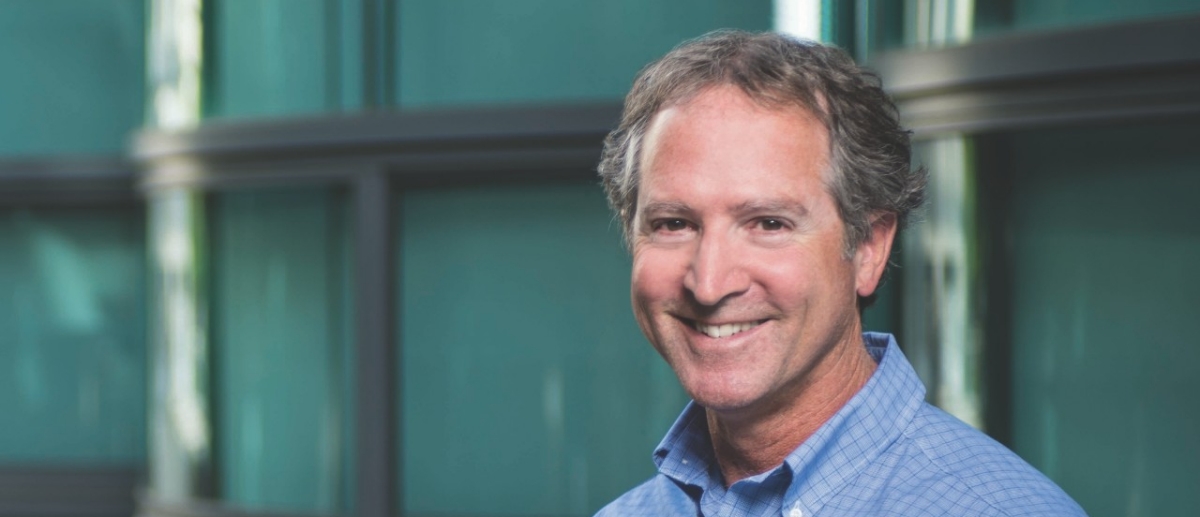
DAVID RELMAN, MD

David Relman, MD, Thomas C. and Joan M. Merigan Professor of Medicine and professor of microbiology and immunology, has been working for two decades on the microbiome. He adds, “What I love about my work is the discovery of unrecognized diversity and function in the microbial world (where the vast majority of biological diversity has arisen) and unraveling the interwoven relationships between microbes and humans.”

When Relman applied to the Chan Zuckerberg Biohub Initiative, leaders created a Microbiome Initiative with several faculty at Stanford, UCSF, and UC-Berkeley, in addition to Relman. The point of the initiative — and Relman’s work — is to bring investigators together to better understand the “key properties of native microbial communities in the human body” and how they “confer and support health.” Relman and his collaborators hope this will allow doctors and scientists to someday create synthetic communities in the lab that can be used therapeutically.

To that end, over at least three years, Relman and his collaborators — Michael Fischbach (bioengineering), KC Huang (bioengineering), and Justin Sonnenburg (microbiology and immunology) at Stanford, as well as colleagues at UC-Berkeley and UCSF — plan to use robotics, anaerobic microbial cultivation technology, mass spectrometry, and ecological theory to explore the microbial communities of humans.

An important feature of these microbial communities is how community members interact with each other and with their host. These interactions will be “a major focus” of the teams’ research. Relman in particular will, as he explains, “lend expertise in studying stability and resilience, explore the use of new technology to study the human small intestine, and apply some of our findings from and to human subjects and patients.”

Relman appreciates the Biohub’s “emphasis on group efforts, shared skills, and transdisciplinary thinking,” adding, “This approach in some ways mirrors the workings of the microbial communities that we study: cooperation, shared resources and products, and diversity. We’re hoping that we can produce benefits for our community (of humans) that match even a small portion of the benefits that our microbial communities provide to us!”
The UC Berkeley team will be studying genetic variants. Ashley explains that in the past researchers usually had to confine themselves to studying a single variant at a time, but that “doesn’t get close to understanding the complexity of a biological system” in which potentially thousands of variants interact. The UC Berkeley team will attempt to “model combinations of genetic variants” and get closer to understanding the complexity of the genetic control of the heart.

Finally, Ashley’s team at Stanford will be looking at the smaller picture: single cells. Their aim is to “look at and characterize individual single cells: measure their size, their shape, their distensibility, and then connect that to the genetic changes that we noted in the first and second parts of the grant.”

Ashley plans to take full advantage of the Biohub community and its resources, including sequencing resources and a community of investigators regularly presenting their work to one another. As he puts it, “I love collaboration and I love the interdisciplinary nature of the Biohub.”


DAVID RELMAN, MD

David Relman, MD, Thomas C. and Joan M. Merigan Professor of Medicine and professor of microbiology and immunology, has been working for two decades on the microbiome. He adds, “What I love about my work is the discovery of unrecognized diversity and function in the microbial world (where the vast majority of biological diversity has arisen) and unraveling the interwoven relationships between microbes and humans.”

When Relman applied to the Chan Zuckerberg Biohub Initiative, leaders created a Microbiome Initiative with several faculty at Stanford, UCSF, and UC-Berkeley, in addition to Relman. The point of the initiative — and Relman’s work — is to bring investigators together to better understand the “key properties of native microbial communities in the human body” and how they “confer and support health.” Relman and his collaborators hope this will allow doctors and scientists to someday create synthetic communities in the lab that can be used therapeutically.

To that end, over at least three years, Relman and his collaborators — Michael Fischbach (bioengineering), KC Huang (bioengineering), and Justin Sonnenburg (microbiology and immunology) at Stanford, as well as colleagues at UC-Berkeley and UCSF — plan to use robotics, anaerobic microbial cultivation technology, mass spectrometry, and ecological theory to explore the microbial communities of humans.

An important feature of these microbial communities is how community members interact with each other and with their host. These interactions will be “a major focus” of the teams’ research. Relman in particular will, as he explains, “lend expertise in studying stability and resilience, explore the use of new technology to study the human small intestine, and apply some of our findings from and to human subjects and patients.”

Relman appreciates the Biohub’s “emphasis on group efforts, shared skills, and transdisciplinary thinking,” adding, “This approach in some ways mirrors the workings of the microbial communities that we study: cooperation, shared resources and products, and diversity. We’re hoping that we can produce benefits for our community (of humans) that match even a small portion of the benefits that our microbial communities provide to us!”
 

GI’s Move to Redwood City: Creating Multiple Opportunities

by emli1120 | Feb 26, 2024 | 2019, caring for our community 2019

Baldeep Singh, MD, with staff at Samaritan House

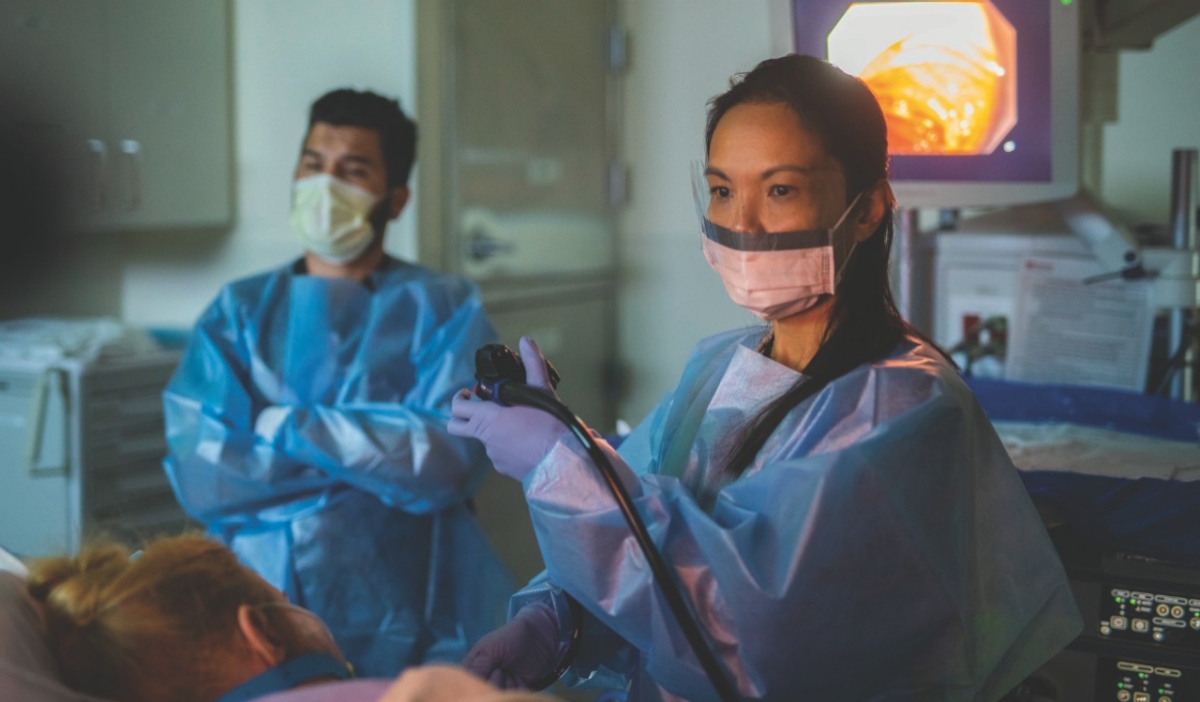
LINDA NGUYEN, MD (right), performs a procedure.

GI’s Move to Redwood City: Creating Multiple Opportunities

LINDA NGUYEN, MD (right), performs a procedure.

GI’s Move to Redwood City: Creating Multiple Opportunities

Not long ago, new patients at the gastroenterology and hepatology (GI) division would sometimes wait for months for a non-urgent appointment. They were well cared for once they got in, but the clinic space in Palo Alto was small, the huge enterprise was overwhelming and intimidating, and parking was nightmarish. Then someone suggested the possibility of moving five miles away to Redwood City, where an existing building could be redesigned to meet their needs. The division’s leadership decided to do it.

Preparations for the move were exhaustively detailed. Consultants were brought in and, says W. Ray Kim, MD, chief of the division, “They literally counted the steps that patients take, that staff take, that physicians take. Then they came in with Lego-like building blocks, and they had us arrange them.

Then they mocked it up with cardboard boxes and we went through a day in the clinic with that mockup, then fixed things the best we could.They analyzed our workflow and talked with us about optimizing it. And then they built a physical space that would support the clinic space we wanted.”

The building’s redesign incorporated all the changes faculty sought to accommodate patients on the long appointment waiting list. It also gave them the opportunity to build to meet their future needs.

“As we were planning for the move,” says Uri Ladabaum, MD, senior vice chief of the division and medical director of the Digestive Health Center, “we stepped back to see how we wanted to practice in the future.

The changes we wanted revolved around having patients taken care of by teams of people — physicians, nurses, patient care coordinators, medical assistants — who are now grouped into team cells. Every patient has one individual key contact person or navigator on their team cell. The physical space, the hardware, was designed around our new practice model, the software.”

Clinical spaces — including imaging and pharmacy on the first floor, the clinic on the second floor, and endoscopy on the third floor — occupy Pavilion D while administrative and clinical research areas are across a 30-foot-long bridge in Pavilion C. “The co-location of the clinic activity with clinical research and administrative space is really a huge thing for us,” says Ladabaum. Kim agrees: “It’s fantastic.”

The Clinic
Patients access the examination rooms in the clinic through one door, and members of the team cell through another. Behind the second door is a large area where all members of team cells work together. Ladabaum describes the clinic as “a very efficient space, very pleasant, calming. People have a good feeling being here, first and foremost the patients and their families, who are always the focus of the design, but then also the staff and faculty who work here.”

The clinic space lends itself to housing several multidisciplinary clinics, which especially pleases Linda Nguyen, MD, head of the clinic. “We have a pelvic health program where colorectal surgery, GI, urology, and urogynecology all see patients in the same area. We also have a multidisciplinary esophageal program, where both a gastroenterologist who specializes in esophageal disorders and a foregut surgeon can take care of patients with GI motility disorders like gastroparesis.”

“Because we’re working together, we’re easily able to talk to each other about mutual patients, and we meet to discuss those patients both informally and formally and come up with a comprehensive plan. In this way, patients with complex problems, irrespective of which one of us they see, have a group of physicians who are on top of their case,” Nguyen adds.

One administrative change that directly benefits patients is moving procedure scheduling under the supervision of the clinic. Now when patients are seen in the clinic and are found to need procedures, those procedures are scheduled before they leave the clinic.

RAY KIM, MD (left), works with a team cell member.

Not long ago, new patients at the gastroenterology and hepatology (GI) division would sometimes wait for months for a non-urgent appointment. They were well cared for once they got in, but the clinic space in Palo Alto was small, the huge enterprise was overwhelming and intimidating, and parking was nightmarish. Then someone suggested the possibility of moving five miles away to Redwood City, where an existing building could be redesigned to meet their needs. The division’s leadership decided to do it.

Preparations for the move were exhaustively detailed. Consultants were brought in and, says W. Ray Kim, MD, chief of the division, “They literally counted the steps that patients take, that staff take, that physicians take. Then they came in with Lego-like building blocks, and they had us arrange them. Then they mocked it up with cardboard boxes and we went through a day in the clinic with that mockup, then fixed things the best we could. They analyzed our workflow and talked with us about optimizing it. And then they built a physical space that would support the clinic space we wanted.”

The building’s redesign incorporated all the changes faculty sought to accommodate patients on the long appointment waiting list. It also gave them the opportunity to build to meet their future needs.

“As we were planning for the move,” says Uri Ladabaum, MD, senior vice chief of the division and medical director of the Digestive Health Center, “we stepped back to see how we wanted to practice in the future. The changes we wanted revolved around having patients taken care of by teams of people — physicians, nurses, patient care coordinators, medical assistants — who are now grouped into team cells. Every patient has one individual key contact person or navigator on their team cell. The physical space, the hardware, was designed around our new practice model, the software.”

Clinical spaces — including imaging and pharmacy on the first floor, the clinic on the second floor, and endoscopy on the third floor — occupy Pavilion D while administrative and clinical research areas are across a 30-foot-long bridge in Pavilion C. “The co-location of the clinic activity with clinical research and administrative space is really a huge thing for us,” says Ladabaum. Kim agrees: “It’s fantastic.”

RAY KIM, MD (left), works with a team cell member.

The Clinic
Patients access the examination rooms in the clinic through one door, and members of the team cell through another. Behind the second door is a large area where all members of team cells work together. Ladabaum describes the clinic as “a very efficient space, very pleasant, calming. People have a good feeling being here, first and foremost the patients and their families, who are always the focus of the design, but then also the staff and faculty who work here.”

The clinic space lends itself to housing several multidisciplinary clinics, which especially pleases Linda Nguyen, MD, head of the clinic. “We have a pelvic health program where colorectal surgery, GI, urology, and urogynecology all see patients in the same area. We also have a multidisciplinary esophageal program, where both a gastroenterologist who specializes in esophageal disorders and a foregut surgeon can take care of patients with GI motility disorders like gastroparesis.”

“Because we’re working together, we’re easily able to talk to each other about mutual patients, and we meet to discuss those patients both informally and formally and come up with a comprehensive plan. In this way, patients with complex problems, irrespective of which one of us they see, have a group of physicians who are on top of their case,” Nguyen adds.

One administrative change that directly benefits patients is moving procedure scheduling under the supervision of the clinic. Now when patients are seen in the clinic and are found to need procedures, those procedures are scheduled before they leave the clinic.

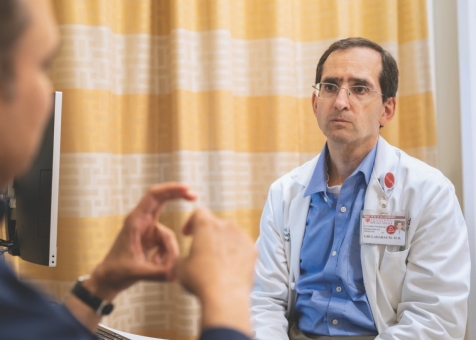
URI LAUDABAUM, MD, listens to a patient.

The Endoscopy Suite
One floor up from the GI clinic is the endoscopy suite. Its design also reflects thoughtful attention to detail: All medical equipment is suspended from the ceiling or walls, freeing the floor for ready reconfiguration of rooms for different procedures. There are nine rooms for endoscopy procedures, and each has a pre-procedure area immediately outside. Rather than wait in a common waiting room, patients occupy the pre-procedure area outside their endoscopy suite and then are taken just a few feet for their procedure. Afterward they are taken to a central recovery room.

Back in Palo Alto, a second endoscopy suite is maintained at Stanford Hospital. Ladabaum explains the reasoning behind this decision: “That suite is focused on more advanced, complicated cases: inpatients who are sicker, and certain types of procedures that need fluoroscopy or complicated equipment. By focusing on just those types of patients, that unit is developing efficiencies in more challenging scenarios.”

Two other clinics remain in Palo Alto, explains Kim: “a liver transplant clinic where we need surgeons, nurse coordinators, and others located at the hospital helping us; and a collaborative clinic at the cancer center.”

Accomplishing Their Mission
Academic medical centers pride themselves on attention to their tripartite mission: to care for patients, to conduct research, and to train the next generation of care providers. Ladabaum believes the new facility that gastroenterology and hepatology occupies in Redwood City helps the division accomplish those goals. He says, “The idea is to fulfill our mission as an academic division. First, we want to provide outstanding patient care in a very friendly environment, and now we have what’s necessary to do that. Second, we need to integrate clinical research, and the personnel to do that are right here with us. Third, we need to train fellows, residents and medical students, and the space really is conducive to that, too.”

URI LAUDABAUM, MD, listens to a patient.

The Endoscopy Suite
One floor up from the GI clinic is the endoscopy suite. Its design also reflects thoughtful attention to detail: All medical equipment is suspended from the ceiling or walls, freeing the floor for ready reconfiguration of rooms for different procedures. There are nine rooms for endoscopy procedures, and each has a pre-procedure area immediately outside. Rather than wait in a common waiting room, patients occupy the pre-procedure area outside their endoscopy suite and then are taken just a few feet for their procedure. Afterward they are taken to a central recovery room.

Back in Palo Alto, a second endoscopy suite is maintained at Stanford Hospital. Ladabaum explains the reasoning behind this decision: “That suite is focused on more advanced, complicated cases: inpatients who are sicker, and certain types of procedures that need fluoroscopy or complicated equipment. By focusing on just those types of patients, that unit is developing efficiencies in more challenging scenarios.”

Two other clinics remain in Palo Alto, explains Kim: “a liver transplant clinic where we need surgeons, nurse coordinators, and others located at the hospital helping us; and a collaborative clinic at the cancer center.”

Accomplishing Their Mission
Academic medical centers pride themselves on attention to their tripartite mission: to care for patients, to conduct research, and to train the next generation of care providers. Ladabaum believes the new facility that gastroenterology and hepatology occupies in Redwood City helps the division accomplish those goals. He says, “The idea is to fulfill our mission as an academic division. First, we want to provide outstanding patient care in a very friendly environment, and now we have what’s necessary to do that. Second, we need to integrate clinical research, and the personnel to do that are right here with us. Third, we need to train fellows, residents and medical students, and the space really is conducive to that, too.”

A Database of a Million Veterans

by emli1120 | Feb 26, 2024 | 2019, caring for our community 2019

Baldeep Singh, MD, with staff at Samaritan House

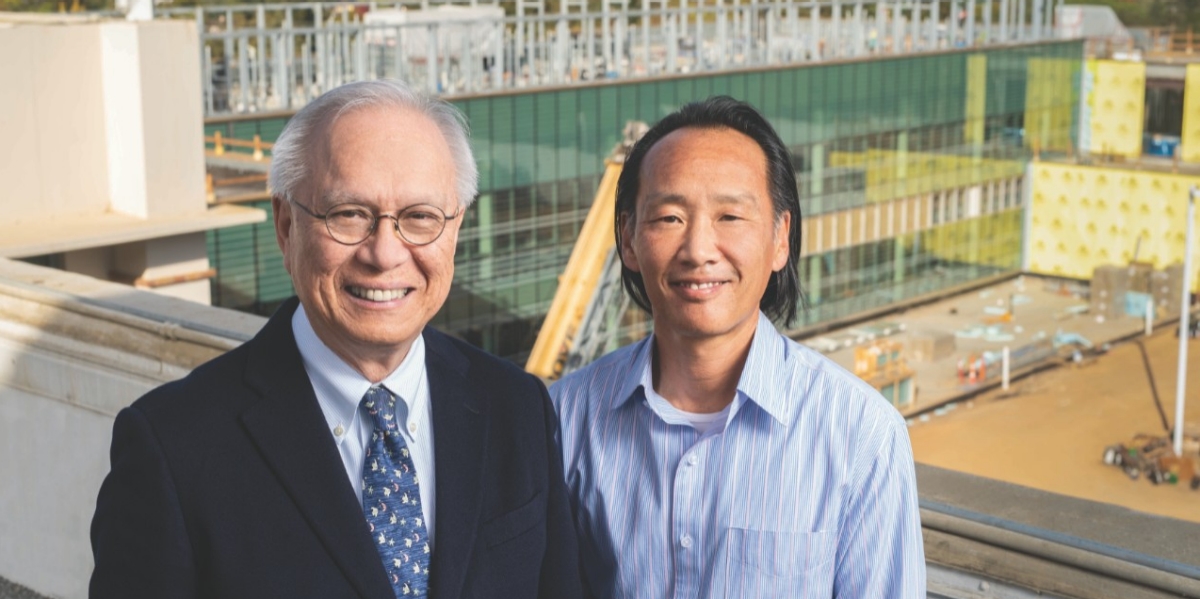
LAWRENCE LEUNG, MD (left), and PHILIP TSAO, PHD

A Database of a Million Veterans

LAWRENCE LEUNG, MD (left), and PHILIP TSAO, PHD

A Database of a Million Veterans

The goal is simple but ambitious: collect samples and medical data from a million American veterans to create an enormous database of medical information. For Philip Tsao, PhD, research professor of cardiovascular medicine, and Lawrence Leung, MD, Maureen Lyles D’Ambrogio Professor of Medicine and senior associate dean for Veteran Affairs, the Million Veterans Program, or MVP, is a way to enhance both veterans’ health and the medical field in general.

Tsao and Leung have been collaborators for years, and when Leung started work as chief of staff at the Palo Alto VA, he invited Tsao to join him. Leung believed that the VA — a nationally integrated hospital system with records that went back decades, and in fact the first adopter of what is now the EHR or electronic health record—was an ideal place for genomics research.

So seven years ago Tsao moved his lab to the VA, and they began their work.

Both doctors thought the Palo Alto VA in particular was an excellent site for genomics research, with roughly 1,000,000 outpatient encounters per year and a close relationship with Stanford, where they’d be able to, as Tsao says, “leverage the local talent” in various departments, including medicine, genetics, and statistics. Tsao explains that the VA would provide “an opportunity to really quickly collect a large cohort.”

The Beginnings of MVP
Leung and Tsao’s interest in genomics research led them to Washington, DC, where they hoped to pitch their project plans to national VA leaders. Ironically, that was when they found out about the MVP program, an effort much like theirs that was already in motion. That was 2011, and now over 50 VA sites across the country are recruiting individuals for MVP. The program has passed 700,000 participants, “well on the way to a million,” Tsao says. Now they’re thinking of surpassing a million.

MVP participants donate at least four sources of data: a blood sample, access to their electronic health record, a baseline lifestyle survey with demographic information, and a more extensive lifestyle survey with detailed dietary information as well as other medical statistics. All participants can opt out of any part of the voluntary program, but many do everything, including the longer lifestyle survey.

They’re also asked to consent to be re-contacted once their data has been processed. For Tsao this is a crucial part of the project both for the veterans and the larger medical world: Their data can be revisited, their health resampled to “see how their biological signals are changing over time.” And if researchers discover a correlation between, for example, genomic material and a particular disease, they can go back to individuals and study them in more detail, in what Tsao describes as “types of fine mapping studies” that will be crucial as the program goes forward.

The goal is simple but ambitious: collect samples and medical data from a million American veterans to create an enormous database of medical information. For Philip Tsao, PhD, research professor of cardiovascular medicine, and Lawrence Leung, MD, Maureen Lyles D’Ambrogio Professor of Medicine and senior associate dean for Veteran Affairs, the Million Veterans Program, or MVP, is a way to enhance both veterans’ health and the medical field in general.

Tsao and Leung have been collaborators for years, and when Leung started work as chief of staff at the Palo Alto VA, he invited Tsao to join him. Leung believed that the VA — a nationally integrated hospital system with records that went back decades, and in fact the first adopter of what is now the EHR or electronic health record—was an ideal place for genomics research.

So seven years ago Tsao moved his lab to the VA, and they began their work. Both doctors thought the Palo Alto VA in particular was an excellent site for genomics research, with roughly 1,000,000 outpatient encounters per year and a close relationship with Stanford, where they’d be able to, as Tsao says, “leverage the local talent” in various departments, including medicine, genetics, and statistics. Tsao explains that the VA would provide “an opportunity to really quickly collect a large cohort.”

The Beginnings of MVP
Leung and Tsao’s interest in genomics research led them to Washington, DC, where they hoped to pitch their project plans to national VA leaders. Ironically, that was when they found out about the MVP program, an effort much like theirs that was already in motion. That was 2011, and now over 50 VA sites across the country are recruiting individuals for MVP. The program has passed 700,000 participants, “well on the way to a million,” Tsao says. Now they’re thinking of surpassing a million.

MVP participants donate at least four sources of data: a blood sample, access to their electronic health record, a baseline lifestyle survey with demographic information, and a more extensive lifestyle survey with detailed dietary information as well as other medical statistics. All participants can opt out of any part of the voluntary program, but many do everything, including the longer lifestyle survey.

They’re also asked to consent to be re-contacted once their data has been processed. For Tsao this is a crucial part of the project both for the veterans and the larger medical world: Their data can be revisited, their health resampled to “see how their biological signals are changing over time.” And if researchers discover a correlation between, for example, genomic material and a particular disease, they can go back to individuals and study them in more detail, in what Tsao describes as “types of fine mapping studies” that will be crucial as the program goes forward.

Veterans proved to be ideal genomic study subjects for another reason: their patriotism. “They’re very much interested in continuing to serve their country,” Tsao says, adding that he’s heard dozens of participants say that participating in MVP is “one way they can contribute, not only to their brothers in arms but also to their country. The research effort may not help them individually but it will help not only their brothers but also generations to come. Veterans are very interested in research that will pay forward.”

Translating Data into Results
So far, so good. But the next step is both daunting and slightly ambiguous: What will they do with all the information they’ve collected? Seven years in, the data is being organized, and qualified researchers are beginning to access it. As Tsao states, “Some of our first papers are just coming out, and we’re very excited about not only what has been done up to this point, but the potential of the study itself.” For example, the team at Stanford/Palo Alto VA has recently published a study in Nature Genetics that greatly expands the number of genetic factors that contribute to lipid levels. (High levels of these blood fats are a major risk factor for heart disease.)

The possibilities raised by this type of data are exciting. “We know that certain risk factors such as blood pressure and your cholesterol level are important for heart attacks, and we now can go back decades and get people’s cholesterol levels over time. We can look at their maximum cholesterol level, we can look at the trajectory, and we can look at what the interaction with different drugs may have been.”

The Palo Alto VA has also launched its own center: the VA Palo Alto Epidemiology Research and Information Center, or ERIC, to facilitate the analysis of MVP-gathered data. The center will take advantage of the proximity to Stanford and involve contributions from many Stanford-based programs in harvesting MVP’s data for research. Collaborators include Tim Assimes, MD, PhD, associate professor of cardiology and epidemiology; Michael Snyder, PhD, professor and chair of genetics at the Stanford University School of Medicine; Wing Wong, PhD, Stephen R. Pierce Family Goldman Sachs Professor in Science and Human Health and professor of biomedical data science; and Hua Tang, PhD, professor of genetics and statistics.

“There’s a diverse and deep amount of talent at Stanford,” Tsao says. This type of collaboration leads to novel methods to approach biology. Tsao, Leung, Snyder, and colleagues recently published a paper describing a new technique that harnesses the power of machine learning applied to genetic data and health records.

Tsao and Leung are currently co-directors of the Palo Alto MVP program, as well as co-directors of ERIC with Assimes. Tsao is one of the three principal investigators for the nationwide MVP program, and he’s the principal investigator of one of the first approved studies to examine the MVP data: a study on cardiometabolic disease with Assimes and Jennifer Lee, MD, PhD, associate professor of endocrinology and epidemiology. Lee and Assimes are also involved in a study to incorporate some of the work of Nigam Shah, MBBS, PhD, associate professor of biomedical informatics, into the VA electronic health record to improve the phenotyping of individuals, which they will then apply to their genomics work. 

The Future of MVP
The far-reaching goals of MVP can overwhelm, Tsao says. “One of the fears would be that we make a lot of discoveries and then we inundate both patient and provider to a point where it becomes more harm than good,” he explains. “Beyond the science there’s a whole host of work that needs to be done to integrate this into health care.”

But he’s optimistic about its overarching hopes. “The ultimate goal would be to discover diagnostics, prognostics, and theranostics that could be eventually brought into the clinic. And of course understanding the basic underpinnings of disease and how we can apply those to identify individuals who are at risk, and then help in the management of both disease and health.”

Both Leung and Tsao clearly believe in the enormous potential of this study. “MVP is the crown jewel of VA research,” Leung says. “Palo Alto VA, in close partnership with the Stanford School of Medicine, will continue to play a leading role in the translation of this program in defining precision medicine.”

Veterans proved to be ideal genomic study subjects for another reason: their patriotism. “They’re very much interested in continuing to serve their country,” Tsao says, adding that he’s heard dozens of participants say that participating in MVP is “one way they can contribute, not only to their brothers in arms but also to their country. The research effort may not help them individually but it will help not only their brothers but also generations to come. Veterans are very interested in research that will pay forward.”

Translating Data into Results
So far, so good. But the next step is both daunting and slightly ambiguous: What will they do with all the information they’ve collected? Seven years in, the data is being organized, and qualified researchers are beginning to access it. As Tsao states, “Some of our first papers are just coming out, and we’re very excited about not only what has been done up to this point, but the potential of the study itself.” For example, the team at Stanford/Palo Alto VA has recently published a study in Nature Genetics that greatly expands the number of genetic factors that contribute to lipid levels. (High levels of these blood fats are a major risk factor for heart disease.)

The possibilities raised by this type of data are exciting. “We know that certain risk factors such as blood pressure and your cholesterol level are important for heart attacks, and we now can go back decades and get people’s cholesterol levels over time. We can look at their maximum cholesterol level, we can look at the trajectory, and we can look at what the interaction with different drugs may have been.”

The Palo Alto VA has also launched its own center: the VA Palo Alto Epidemiology Research and Information Center, or ERIC, to facilitate the analysis of MVP-gathered data. The center will take advantage of the proximity to Stanford and involve contributions from many Stanford-based programs in harvesting MVP’s data for research. Collaborators include Tim Assimes, MD, PhD, associate professor of cardiology and epidemiology; Michael Snyder, PhD, professor and chair of genetics at the Stanford University School of Medicine; Wing Wong, PhD, Stephen R. Pierce Family Goldman Sachs Professor in Science and Human Health and professor of biomedical data science; and Hua Tang, PhD, professor of genetics and statistics.

“There’s a diverse and deep amount of talent at Stanford,” Tsao says. This type of collaboration leads to novel methods to approach biology. Tsao, Leung, Snyder, and colleagues recently published a paper describing a new technique that harnesses the power of machine learning applied to genetic data and health records.

Tsao and Leung are currently co-directors of the Palo Alto MVP program, as well as co-directors of ERIC with Assimes. Tsao is one of the three principal investigators for the nationwide MVP program, and he’s the principal investigator of one of the first approved studies to examine the MVP data: a study on cardiometabolic disease with Assimes and Jennifer Lee, MD, PhD, associate professor of endocrinology and epidemiology. Lee and Assimes are also involved in a study to incorporate some of the work of Nigam Shah, MBBS, PhD, associate professor of biomedical informatics, into the VA electronic health record to improve the phenotyping of individuals, which they will then apply to their genomics work.

The Future of MVP
The far-reaching goals of MVP can overwhelm, Tsao says. “One of the fears would be that we make a lot of discoveries and then we inundate both patient and provider to a point where it becomes more harm than good,” he explains. “Beyond the science there’s a whole host of work that needs to be done to integrate this into health care.”

But he’s optimistic about its overarching hopes. “The ultimate goal would be to discover diagnostics, prognostics, and theranostics that could be eventually brought into the clinic. And of course understanding the basic underpinnings of disease and how we can apply those to identify individuals who are at risk, and then help in the management of both disease and health.”

Both Leung and Tsao clearly believe in the enormous potential of this study. “MVP is the crown jewel of VA research,” Leung says. “Palo Alto VA, in close partnership with the Stanford School of Medicine, will continue to play a leading role in the translation of this program in defining precision medicine.”

Can AI Really Improve Care?

by emli1120 | Feb 26, 2024 | 2019, caring for our community 2019

Baldeep Singh, MD, with staff at Samaritan House

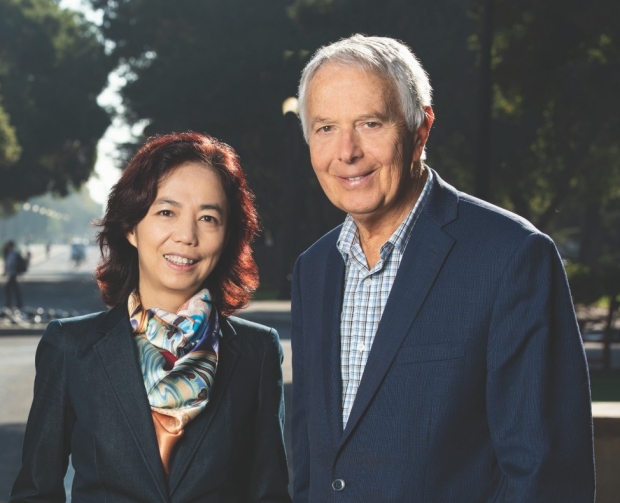
ARNOLD MILSTEIN, MD (right), collaborates with FEI-FEI LI, PHD, director of the Artificial Intelligence Lab

Can AI Really Improve Care?

ARNOLD MILSTEIN, MD (right), collaborates with FEI-FEI LI, PHD, director of the Artificial Intelligence Lab

Can AI Really Improve Care?

Arnold Milstein, MD, came to Stanford eight years ago with a simple assignment: Find out how to lower the national cost of producing great health care. Put another way, if we could find more affordable ways to deliver better care for conditions that consume the bulk of the country’s health care spending, more monies would be available for other ways to improve human well-being — like education and social services.

Milstein was ideally suited to the task. He spent two decades working to improve health care value in the private sector, after which he served as an advisor to Congress and the White House. In 2011 he created Stanford’s Clinical Excellence Research Center (CERC). It is the first university-based research center exclusively dedicated to discovering, testing, and disseminating cost-saving innovations in clinically excellent care.

One of CERC’s areas of emphasis is discovering how artificial intelligence (AI) can prevent inadvertent and costly failures in intended care delivery. This focus began with a call from Professor Fei-Fei Li, PhD, director of the Artificial Intelligence Lab in the Stanford School of Engineering.

“Our subsequent conversations sparked a decision to create a unique cross-school Partnership in AI-assisted Healthcare, which we call PAC. We imagined a world in which AI improves the performance of a broad range of human services that affect health,” Milstein says.

“We initially focused solely on health care in order to learn and make a difference before we expand our use of AI to improve performance across a broad range of health-affecting services,” adds Milstein, who turns to a favorite initial target: lowering the incidence of hospital-acquired conditions or HACs.

“Every time a patient in a U.S. hospital acquires an infection that they didn’t come in with, human misery and tens of thousands of dollars to the cost of a hospitalization follow,” he explains.

“No clinician wants to impose hospital-acquired infections on their patients. But clinicians are busy. They’re human. They’re imperfect. So they don’t always notice when they’ve just skipped a critical intended action step.”

That led to thinking about how artificial intelligence could be used to help detect and correct — in real time — deviations in essential clinical actions, like maintaining hand hygiene, which is a primary way to prevent hospital-acquired infections.

In 2015 CERC researchers, alongside graduate students and faculty in the AI Lab, began developing a system that detects whether someone used the alcohol hand dispenser that sits on the wall next to every hospital room entrance.

Arnold Milstein, MD, came to Stanford eight years ago with a simple assignment: Find out how to lower the national cost of producing great health care. Put another way, if we could find more affordable ways to deliver better care for conditions that consume the bulk of the country’s health care spending, more monies would be available for other ways to improve human well-being — like education and social services.

Milstein was ideally suited to the task. He spent two decades working to improve health care value in the private sector, after which he served as an advisor to Congress and the White House. In 2011 he created Stanford’s Clinical Excellence Research Center (CERC). It is the first university-based research center exclusively dedicated to discovering, testing, and disseminating cost-saving innovations in clinically excellent care.

One of CERC’s areas of emphasis is discovering how artificial intelligence (AI) can prevent inadvertent and costly failures in intended care delivery. This focus began with a call from Professor Fei-Fei Li, PhD, director of the Artificial Intelligence Lab in the Stanford School of Engineering.

“Our subsequent conversations sparked a decision to create a unique cross-school Partnership in AI-assisted Healthcare, which we call PAC. We imagined a world in which AI improves the performance of a broad range of human services that affect health,” Milstein says.

“We initially focused solely on health care in order to learn and make a difference before we expand our use of AI to improve performance across a broad range of health-affecting services,” adds Milstein, who turns to a favorite initial target: lowering the incidence of hospital-acquired conditions or HACs.

“Every time a patient in a U.S. hospital acquires an infection that they didn’t come in with, human misery and tens of thousands of dollars to the cost of a hospitalization follow,” he explains.

“No clinician wants to impose hospital-acquired infections on their patients. But clinicians are busy. They’re human. They’re imperfect. So they don’t always notice when they’ve just skipped a critical intended action step.”

That led to thinking about how artificial intelligence could be used to help detect and correct — in real time — deviations in essential clinical actions, like maintaining hand hygiene, which is a primary way to prevent hospital-acquired infections.

In 2015 CERC researchers, alongside graduate students and faculty in the AI Lab, began developing a system that detects whether someone used the alcohol hand dispenser that sits on the wall next to every hospital room entrance. Their system relies on computer vision, a rapidly progressing domain of artificial intelligence used in the automotive and other industries.

“If computer vision can detect when drivers initiate dangerous lane changes and safely control vehicular steering, can it similarly analyze motion to detect unintended deviations in important clinician behaviors or patient activities?” asked Milstein and Li’s research team in a New England Journal of Medicine article.

AI systems that take advantage of computer vision are relatively inexpensive. By using them, the team has shown it can achieve greater than 95 percent accuracy in detecting inadvertent omissions in the use of the hand sanitizer before staff enter patient rooms.

The vision of making excellent care more effective and efficient also targets behaviors that affect lifelong health trajectories. In collaboration with Stanford researchers in child development and pediatrics, the team is testing how computer vision can let mothers know if their eyes inadvertently drift to their smartphone screen instead of responsively returning their infant’s gaze.

The hope, Milstein says, is to unite technology and human care. “By mobilizing emerging science and technology from engineering, behavioral sciences, and medicine, Stanford can address a seemingly intractable national challenge to make affordable all forms of human caring that powerfully affect health.”

Their system relies on computer vision, a rapidly progressing domain of artificial intelligence used in the automotive and other industries.

“If computer vision can detect when drivers initiate dangerous lane changes and safely control vehicular steering, can it similarly analyze motion to detect unintended deviations in important clinician behaviors or patient activities?” asked Milstein and Li’s research team in a New England Journal of Medicine article.

AI systems that take advantage of computer vision are relatively inexpensive. By using them, the team has shown it can achieve greater than 95 percent accuracy in detecting inadvertent omissions in the use of the hand sanitizer before staff enter patient rooms.

The vision of making excellent care more effective and efficient also targets behaviors that affect lifelong health trajectories. In collaboration with Stanford researchers in child development and pediatrics, the team is testing how computer vision can let mothers know if their eyes inadvertently drift to their smartphone screen instead of responsively returning their infant’s gaze.

The hope, Milstein says, is to unite technology and human care. “By mobilizing emerging science and technology from engineering, behavioral sciences, and medicine, Stanford can address a seemingly intractable national challenge to make affordable all forms of human caring that powerfully affect health.”

Humans and AI, Not Humans versus AI

by emli1120 | Feb 26, 2024 | 2019, caring for our community 2019

Baldeep Singh, MD, with staff at Samaritan House

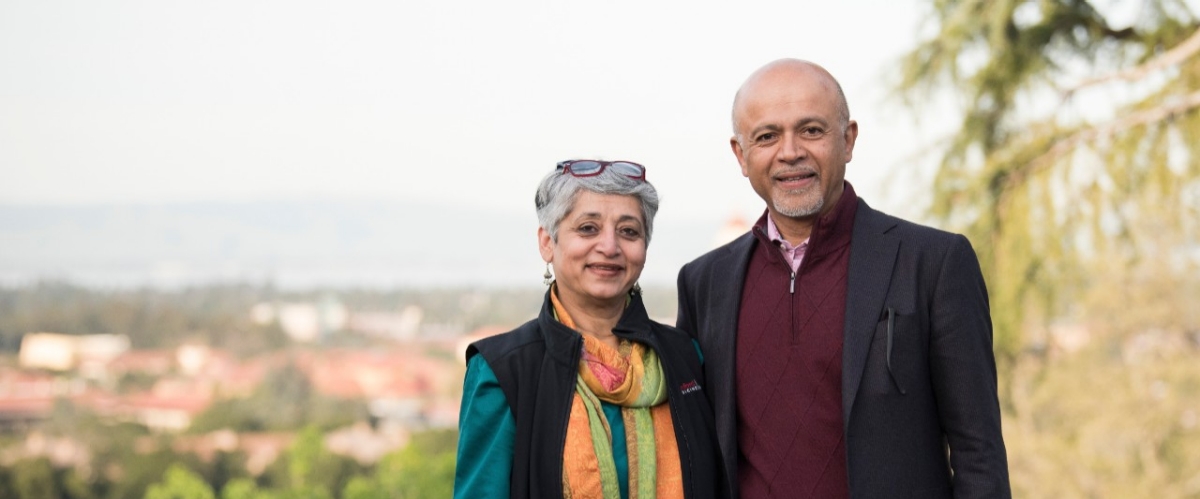
SONOO THADANEY, MBA (left) and ABRAHAM VERGHESE, MD

Humans and AI, Not Humans versus AI

SONOO THADANEY, MBA (left) and ABRAHAM VERGHESE, MD

Humans and AI, Not Humans versus AI

“I hold out hope that artificial intelligence and machine-learning algorithms will transform our experience, particularly if natural-language processing and video technology allow us to capture what is actually said and done in the exam room,” writes Abraham Verghese, MD, professor of medicine and founding faculty director of the Stanford Presence Center.

“The physician focuses on the patient and family, and if there is a screen in the room, it is to summarize or to share images with the patient; by the end of the visit, the progress notes and billing are done.

But AI applications will help us only if we vet all of them for their unintended consequences. Technology that is not subject to such scrutiny doesn’t deserve our trust, nor should we ever allow it to be deeply integrated into our work,” Verghese continues in a May 2018 article that appeared in The New York Times Magazine.

That sentiment is behind a key focus for Presence, a center that emphasizes the value of the human connection in the high-wire balancing act between high tech and high touch.

Presence aims to ensure that patients, clinicians, funders, legislators, and other stakeholders are at the table as equitable and inclusive AI solutions are created and deployed in health care.

To that end, Presence presented two symposia during 2018. In April, Jonathan Chen, MD, assistant professor of biomedical informatics, was a leader of the first symposium, “Human Intelligence and Artificial Intelligence in Medicine,” which addressed augmented intelligence of humans and machines for diagnostics.

“I hold out hope that artificial intelligence and machine-learning algorithms will transform our experience, particularly if natural-language processing and video technology allow us to capture what is actually said and done in the exam room,” writes Abraham Verghese, MD, professor of medicine and founding faculty director of the Stanford Presence Center.

“The physician focuses on the patient and family, and if there is a screen in the room, it is to summarize or to share images with the patient; by the end of the visit, the progress notes and billing are done. But AI applications will help us only if we vet all of them for their unintended consequences. Technology that is not subject to such scrutiny doesn’t deserve our trust, nor should we ever allow it to be deeply integrated into our work,” Verghese continues in a May 2018 article that appeared in The New York Times Magazine.

That sentiment is behind a key focus for Presence, a center that emphasizes the value of the human connection in the high-wire balancing act between high tech and high touch.

Presence aims to ensure that patients, clinicians, funders, legislators, and other stakeholders are at the table as equitable and inclusive AI solutions are created and deployed in health care.

To that end, Presence presented two symposia during 2018. In April, Jonathan Chen, MD, assistant professor of biomedical informatics, was a leader of the first symposium, “Human Intelligence and Artificial Intelligence in Medicine,” which addressed augmented intelligence of humans and machines for diagnostics. The 350 physicians, business leaders, policymakers, social and behavioral scientists, venture capitalists, and political activists in attendance were challenged to determine how to ensure that humans are augmented by AI in defining and delivering compassionate services.

On that subject Verghese says, “Pitting humans against machines is not the point. Rather, how best to relevantly engage both for the sum to be greater than the parts should be the focus.”

“Machines do many things very well, but they really can’t do the caring work, so how do we augment the two preemptively, proactively, and equitably for the outcome that we all seek?” he asks.

Pitting humans against machines is not the point. Rather, how best to relevantly engage both for the sum to be greater than the parts should be the focus

“Artificial Intelligence in Medicine: Inclusion and Equity” was the second symposium in August, which drew 275 attendees from around the world. Presence executive director Sonoo Thadaney, MBA, co-chair of the National Academy of Medicine’s Working Group on AI in Healthcare, was one of the symposium leaders. Acknowledging the potential unintended consequences of AI in medicine, she examined how to prevent and manage the possible exacerbation of inequity and exclusion in health care.

Thadaney speaks of a huge inequity that looms depending on an individual’s circumstances, saying: “We cannot have a world where technology creates greater inequity such that those of us with privilege have access to second opinions and concierge physicians, and the rest of the planet ends up with medicine that is meted out with the efficiency and emptiness of fast food. We cannot afford a health care apartheid.”

The Gordon and Betty Moore Foundation and the Robert Wood Johnson Foundation support Presence by funding the symposia as well as another innovative program that began at the end of 2018: the AI in Medicine Inclusion & Equity (AiMIE) 2018 Seed Grants Program. The AiMIE program provides initial funding for projects seeking equitable and inclusive frameworks for AI in medicine.

The 350 physicians, business leaders, policymakers, social and behavioral scientists, venture capitalists, and political activists in attendance were challenged to determine how to ensure that humans are augmented by AI in defining and delivering compassionate services.

On that subject Verghese says, “Pitting humans against machines is not the point. Rather, how best to relevantly engage both for the sum to be greater than the parts should be the focus.”

“Machines do many things very well, but they really can’t do the caring work, so how do we augment the two preemptively, proactively, and equitably for the outcome that we all seek?” he asks.

Pitting humans against machines is not the point. Rather, how best to relevantly engage both for the sum to be greater than the parts should be the focus

“Artificial Intelligence in Medicine: Inclusion and Equity” was the second symposium in August, which drew 275 attendees from around the world. Presence executive director Sonoo Thadaney, MBA, co-chair of the National Academy of Medicine’s Working Group on AI in Healthcare, was one of the symposium leaders. Acknowledging the potential unintended consequences of AI in medicine, she examined how to prevent and manage the possible exacerbation of inequity and exclusion in health care.

Thadaney speaks of a huge inequity that looms depending on an individual’s circumstances, saying: “We cannot have a world where technology creates greater inequity such that those of us with privilege have access to second opinions and concierge physicians, and the rest of the planet ends up with medicine that is meted out with the efficiency and emptiness of fast food. We cannot afford a health care apartheid.”

The Gordon and Betty Moore Foundation and the Robert Wood Johnson Foundation support Presence by funding the symposia as well as another innovative program that began at the end of 2018: the AI in Medicine Inclusion & Equity (AiMIE) 2018 Seed Grants Program. The AiMIE program provides initial funding for projects seeking equitable and inclusive frameworks for AI in medicine.

« Older Entries
Next Entries »

Recent Posts

  • SCCR: The Engine of Innovation
  • The Smoking Cessation Program for Veterans That Doesn’t Quit
  • The Stanford Advantage
  • Limited Sobriety Pathway Saves the Lives of Those With Little Hope
  • Shots on Goal

Recent Comments

No comments to show.

Department of Medicine

About Us Research
Faculty Patient Care
Residency News
Education Events


Stanford School of Medicine

About Basic Science Departments
Contact Clinical Science Departments
Maps & Directions Academic Programs
Careers Vision
Find People
Visit Stanford
Search Clinical Trials
Give a Gift
©2024 Stanford Medicine

    Privacy Policy • Terms of Use • Accessibility

    • Follow
    • Follow