Residents Create a New Curriculum for Future Hospitalists

Baldeep Singh, MD, with staff at Samaritan House

Poonam Hosamani, MD, Andre Kumar, MD, Andrea Smeraglio, MD, and Neera Ahuja, MD 

Residents Create a New Curriculum for Future Hospitalists
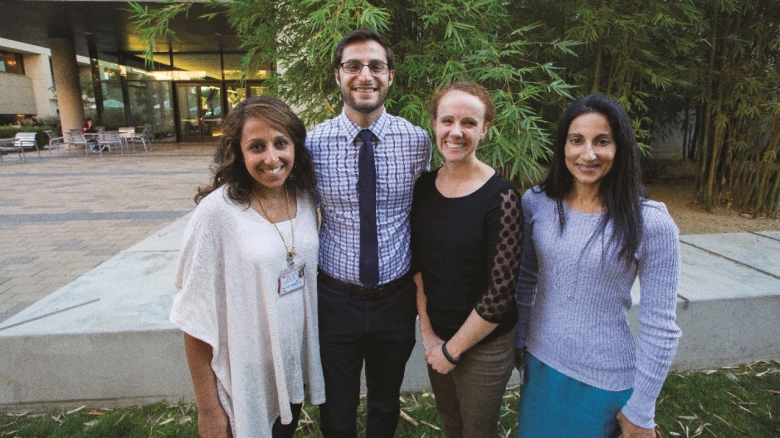
Poonam Hosamani, MD, Andre Kumar, MD, Andrea Smeraglio, MD, and Neera Ahuja, MD 

Residents Create a New Curriculum for Future Hospitalists

Hospital medicine, whose practitioners are known as hospitalists, is a popular career choice for Stanford residents in internal medicine and also has been the fastest growing specialty across the country over the past eight years. Given the attention that such statistics can command, is it at all surprising that leaders of the residency program took it seriously when two of their residents suggested that a new curriculum be devised for those pursuing a career in hospital medicine?

Why is hospital medicine so popular?
According to Neera Ahuja, MD (clinical associate professor, General Medical Disciplines), there are several reasons; “In part I think it’s because residents receive a good deal of exposure to hospital medicine during their training:

through working with hospitalists in the clinical setting; with hospitalists being a part of many of the educational initiatives in the residency program (the Stanford 25, the pathways of distinction [PODs], the popular quality improvement elective led by Lisa Shieh, MD, PhD [clinical professor, General Medical Disciplines]); and as core faculty/mentors. So they know what they’re getting into. And secondly, there’s no additional training requirement.” When residents graduate from their residency program, they are qualified to be hospitalists. As both the Director of the Stanford Hospitalist Program and associate residency program director, Ahuja is in a position to know.

Two second-year residents, Andrea Smeraglio, MD, and Andre Kumar, MD, came up with a proposal: what if we had a curriculum that residents could opt-in to, so that those who were interested in becoming hospitalists could take certain electives during residency to better prepare themselves?

Seeking data to back up their idea and to determine the amount of interest it engendered, the residents surveyed their peers, and the results of the survey helped to build the curriculum. Here are some pivotal results:

Hospital medicine, whose practitioners are known as hospitalists, is a popular career choice for Stanford residents in internal medicine and also has been the fastest growing specialty across the country over the past eight years. Given the attention that such statistics can command, is it at all surprising that leaders of the residency program took it seriously when two of their residents suggested that a new curriculum be devised for those pursuing a career in hospital medicine?

Why is hospital medicine so popular?
According to Neera Ahuja, MD (clinical associate professor, General Medical Disciplines), there are several reasons; “In part I think it’s because residents receive a good deal of exposure to hospital medicine during their training: through working with hospitalists in the clinical setting; with hospitalists being a part of many of the educational initiatives in the residency program (the Stanford 25, the pathways of distinction [PODs], the popular quality improvement elective led by Lisa Shieh, MD, PhD [clinical professor, General Medical Disciplines]); and as core faculty/mentors. So they know what they’re getting into. And secondly, there’s no additional training requirement.” When residents graduate from their residency program, they are qualified to be hospitalists. As both the Director of the Stanford Hospitalist Program and associate residency program director, Ahuja is in a position to know.

Two second-year residents, Andrea Smeraglio, MD, and Andre Kumar, MD, came up with a proposal: what if we had a curriculum that residents could opt-in to, so that those who were interested in becoming hospitalists could take certain electives during residency to better prepare themselves?

Seeking data to back up their idea and to determine the amount of interest it engendered, the residents surveyed their peers, and the results of the survey helped to build the curriculum. Here are some pivotal results:

Interest was clearly keen among many residents, but balance was critical. Making mandatory changes to the internal medicine residency program to benefit future hospitalists would not benefit everyone. Out of this concern for balance came SHAPE, Stanford Hospitalist Advanced Practice & Education, a certificate-awarding program aimed at those resident colleagues of Kumar and Smeraglio who anticipate becoming career hospitalists.

“This curriculum is not the easy way out,” says Ahuja. In addition to the usual rotations required of all residents, “there’s an extra ICU month, some perioperative medicine which residents don’t get a lot of exposure to, some neurology, and some consultative electives.”

SHAPE is a three-year program, and there are expected to be five residents participating per year. After starting July 1, 2015, there are currently between eight and 12 SHAPE participants, including some interns who want to start preparing themselves now.

SHAPE has three foci. The first is clinical excellence, which will be achieved in part through the new curriculum. The second is academic advancement, which will include some targeted lectures, including a medical teaching workshop led by Kelley Skeff, MD, PhD (professor, General Medical Disciplines), and a course on the use of bedside ultrasound as suggested in the survey. The third is mentorship, also a key finding from the survey, in which hospitalist faculty will provide guidance in areas such as research, quality improvement activities, CV building and, ultimately, job applications.

The SHAPE curriculum includes a research requirement: a project and a presentation at an academic meeting. The project is designed to begin in the first year. Ahuja explains: “We will first hear what each resident is interested in; for those who are unsure about a topic, the mentors will make some suggestions and give them some options and let them choose one that suits their interests. Their mentors will help them start the project, maybe in quality improvement or medical education, maybe something a little more clinical. My hope is that in three years they’ll do more than one project.”

The key to SHAPE in Ahuja’s mind is that it was resident-initiated. “This is a generation that is comfortable being vocal and empowering change,” she says. “The housestaff have a voice and we are very open to changes that can help the residency program.”

No one anticipates that SHAPE was born fully formed. As some elements fail to gain traction, they will be replaced with others of interest to the participants. It will evolve, says Ahuja, “according to the residents’ voice. I really commend Ann and Andre for being creative and proactive about it.”

“This is really an exciting time for hospitalists,” explains Smeraglio. “The career, the training, and the opportunities are exponentially expanding. We want Stanford to be on the cutting edge of that growth, and with SHAPE I believe we will be.”

Kumar adds: “We are hoping to train the best, and we have set the bar high.”
Interest was clearly keen among many residents, but balance was critical. Making mandatory changes to the internal medicine residency program to benefit future hospitalists would not benefit everyone. Out of this concern for balance came SHAPE, Stanford Hospitalist Advanced Practice & Education, a certificate-awarding program aimed at those resident colleagues of Kumar and Smeraglio who anticipate becoming career hospitalists.

“This curriculum is not the easy way out,” says Ahuja. In addition to the usual rotations required of all residents, “there’s an extra ICU month, some perioperative medicine which residents don’t get a lot of exposure to, some neurology, and some consultative electives.”

SHAPE is a three-year program, and there are expected to be five residents participating per year. After starting July 1, 2015, there are currently between eight and 12 SHAPE participants, including some interns who want to start preparing themselves now.

SHAPE has three foci. The first is clinical excellence, which will be achieved in part through the new curriculum. The second is academic advancement, which will include some targeted lectures, including a medical teaching workshop led by Kelley Skeff, MD, PhD (professor, General Medical Disciplines), and a course on the use of bedside ultrasound as suggested in the survey. The third is mentorship, also a key finding from the survey, in which hospitalist faculty will provide guidance in areas such as research, quality improvement activities, CV building and, ultimately, job applications.

The SHAPE curriculum includes a research requirement: a project and a presentation at an academic meeting. The project is designed to begin in the first year. Ahuja explains: “We will first hear what each resident is interested in; for those who are unsure about a topic, the mentors will make some suggestions and give them some options and let them choose one that suits their interests. Their mentors will help them start the project, maybe in quality improvement or medical education, maybe something a little more clinical. My hope is that in three years they’ll do more than one project.”

The key to SHAPE in Ahuja’s mind is that it was resident-initiated. “This is a generation that is comfortable being vocal and empowering change,” she says. “The housestaff have a voice and we are very open to changes that can help the residency program.”

No one anticipates that SHAPE was born fully formed. As some elements fail to gain traction, they will be replaced with others of interest to the participants. It will evolve, says Ahuja, “according to the residents’ voice. I really commend Ann and Andre for being creative and proactive about it.”

“This is really an exciting time for hospitalists,” explains Smeraglio. “The career, the training, and the opportunities are exponentially expanding. We want Stanford to be on the cutting edge of that growth, and with SHAPE I believe we will be.”

Kumar adds: “We are hoping to train the best, and we have set the bar high.”

Inaugural Stanford Medicine 25 Skills Symposium

Baldeep Singh, MD, with staff at Samaritan House

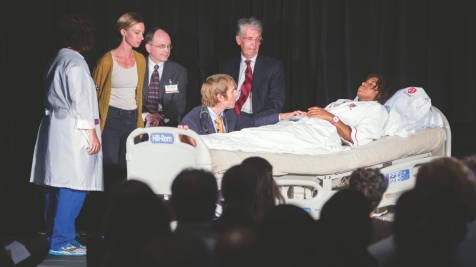
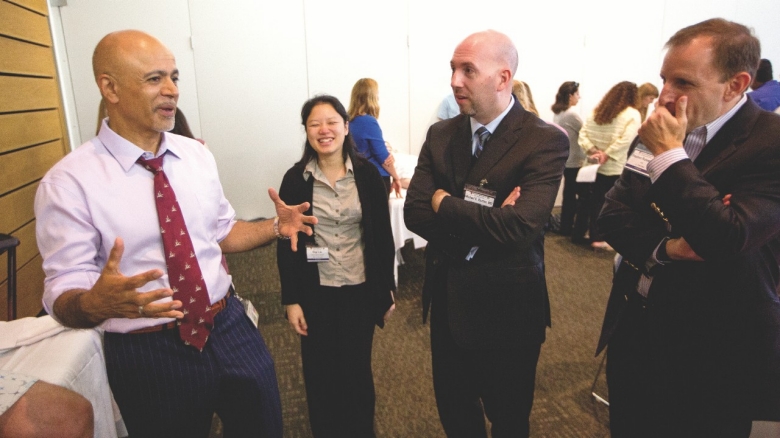
Abraham Verghese, MD, with symposium attendees

Inaugural Stanford Medicine 25 Skills Symposium

Abraham Verghese, MD, with symposium attendees

Inaugural Stanford Medicine 25 Skills Symposium

On his first day as an attending physician at Stanford, Abraham Verghese, MD, noticed something unusual. “I was struck by the fact that the house staff were spending a great deal of time wedded to their computers,” he recalled. “And it was not their doing. They didn’t sign on to do that.”

His experience reflects an increasingly common trend in modern medicine: With the introduction of new medical technologies, physicians today find themselves spending more time at the monitor and less time at the bedside.

Verghese recounted his story to a packed room of physicians and clinical educators who had traveled to Stanford from places as far flung as Brazil and Australia to attend the inaugural Stanford Medicine 25 Symposium.

The two-day event provided attendees with the tools to foster and encourage a robust bedside medicine culture at their home institutions.

The time is right, said Verghese. Today, many physicians and educators are advocating for a more hands-on approach to medicine. At the same time, an increasing number of bedside medicine programs are popping up at universities and hospitals worldwide. “I’m hoping that this is the moment when we all come together, and we stay together and connected in this effort to take what we all believe are fundamental and important skills—important to the welfare of the patient, important to practice cost-effective medicine, important in choosing wisely—and we form a community with solidarity around that theme.”

Throughout the symposium, participants learned the basics of evidence-based physical diagnosis from Steve McGee, MD, author of a textbook of the same name and a professor of medicine at the University of Washington. They learned how to schedule and program consistent teaching rounds and how to incorporate technology without losing connection with the patient. 

They also heard from Andrew Elder, MD, a professor of medicine at Edinburgh University and Junaid Zaman, MD, a postdoctoral researcher at Imperial College London and Stanford, about the MRCP PACES examination—a high stakes clinical exam that all medical school graduates in the UK must pass to continue their postgraduate education, an exam run and administered by Elder.

During an afternoon panel, experts from Johns Hopkins, Stanford, the Seattle VA, and the University of Alabama, Birmingham discussed ways to create a bedside medicine culture. Ideas included inviting master clinicians to teach at the bedside and hosting regular workshops. But, the panelists agreed, the support of community is critical. “It’s really hard to build a bedside medicine experience,” noted Brian Garibaldi, MD, of Johns Hopkins. “Community is key.”

On his first day as an attending physician at Stanford, Abraham Verghese, MD, noticed something unusual. “I was struck by the fact that the house staff were spending a great deal of time wedded to their computers,” he recalled. “And it was not their doing. They didn’t sign on to do that.”

His experience reflects an increasingly common trend in modern medicine: With the introduction of new medical technologies, physicians today find themselves spending more time at the monitor and less time at the bedside.

Verghese recounted his story to a packed room of physicians and clinical educators who had traveled to Stanford from places as far flung as Brazil and Australia to attend the inaugural Stanford Medicine 25 Symposium.

The two-day event provided attendees with the tools to foster and encourage a robust bedside medicine culture at their home institutions.

I’m hoping that this is the moment when we all come together…in this effort

The time is right, said Verghese. Today, many physicians and educators are advocating for a more hands-on approach to medicine. At the same time, an increasing number of bedside medicine programs are popping up at universities and hospitals worldwide. “I’m hoping that this is the moment when we all come together, and we stay together and connected in this effort to take what we all believe are fundamental and important skills—important to the welfare of the patient, important to practice cost-effective medicine, important in choosing wisely—and we form a community with solidarity around that theme.”

Throughout the symposium, participants learned the basics of evidence-based physical diagnosis from Steve McGee, MD, author of a textbook of the same name and a professor of medicine at the University of Washington. They learned how to schedule and program consistent teaching rounds and how to incorporate technology without losing connection with the patient. They also heard from Andrew Elder, MD, a professor of medicine at Edinburgh University and Junaid Zaman, MD, a postdoctoral researcher at Imperial College London and Stanford, about the MRCP PACES examination—a high stakes clinical exam that all medical school graduates in the UK must pass to continue their postgraduate education, an exam run and administered by Elder.

During an afternoon panel, experts from Johns Hopkins, Stanford, the Seattle VA, and the University of Alabama, Birmingham discussed ways to create a bedside medicine culture. Ideas included inviting master clinicians to teach at the bedside and hosting regular workshops. But, the panelists agreed, the support of community is critical. “It’s really hard to build a bedside medicine experience,” noted Brian Garibaldi, MD, of Johns Hopkins. “Community is key.”

In a series of breakout sessions, participants had the opportunity to practice exam techniques and to work together to develop their own 5 Minute Bedside Moment—a teaching vignette that includes both a narrative and a physical maneuver.

After an hour of brainstorming, they took to the stage with their stethoscopes and reflex hammers in hand. Presentations varied widely, from the gait assessment of elderly patients to pediatric oral examinations. One group chose to tackle opiate toxicity in hospice patients and also demonstrated ways to compassionately support grief-stricken family members. The audience gave each presentation their rapt attention, nodding their heads in agreement and recognition, laughing when a seasoned physician played the role of an unsure medical student, knitting their brows in concern, and furiously taking notes.

For many attendees, the symposium was a unique chance to interact and collaborate with like-minded professionals. “This meeting was a great model of what all of us should be doing,” said Ruth Berggrenn, MD, the director of the Center for Medical Humanities & Ethics at the University of Texas, San Antonio. “We should go back to our institutions, engage others, and train more facilitators. And we should have a sense of pride and belonging in this movement.”

This feeling of connection and community lingered long after symposium co-director John Kugler, MD, offered his closing remarks. During the final reception, participants exchanged cards, contact information, and ideas about future collaborations. “You should give rounds at our institution,” one physician suggested to a new acquaintance. “I bet our residents would love to hear about the work you’re doing.”

I’m hoping that this is the moment when we all come together…in this effort

In a series of breakout sessions, participants had the opportunity to practice exam techniques and to work together to develop their own 5 Minute Bedside Moment—a teaching vignette that includes both a narrative and a physical maneuver.

After an hour of brainstorming, they took to the stage with their stethoscopes and reflex hammers in hand. Presentations varied widely, from the gait assessment of elderly patients to pediatric oral examinations. One group chose to tackle opiate toxicity in hospice patients and also demonstrated ways to compassionately support grief-stricken family members. The audience gave each presentation their rapt attention, nodding their heads in agreement and recognition, laughing when a seasoned physician played the role of an unsure medical student, knitting their brows in concern, and furiously taking notes.

For many attendees, the symposium was a unique chance to interact and collaborate with like-minded professionals. “This meeting was a great model of what all of us should be doing,” said Ruth Berggrenn, MD, the director of the Center for Medical Humanities & Ethics at the University of Texas, San Antonio. “We should go back to our institutions, engage others, and train more facilitators. And we should have a sense of pride and belonging in this movement.”

This feeling of connection and community lingered long after symposium co-director John Kugler, MD, offered his closing remarks. During the final reception, participants exchanged cards, contact information, and ideas about future collaborations. “You should give rounds at our institution,” one physician suggested to a new acquaintance. “I bet our residents would love to hear about the work you’re doing.”

Expanding Global Health Opportunities for Medicine Residents

Baldeep Singh, MD, with staff at Samaritan House

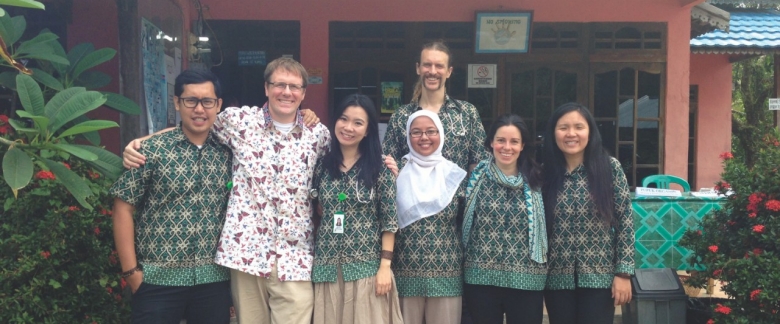
Michael Mancuso, MD (second from left), with colleagues during his Johnson & Johnson rotation at the Alam Sehat Lestari clinic in Borneo

Expanding Global Health Opportunities for Medicine Residents

Michael Mancuso, MD (second from left), with colleagues during his Johnson & Johnson rotation at the Alam Sehat Lestari clinic in Borneo

Expanding Global Health Opportunities for Medicine Residents

In the last five years, the Department of Medicine has made global health education a priority by implementing a number of programs dedicated to reducing health disparities and strengthening human capital. Leading the charge is Michele Barry, MD, a pioneer in the field who was recruited to Stanford from Yale University in 2009 to assume a new position of Senior Associate Dean for Global Health at the School of Medicine and Director of Global Health Programs in the Department of Medicine.

Upon her arrival, Barry established the Center for Innovation in Global Health (CIGH), which has enabled the growth of global health educational opportunities and curriculum within the Department, and serves as a catalyst for interdisciplinary collaboration across the university.

“To have Stanford lead in global health medical education requires not just highlighting cutting-edge technologies and biomedical innovation, but also thinking about how we can implement these technologies to reduce the dramatic health inequities around the world,” says Barry. “There’s much we can also learn from our colleagues who provide care with limited resources while we help contribute towards building medical capacity in those settings.”

While at Yale, Barry co-founded the country’s first organized program to send physicians overseas in an effort to inspire a global vision of health care in a traditional internal medicine residency program. Known today as the Yale/Stanford Johnson & Johnson Global Health Scholars Program, or simply as the J&J Global Health Scholars Program, the program has mobilized almost 1100 physicians to underserved sites around the world. 

It has become a pillar of global health education in the Stanford medicine residency program, enabling physicians and trainees to work alongside their international colleagues at carefully selected sites.

Interest in global health has grown significantly within the Department; the number of residents participating in an overseas rotation has doubled within the last two years. In the 2015-2016 academic year, 23 medicine residents will participate in an overseas rotation, representing two-thirds of the PGY3 class. These residents will spend six weeks at partner sites in South Africa, Uganda, Rwanda, Indonesia, Zimbabwe and Ecuador, a new site established in 2015.

The experience provides physicians with invaluable skills training and a deep sense of cultural humility critical to practicing medicine in any setting. J&J Global Health Scholar Andrew Chang, MD, reflected on his rotation in Rwanda, which coincided with the annual commemoration of the 1994 genocide.

In the last five years, the Department of Medicine has made global health education a priority by implementing a number of programs dedicated to reducing health disparities and strengthening human capital. Leading the charge is Michele Barry, MD, a pioneer in the field who was recruited to Stanford from Yale University in 2009 to assume a new position of Senior Associate Dean for Global Health at the School of Medicine and Director of Global Health Programs in the Department of Medicine.

Upon her arrival, Barry established the Center for Innovation in Global Health (CIGH), which has enabled the growth of global health educational opportunities and curriculum within the Department, and serves as a catalyst for interdisciplinary collaboration across the university.

“To have Stanford lead in global health medical education requires not just highlighting cutting-edge technologies and biomedical innovation, but also thinking about how we can implement these technologies to reduce the dramatic health inequities around the world,” says Barry. “There’s much we can also learn from our colleagues who provide care with limited resources while we help contribute towards building medical capacity in those settings.”

While at Yale, Barry co-founded the country’s first organized program to send physicians overseas in an effort to inspire a global vision of health care in a traditional internal medicine residency program. Known today as the Yale/Stanford Johnson & Johnson Global Health Scholars Program, or simply as the J&J Global Health Scholars Program, the program has mobilized almost 1100 physicians to underserved sites around the world. It has become a pillar of global health education in the Stanford medicine residency program, enabling physicians and trainees to work alongside their international colleagues at carefully selected sites.

It’s an exciting time to be working in global health at Stanford

Interest in global health has grown significantly within the Department; the number of residents participating in an overseas rotation has doubled within the last two years. In the 2015-2016 academic year, 23 medicine residents will participate in an overseas rotation, representing two-thirds of the PGY3 class. These residents will spend six weeks at partner sites in South Africa, Uganda, Rwanda, Indonesia, Zimbabwe and Ecuador, a new site established in 2015.

The experience provides physicians with invaluable skills training and a deep sense of cultural humility critical to practicing medicine in any setting. J&J Global Health Scholar Andrew Chang, MD, reflected on his rotation in Rwanda, which coincided with the annual commemoration of the 1994 genocide.

“I looked for signs of discontent, of division and resentment in my team. I found none. The trainees who had lost the most in the genocide were often my hardest workers, most committed to rebuilding the health care system and caring for the underserved,” wrote Chang. “Through our medication shortages, inconsistent laboratory, and inadequate procedure materials, I developed a respect for the resilience and optimism I saw in my Rwandan colleagues…I left Kigali impressed with the strength and generosity of the Rwandan spirit.”

Chang is one of two physicians per year who match into the Stanford Global Health Track in the medicine residency program. Residents in the Global Health Track have up to 18 weeks of dedicated time overseas, participate in rotations and a Social Medicine elective at Santa Clara Valley Medical Center, as well as continuity clinic at Fair Oaks. Through these experiences, residents care for underserved patient populations locally and abroad.

They also have access to focused educational opportunities to build clinical and research skills applicable to global health. The flexibility of the track, along with its mentorship in developing a research career, led Chang to attend Stanford for his residency.

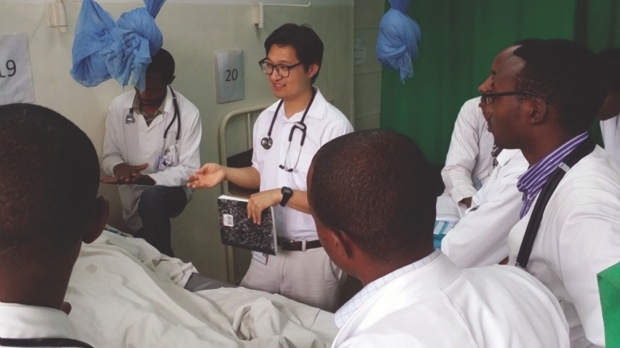
Andrew Chang, MD, during his Johnson & Johnson rotation in Rwanda

“We are increasingly seeing overseas rotations being incorporated into residency programs nationwide, but it can be challenging to fit a wide range of opportunities focused on caring for underserved patient populations into the rigorous rotation schedule,” says Cybele Renault, MD, clinical assistant professor of medicine and Program Lead for Global Health in the Internal Medicine Residency Program. “One of the major draws of our Global Health Track is the amount of time residents are able to spend overseas and our ability to customize the program based on each individual’s career aspirations.”

Global Health Track residents also have the option to pursue a funded Masters degree during the year following residency, which allows them to gain a complementary skill set. Graduating residents have chosen to take a variety of career paths. For example, Global Health Track graduate Alexander Sandhu, MD, is currently pursuing a fellowship in health services research and development at Stanford’s Center for Health Policy/Center for Primary Care Outcomes Research to support his interests in cardiovascular medicine, health economics, and cost-effective analysis research.

Laura Greisman, MD, is currently a PGY3 Global Health Track resident. With a passion for bedside medicine, she aspires to continue her training next year as a student in the Gorgas course in clinical tropical medicine, a nine-week diploma course taught in Peru.

The Global Health Track in medicine provides a framework for other specialties looking to establish more formalized global health opportunities in their residency programs. Through conversations with colleagues in other specialties, Renault recognized a need for increased communication and collaboration between departments. With support from CIGH, Renault helped create the Program Leadership Council, which brings together faculty representatives from each residency program on a quarterly basis to share best practices and key learnings in global health program development.

Interdisciplinary collaboration has been integral to Barry’s mission since day 1. Looking ahead, she plans to build on the increasing momentum and excitement for global health within the medical school and across campus.

“It’s an exciting time to be working in global health at Stanford,” says Barry. “We are continuing to build on our interdisciplinary strengths, culture of disruptive innovation and commitment to research to be able to tackle some of the tough questions in achieving global health equity, but there is much more left to do.”

It’s an exciting time to be working in global health at Stanford

“I looked for signs of discontent, of division and resentment in my team. I found none. The trainees who had lost the most in the genocide were often my hardest workers, most committed to rebuilding the health care system and caring for the underserved,” wrote Chang. “Through our medication shortages, inconsistent laboratory, and inadequate procedure materials, I developed a respect for the resilience and optimism I saw in my Rwandan colleagues…I left Kigali impressed with the strength and generosity of the Rwandan spirit.”

Chang is one of two physicians per year who match into the Stanford Global Health Track in the medicine residency program. Residents in the Global Health Track have up to 18 weeks of dedicated time overseas, participate in rotations and a Social Medicine elective at Santa Clara Valley Medical Center, as well as continuity clinic at Fair Oaks. Through these experiences, residents care for underserved patient populations locally and abroad.

They also have access to focused educational opportunities to build clinical and research skills applicable to global health. The flexibility of the track, along with its mentorship in developing a research career, led Chang to attend Stanford for his residency.

“We are increasingly seeing overseas rotations being incorporated into residency programs nationwide, but it can be challenging to fit a wide range of opportunities focused on caring for underserved patient populations into the rigorous rotation schedule,” says Cybele Renault, MD, clinical assistant professor of medicine and Program Lead for Global Health in the Internal Medicine Residency Program. “One of the major draws of our Global Health Track is the amount of time residents are able to spend overseas and our ability to customize the program based on each individual’s career aspirations.”

Andrew Chang, MD, during his Johnson & Johnson rotation in Rwanda

Global Health Track residents also have the option to pursue a funded Masters degree during the year following residency, which allows them to gain a complementary skill set. Graduating residents have chosen to take a variety of career paths. For example, Global Health Track graduate Alexander Sandhu, MD, is currently pursuing a fellowship in health services research and development at Stanford’s Center for Health Policy/Center for Primary Care Outcomes Research to support his interests in cardiovascular medicine, health economics, and cost-effective analysis research.

Laura Greisman, MD, is currently a PGY3 Global Health Track resident. With a passion for bedside medicine, she aspires to continue her training next year as a student in the Gorgas course in clinical tropical medicine, a nine-week diploma course taught in Peru.

The Global Health Track in medicine provides a framework for other specialties looking to establish more formalized global health opportunities in their residency programs. Through conversations with colleagues in other specialties, Renault recognized a need for increased communication and collaboration between departments. With support from CIGH, Renault helped create the Program Leadership Council, which brings together faculty representatives from each residency program on a quarterly basis to share best practices and key learnings in global health program development.

Interdisciplinary collaboration has been integral to Barry’s mission since day 1. Looking ahead, she plans to build on the increasing momentum and excitement for global health within the medical school and across campus.

“It’s an exciting time to be working in global health at Stanford,” says Barry. “We are continuing to build on our interdisciplinary strengths, culture of disruptive innovation and commitment to research to be able to tackle some of the tough questions in achieving global health equity, but there is much more left to do.”

Mentoring Residents

Baldeep Singh, MD, with staff at Samaritan House

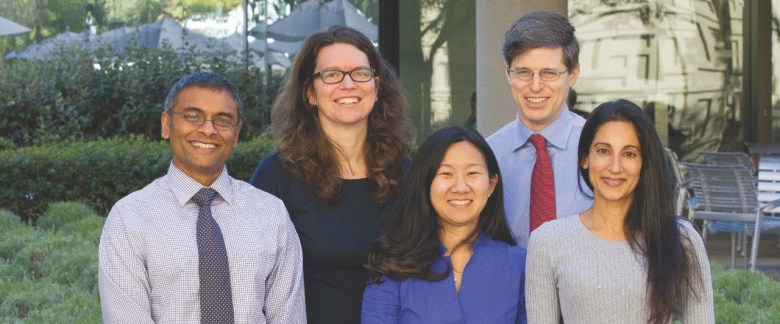
Shriram Nallamshetty, MD, Angela Rogers, MD, MPH, Stephanie Harman, MD, Ronald Witteles, MD, and Neera Ahuja, MD

Mentoring Residents

Shriram Nallamshetty, MD, Angela Rogers, MD, MPH, Stephanie Harman, MD, Ronald Witteles, MD, and Neera Ahuja, MD

Mentoring Residents

The latest class of internal medicine residents—50 of them—arrived on the Stanford campus at the end of June. They had just completed four rigorous years of medical school, and they were looking forward to the next phase of their careers.

Residency is an important time when newly minted MDs hone and develop their knowledge and skill. It’s also a critical time for mentorship and guidance. Two Department of Medicine programs are specifically designed to support incoming residents and propel them into successful professional and academic careers.

Pathways of Distinction
Pathways of Distinction, or PODs, is a new initiative that allows residents to select one of several individualized pathways—clinical research, underserved populations/ global health, clinical teaching, primary care, basic/translational science, and innovation/biodesign—that best aligns with their academic and professional interests.

Each POD is led by a senior faculty member in the department, and offers residents a host of opportunities, including lectures, courses, specialized rotations, and additional training. “The PODs allow residents to get extra mentorship and training, and provide a unique addition to their education that they wouldn’t have the ability to receive elsewhere,” explains Ronald Witteles, MD (associate professor, Cardiovascular Medicine), who directs the residency program.

The PODs are also meant to encourage connection between residents and faculty. “As the program matures, residents can expect a growing sense of community amongst the participants as well as faculty.”

Though the program is only a few months old, Witteles says that preliminary feedback has been positive. “We’ve received a lot of informal, positive reviews from the residents so far. We recognize that it’s a brand new program and we’ll learn along the way. 

We’ll undoubtedly make some changes, and we’re extremely interested in hearing from both the residents and the faculty, but we’re excited about this. I think it’s going to be a great addition to the residency program.”

Faculty Mentorship Program
A second opportunity is the department’s core faculty mentorship program, which gives interns an additional layer of sponsorship and support. The program, which is now entering its third year, pairs first-year interns with a core faculty membership team comprised of one senior and one junior faculty advisor. This structure is valuable to residents, Witteles says, because it introduces them to a range of perspectives. “If you’re a new intern, there are a lot of things you can learn from a junior faculty member and a senior faculty member. For example, one might be able to answer your questions about how to succeed on the wards, while the other might be able to offer broad, far-reaching career advice.”

The latest class of internal medicine residents—50 of them—arrived on the Stanford campus at the end of June. They had just completed four rigorous years of medical school, and they were looking forward to the next phase of their careers.

Residency is an important time when newly minted MDs hone and develop their knowledge and skill. It’s also a critical time for mentorship and guidance. Two Department of Medicine programs are specifically designed to support incoming residents and propel them into successful professional and academic careers.

Pathways of Distinction
Pathways of Distinction, or PODs, is a new initiative that allows residents to select one of several individualized pathways—clinical research, underserved populations/ global health, clinical teaching, primary care, basic/translational science, and innovation/biodesign—that best aligns with their academic and professional interests. Each POD is led by a senior faculty member in the department, and offers residents a host of opportunities, including lectures, courses, specialized rotations, and additional training. “The PODs allow residents to get extra mentorship and training, and provide a unique addition to their education that they wouldn’t have the ability to receive elsewhere,” explains Ronald Witteles, MD (associate professor, Cardiovascular Medicine), who directs the residency program.

The PODs are also meant to encourage connection between residents and faculty. “As the program matures, residents can expect a growing sense of community amongst the participants as well as faculty.”

Though the program is only a few months old, Witteles says that preliminary feedback has been positive. “We’ve received a lot of informal, positive reviews from the residents so far. We recognize that it’s a brand new program and we’ll learn along the way. We’ll undoubtedly make some changes, and we’re extremely interested in hearing from both the residents and the faculty, but we’re excited about this. I think it’s going to be a great addition to the residency program.”

Faculty Mentorship Program
A second opportunity is the department’s core faculty mentorship program, which gives interns an additional layer of sponsorship and support. The program, which is now entering its third year, pairs first-year interns with a core faculty membership team comprised of one senior and one junior faculty advisor. This structure is valuable to residents, Witteles says, because it introduces them to a range of perspectives. “If you’re a new intern, there are a lot of things you can learn from a junior faculty member and a senior faculty member. For example, one might be able to answer your questions about how to succeed on the wards, while the other might be able to offer broad, far-reaching career advice.”

These mentorship groups meet quarterly throughout an intern’s career, often at casual, off-hour events. “Though these meetings are meant to be informal, they provide an important opportunity for career guidance, and they create a real sense of community,” says Witteles. “The faculty have really enjoyed getting to know residents in a less formal, unstructured setting.”

Additionally, the mentorship program aims to encourage interns’ scholarly pursuits and research interests. “One of the advantages of training at Stanford is the ability to work with faculty with the experience and enthusiasm for scholarly pursuits. It’s easy for a resident to get caught up in the day-to-day of being a resident, learning clinical medicine. So we make sure to focus on linking residents with faculty members who can work with them on scholarly work early on. We believe it is our job and a key priority to make sure residents all have the opportunity to pursue and succeed in original scholarly work while they’re here.”

These mentorship groups meet quarterly throughout an intern’s career, often at casual, off-hour events. “Though these meetings are meant to be informal, they provide an important opportunity for career guidance, and they create a real sense of community,” says Witteles. “The faculty have really enjoyed getting to know residents in a less formal, unstructured setting.”

Additionally, the mentorship program aims to encourage interns’ scholarly pursuits and research interests. “One of the advantages of training at Stanford is the ability to work with faculty with the experience and enthusiasm for scholarly pursuits. It’s easy for a resident to get caught up in the day-to-day of being a resident, learning clinical medicine. So we make sure to focus on linking residents with faculty members who can work with them on scholarly work early on. We believe it is our job and a key priority to make sure residents all have the opportunity to pursue and succeed in original scholarly work while they’re here.”