Stanford Amyloid Center: From Start-up to Premier Status
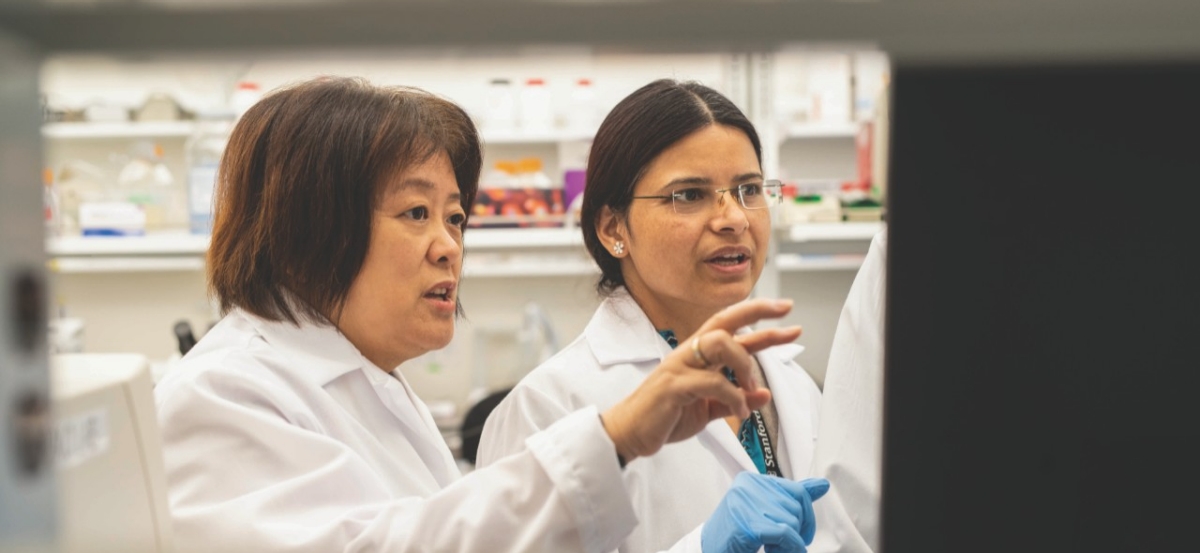
RONGLIH LIAO, PHD (left), reviews research data with lab instructor SEEMA DANGWAL, PHD.
Stanford Amyloid Center: From Start-up to Premier Status
RONGLIH LIAO, PHD (left), reviews research data with lab instructor SEEMA DANGWAL, PHD.
Stanford Amyloid Center: From Start-up to Premier Status
Although Kevin Anderson had committed no crime, he was facing a death sentence when he came to Stanford in 2007.
Anderson was dying from end-stage cardiac amyloidosis, an abnormal accumulation of proteins (amyloid fibrils) in his heart.
He had recently visited the Mayo Clinic in Minnesota to ask about a heart transplant, which at that time was the only viable treatment option for his disease. Because the amyloidosis was mostly in his heart and not in other parts of his body, Anderson qualified for a transplant.
Anderson, a urologist, lived near Sacramento, California. His proximity to Stanford brought him in contact with Ronald Witteles, MD, who at the time was a new faculty member, just starting the Stanford Amyloid Center.
Not long after Witteles met Anderson, the Stanford heart transplant team gave Anderson a second chance at life.
“Without the transplant, Dr. Anderson would not have survived that year. Now, more than a decade later, he remains alive and well, is back to work as a urologist, and he is thriving,” says Witteles, associate professor of cardiovascular medicine.
Antibodies and Light Chains
Anderson was afflicted with AL (primary) amyloidosis, which is related to a type of bone marrow cancer. Normally, plasma cells in the bone marrow produce antibodies. If a plasma cell becomes cancerous, it may produce extra pieces of antibodies called “light chains” (the L in AL amyloidosis). The light chains circulate in the bloodstream and can deposit in the heart and other major organs throughout the body, causing damage.
“A generation ago, a diagnosis of AL amyloidosis often was a death sentence, particularly when it involved the heart, but in the last 10 years treatments have improved by leaps and bounds so we can now give very effective treatments to many patients with the disease,” Witteles says.
Transthyretin (TTR) amyloidosis is the other main type of the disease. It is not related to cancer, and one of its two forms is inherited from those carrying a genetic mutation. The mutation is present in about 1 in 30 African Americans in this country; about 7 percent of the people with the mutation will develop the disease. Another form of TTR amyloidosis, which is not hereditary, first strikes people usually between ages 60 and 80 and causes mainly heart dysfunction. Up to a quarter of men in their 80s and 90s have significant deposits present in their hearts.
A Synergistic Approach
AL amyloidosis, the bone marrow type of the disease, is by definition a cancer, but it endangers other organs — including the heart, the kidneys, the liver, the gastrointestinal tract, and the nerves. Optimum patient care requires a true multidisciplinary approach in which amyloidosis specialists closely collaborate with experts in various medical specialties.
Witteles had that approach in mind when he first contacted Stanley Schrier, MD, professor of hematology, about an opportunity for a Stanford team to form a multidisciplinary group to battle this disease. Colleagues in other disciplines also expressed interest, including Richard Lafayette, MD, a professor of nephrology; Sally Arai, MD, an associate professor of blood and marrow transplantation; and Gerald Berry, MD, a professor of pathology. That first group of physicians wanted to learn everything they could about the disease, and they were willing to work collaboratively to contribute to the body of knowledge. That meant patients who would be coming from great distances could see all their specialists in one coordinated visit.
Although Kevin Anderson had committed no crime, he was facing a death sentence when he came to Stanford in 2007.
Anderson was dying from end-stage cardiac amyloidosis, an abnormal accumulation of proteins (amyloid fibrils) in his heart.
He had recently visited the Mayo Clinic in Minnesota to ask about a heart transplant, which at that time was the only viable treatment option for his disease. Because the amyloidosis was mostly in his heart and not in other parts of his body, Anderson qualified for a transplant.
Anderson, a urologist, lived near Sacramento, California. His proximity to Stanford brought him in contact with Ronald Witteles, MD, who at the time was a new faculty member, just starting the Stanford Amyloid Center.
Not long after Witteles met Anderson, the Stanford heart transplant team gave Anderson a second chance at life.
“Without the transplant, Dr. Anderson would not have survived that year. Now, more than a decade later, he remains alive and well, is back to work as a urologist, and he is thriving,” says Witteles, associate professor of cardiovascular medicine.
Antibodies and Light Chains
Anderson was afflicted with AL (primary) amyloidosis, which is related to a type of bone marrow cancer. Normally, plasma cells in the bone marrow produce antibodies. If a plasma cell becomes cancerous, it may produce extra pieces of antibodies called “light chains” (the L in AL amyloidosis). The light chains circulate in the bloodstream and can deposit in the heart and other major organs throughout the body, causing damage.
“A generation ago, a diagnosis of AL amyloidosis often was a death sentence, particularly when it involved the heart, but in the last 10 years treatments have improved by leaps and bounds so we can now give very effective treatments to many patients with the disease,” Witteles says.
Transthyretin (TTR) amyloidosis is the other main type of the disease. It is not related to cancer, and one of its two forms is inherited from those carrying a genetic mutation. The mutation is present in about 1 in 30 African Americans in this country; about 7 percent of the people with the mutation will develop the disease. Another form of TTR amyloidosis, which is not hereditary, first strikes people usually between ages 60 and 80 and causes mainly heart dysfunction. Up to a quarter of men in their 80s and 90s have significant deposits present in their hearts.
A Synergistic Approach
AL amyloidosis, the bone marrow type of the disease, is by definition a cancer, but it endangers other organs — including the heart, the kidneys, the liver, the gastrointestinal tract, and the nerves. Optimum patient care requires a true multidisciplinary approach in which amyloidosis specialists closely collaborate with experts in various medical specialties.
Witteles had that approach in mind when he first contacted Stanley Schrier, MD, professor of hematology, about an opportunity for a Stanford team to form a multidisciplinary group to battle this disease. Colleagues in other disciplines also expressed interest, including Richard Lafayette, MD, a professor of nephrology; Sally Arai, MD, an associate professor of blood and marrow transplantation; and Gerald Berry, MD, a professor of pathology. That first group of physicians wanted to learn everything they could about the disease, and they were willing to work collaboratively to contribute to the body of knowledge. That meant patients who would be coming from great distances could see all their specialists in one coordinated visit.
From a Modest Start, the Center Quickly Grew
“It turned out that there were many more of these patients than anyone realized, and there was no other center for the disease within a thousand miles of here. Also, by luck of timing, the formation of our center occurred just as new treatments for AL amyloidosis were poised to take off and newer treatments for TTR amyloidosis were being studied and ultimately would be successful and on their way to approval,” Witteles says.
Elucidating the Basic Mechanisms of the Disease
Then came the recruitment in 2017 of Ronglih Liao, PhD, a professor of medicine whose expertise is in the basic science of amyloidosis.
“She and a very talented trainee, Kevin Alexander, MD, a fellow in advanced heart failure and transplant cardiology, moved their lab from Brigham and Women’s Hospital in Boston to Stanford to continue doing remarkable work in elucidating many of the basic mechanisms of the disease,” says Witteles.
The lab has been at the forefront of investigating questions like how amyloid deposits injure organs and why amyloidogenic immunoglobulin light chain proteins are so much more toxic than transthyretin.
The devotion of the Stanford Amyloid Center physicians and staff as well as the leadership in the Department of Medicine were factors that attracted Liao to Stanford.
“I was impressed with the recognition of the critical importance of basic and translational research. There is an understanding of how that research contributes to the continued success in providing top-quality patient care,” Liao says. “We are optimistic that at this center our scientific discoveries can rapidly be translated back to the clinic and we can use our patients to accelerate the discovery process, with each part helping the other. This will set up a feed-forward system that we hope will allow us to develop new therapies in record time.”
Enriching the Reputation
Prior to Liao’s arrival, Stanford was known for being on the cutting edge of some clinical treatments like transplants and newer chemotherapy approaches. Now, the basic science expertise is enriching its reputation.
Today, with about 125 new amyloidosis patients per year, several hundred others receiving regular care, and many enrolled in various clinical trials, the Stanford Amyloid Center is one of the largest such centers in the world. Witteles and Liao lead the center along with Michaela Liedtke, MD, an associate professor of hematology. The staff includes 14 faculty from three departments and five divisions in the Department of Medicine, a dedicated clinical trials coordinator, and two full-time nurse coordinators.
In August 2018 the FDA approved the first drug ever for treating TTR amyloidosis, and two more drugs are expected to receive approval in the coming year. All three of these drugs and many more that are on the way, including AG-10, which was first identified at Stanford, represent classic bench-to-bedside development: An initial understanding of the mechanism of the disease led to treatment approaches based entirely on that understanding.
What that all means is a leading role for the Stanford Amyloid Center in promising bright futures for patients like Kevin Anderson.
From a Modest Start, the Center Quickly Grew
“It turned out that there were many more of these patients than anyone realized, and there was no other center for the disease within a thousand miles of here. Also, by luck of timing, the formation of our center occurred just as new treatments for AL amyloidosis were poised to take off and newer treatments for TTR amyloidosis were being studied and ultimately would be successful and on their way to approval,” Witteles says.
Elucidating the Basic Mechanisms of the Disease
Then came the recruitment in 2017 of Ronglih Liao, PhD, a professor of medicine whose expertise is in the basic science of amyloidosis.
“She and a very talented trainee, Kevin Alexander, MD, a fellow in advanced heart failure and transplant cardiology, moved their lab from Brigham and Women’s Hospital in Boston to Stanford to continue doing remarkable work in elucidating many of the basic mechanisms of the disease,” says Witteles.
The lab has been at the forefront of investigating questions like how amyloid deposits injure organs and why amyloidogenic immunoglobulin light chain proteins are so much more toxic than transthyretin.
The devotion of the Stanford Amyloid Center physicians and staff as well as the leadership in the Department of Medicine were factors that attracted Liao to Stanford.
“I was impressed with the recognition of the critical importance of basic and translational research. There is an understanding of how that research contributes to the continued success in providing top-quality patient care,” Liao says. “We are optimistic that at this center our scientific discoveries can rapidly be translated back to the clinic and we can use our patients to accelerate the discovery process, with each part helping the other. This will set up a feed-forward system that we hope will allow us to develop new therapies in record time.”
Enriching the Reputation
Prior to Liao’s arrival, Stanford was known for being on the cutting edge of some clinical treatments like transplants and newer chemotherapy approaches. Now, the basic science expertise is enriching its reputation.
Today, with about 125 new amyloidosis patients per year, several hundred others receiving regular care, and many enrolled in various clinical trials, the Stanford Amyloid Center is one of the largest such centers in the world. Witteles and Liao lead the center along with Michaela Liedtke, MD, an associate professor of hematology. The staff includes 14 faculty from three departments and five divisions in the Department of Medicine, a dedicated clinical trials coordinator, and two full-time nurse coordinators.
In August 2018 the FDA approved the first drug ever for treating TTR amyloidosis, and two more drugs are expected to receive approval in the coming year. All three of these drugs and many more that are on the way, including AG-10, which was first identified at Stanford, represent classic bench-to-bedside development: An initial understanding of the mechanism of the disease led to treatment approaches based entirely on that understanding.
What that all means is a leading role for the Stanford Amyloid Center in promising bright futures for patients like Kevin Anderson.