Expanding Global Health Opportunities for Medicine Residents
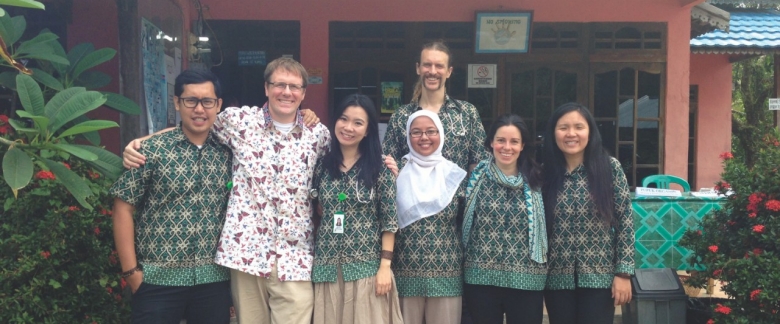
Michael Mancuso, MD (second from left), with colleagues during his Johnson & Johnson rotation at the Alam Sehat Lestari clinic in Borneo
Expanding Global Health Opportunities for Medicine Residents
Michael Mancuso, MD (second from left), with colleagues during his Johnson & Johnson rotation at the Alam Sehat Lestari clinic in Borneo
Expanding Global Health Opportunities for Medicine Residents
In the last five years, the Department of Medicine has made global health education a priority by implementing a number of programs dedicated to reducing health disparities and strengthening human capital. Leading the charge is Michele Barry, MD, a pioneer in the field who was recruited to Stanford from Yale University in 2009 to assume a new position of Senior Associate Dean for Global Health at the School of Medicine and Director of Global Health Programs in the Department of Medicine.
Upon her arrival, Barry established the Center for Innovation in Global Health (CIGH), which has enabled the growth of global health educational opportunities and curriculum within the Department, and serves as a catalyst for interdisciplinary collaboration across the university.
“To have Stanford lead in global health medical education requires not just highlighting cutting-edge technologies and biomedical innovation, but also thinking about how we can implement these technologies to reduce the dramatic health inequities around the world,” says Barry. “There’s much we can also learn from our colleagues who provide care with limited resources while we help contribute towards building medical capacity in those settings.”
While at Yale, Barry co-founded the country’s first organized program to send physicians overseas in an effort to inspire a global vision of health care in a traditional internal medicine residency program. Known today as the Yale/Stanford Johnson & Johnson Global Health Scholars Program, or simply as the J&J Global Health Scholars Program, the program has mobilized almost 1100 physicians to underserved sites around the world.
It has become a pillar of global health education in the Stanford medicine residency program, enabling physicians and trainees to work alongside their international colleagues at carefully selected sites.
Interest in global health has grown significantly within the Department; the number of residents participating in an overseas rotation has doubled within the last two years. In the 2015-2016 academic year, 23 medicine residents will participate in an overseas rotation, representing two-thirds of the PGY3 class. These residents will spend six weeks at partner sites in South Africa, Uganda, Rwanda, Indonesia, Zimbabwe and Ecuador, a new site established in 2015.
The experience provides physicians with invaluable skills training and a deep sense of cultural humility critical to practicing medicine in any setting. J&J Global Health Scholar Andrew Chang, MD, reflected on his rotation in Rwanda, which coincided with the annual commemoration of the 1994 genocide.
In the last five years, the Department of Medicine has made global health education a priority by implementing a number of programs dedicated to reducing health disparities and strengthening human capital. Leading the charge is Michele Barry, MD, a pioneer in the field who was recruited to Stanford from Yale University in 2009 to assume a new position of Senior Associate Dean for Global Health at the School of Medicine and Director of Global Health Programs in the Department of Medicine.
Upon her arrival, Barry established the Center for Innovation in Global Health (CIGH), which has enabled the growth of global health educational opportunities and curriculum within the Department, and serves as a catalyst for interdisciplinary collaboration across the university.
“To have Stanford lead in global health medical education requires not just highlighting cutting-edge technologies and biomedical innovation, but also thinking about how we can implement these technologies to reduce the dramatic health inequities around the world,” says Barry. “There’s much we can also learn from our colleagues who provide care with limited resources while we help contribute towards building medical capacity in those settings.”
While at Yale, Barry co-founded the country’s first organized program to send physicians overseas in an effort to inspire a global vision of health care in a traditional internal medicine residency program. Known today as the Yale/Stanford Johnson & Johnson Global Health Scholars Program, or simply as the J&J Global Health Scholars Program, the program has mobilized almost 1100 physicians to underserved sites around the world. It has become a pillar of global health education in the Stanford medicine residency program, enabling physicians and trainees to work alongside their international colleagues at carefully selected sites.

It’s an exciting time to be working in global health at Stanford
Interest in global health has grown significantly within the Department; the number of residents participating in an overseas rotation has doubled within the last two years. In the 2015-2016 academic year, 23 medicine residents will participate in an overseas rotation, representing two-thirds of the PGY3 class. These residents will spend six weeks at partner sites in South Africa, Uganda, Rwanda, Indonesia, Zimbabwe and Ecuador, a new site established in 2015.
The experience provides physicians with invaluable skills training and a deep sense of cultural humility critical to practicing medicine in any setting. J&J Global Health Scholar Andrew Chang, MD, reflected on his rotation in Rwanda, which coincided with the annual commemoration of the 1994 genocide.
“I looked for signs of discontent, of division and resentment in my team. I found none. The trainees who had lost the most in the genocide were often my hardest workers, most committed to rebuilding the health care system and caring for the underserved,” wrote Chang. “Through our medication shortages, inconsistent laboratory, and inadequate procedure materials, I developed a respect for the resilience and optimism I saw in my Rwandan colleagues…I left Kigali impressed with the strength and generosity of the Rwandan spirit.”
Chang is one of two physicians per year who match into the Stanford Global Health Track in the medicine residency program. Residents in the Global Health Track have up to 18 weeks of dedicated time overseas, participate in rotations and a Social Medicine elective at Santa Clara Valley Medical Center, as well as continuity clinic at Fair Oaks. Through these experiences, residents care for underserved patient populations locally and abroad.
They also have access to focused educational opportunities to build clinical and research skills applicable to global health. The flexibility of the track, along with its mentorship in developing a research career, led Chang to attend Stanford for his residency.
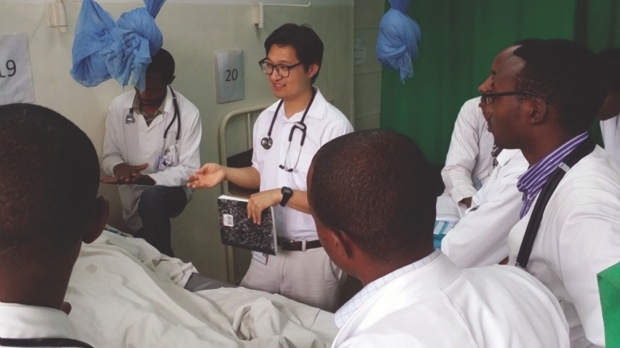
Andrew Chang, MD, during his Johnson & Johnson rotation in Rwanda
“We are increasingly seeing overseas rotations being incorporated into residency programs nationwide, but it can be challenging to fit a wide range of opportunities focused on caring for underserved patient populations into the rigorous rotation schedule,” says Cybele Renault, MD, clinical assistant professor of medicine and Program Lead for Global Health in the Internal Medicine Residency Program. “One of the major draws of our Global Health Track is the amount of time residents are able to spend overseas and our ability to customize the program based on each individual’s career aspirations.”
Global Health Track residents also have the option to pursue a funded Masters degree during the year following residency, which allows them to gain a complementary skill set. Graduating residents have chosen to take a variety of career paths. For example, Global Health Track graduate Alexander Sandhu, MD, is currently pursuing a fellowship in health services research and development at Stanford’s Center for Health Policy/Center for Primary Care Outcomes Research to support his interests in cardiovascular medicine, health economics, and cost-effective analysis research.
Laura Greisman, MD, is currently a PGY3 Global Health Track resident. With a passion for bedside medicine, she aspires to continue her training next year as a student in the Gorgas course in clinical tropical medicine, a nine-week diploma course taught in Peru.
The Global Health Track in medicine provides a framework for other specialties looking to establish more formalized global health opportunities in their residency programs. Through conversations with colleagues in other specialties, Renault recognized a need for increased communication and collaboration between departments. With support from CIGH, Renault helped create the Program Leadership Council, which brings together faculty representatives from each residency program on a quarterly basis to share best practices and key learnings in global health program development.
Interdisciplinary collaboration has been integral to Barry’s mission since day 1. Looking ahead, she plans to build on the increasing momentum and excitement for global health within the medical school and across campus.
“It’s an exciting time to be working in global health at Stanford,” says Barry. “We are continuing to build on our interdisciplinary strengths, culture of disruptive innovation and commitment to research to be able to tackle some of the tough questions in achieving global health equity, but there is much more left to do.”
It’s an exciting time to be working in global health at Stanford
“I looked for signs of discontent, of division and resentment in my team. I found none. The trainees who had lost the most in the genocide were often my hardest workers, most committed to rebuilding the health care system and caring for the underserved,” wrote Chang. “Through our medication shortages, inconsistent laboratory, and inadequate procedure materials, I developed a respect for the resilience and optimism I saw in my Rwandan colleagues…I left Kigali impressed with the strength and generosity of the Rwandan spirit.”
Chang is one of two physicians per year who match into the Stanford Global Health Track in the medicine residency program. Residents in the Global Health Track have up to 18 weeks of dedicated time overseas, participate in rotations and a Social Medicine elective at Santa Clara Valley Medical Center, as well as continuity clinic at Fair Oaks. Through these experiences, residents care for underserved patient populations locally and abroad.
They also have access to focused educational opportunities to build clinical and research skills applicable to global health. The flexibility of the track, along with its mentorship in developing a research career, led Chang to attend Stanford for his residency.
“We are increasingly seeing overseas rotations being incorporated into residency programs nationwide, but it can be challenging to fit a wide range of opportunities focused on caring for underserved patient populations into the rigorous rotation schedule,” says Cybele Renault, MD, clinical assistant professor of medicine and Program Lead for Global Health in the Internal Medicine Residency Program. “One of the major draws of our Global Health Track is the amount of time residents are able to spend overseas and our ability to customize the program based on each individual’s career aspirations.”
Andrew Chang, MD, during his Johnson & Johnson rotation in Rwanda
Global Health Track residents also have the option to pursue a funded Masters degree during the year following residency, which allows them to gain a complementary skill set. Graduating residents have chosen to take a variety of career paths. For example, Global Health Track graduate Alexander Sandhu, MD, is currently pursuing a fellowship in health services research and development at Stanford’s Center for Health Policy/Center for Primary Care Outcomes Research to support his interests in cardiovascular medicine, health economics, and cost-effective analysis research.
Laura Greisman, MD, is currently a PGY3 Global Health Track resident. With a passion for bedside medicine, she aspires to continue her training next year as a student in the Gorgas course in clinical tropical medicine, a nine-week diploma course taught in Peru.
The Global Health Track in medicine provides a framework for other specialties looking to establish more formalized global health opportunities in their residency programs. Through conversations with colleagues in other specialties, Renault recognized a need for increased communication and collaboration between departments. With support from CIGH, Renault helped create the Program Leadership Council, which brings together faculty representatives from each residency program on a quarterly basis to share best practices and key learnings in global health program development.
Interdisciplinary collaboration has been integral to Barry’s mission since day 1. Looking ahead, she plans to build on the increasing momentum and excitement for global health within the medical school and across campus.
“It’s an exciting time to be working in global health at Stanford,” says Barry. “We are continuing to build on our interdisciplinary strengths, culture of disruptive innovation and commitment to research to be able to tackle some of the tough questions in achieving global health equity, but there is much more left to do.”