Unleashing the Power of AI in Primary Care

Steven Lin, MD

Steven Lin, MD

Unleashing the Power of AI in Primary Care
Steven Lin, MD

Steven Lin, MD

Unleashing the Power of AI in Primary Care

Steven Lin, MD, family physician and section chief of general primary care overseeing 150 clinicians, reached a tipping point as he witnessed the impact of overloading primary care physicians with too many administrative burdens.

“I was seeing rampant burnout,” Lin says. “Faculty were leaving us left and right.”

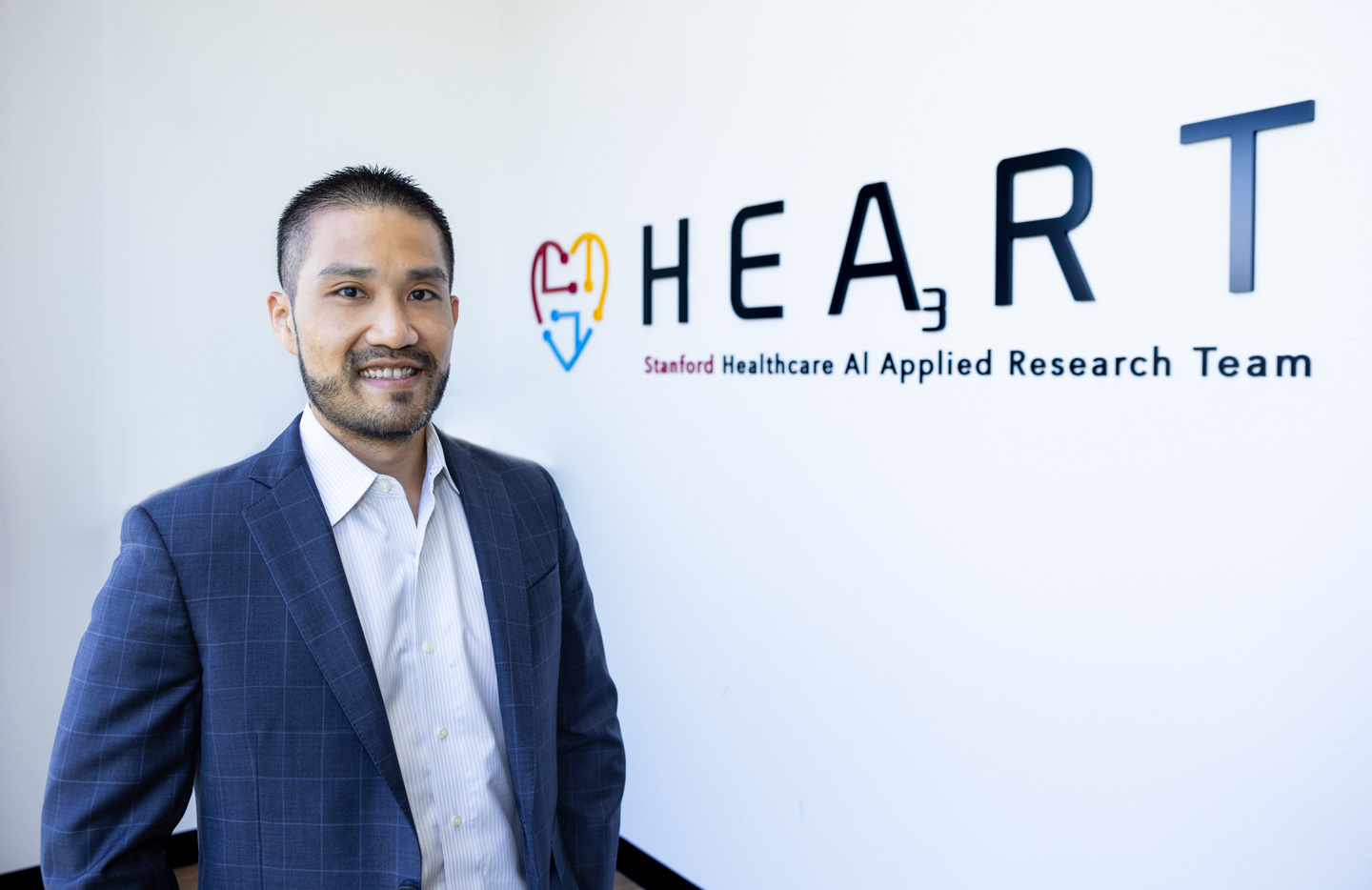
With the aim of revitalizing primary care, in 2019, Lin founded Stanford Healthcare AI Applied Research Team, or HEA₃RT. Its mission is threefold: accelerate the application of artificial intelligence (AI) and machine learning (ML) into the primary care space; support rigorous scientific AI implementation research; and address issues of diversity, equity, and inclusion in AI development. 

HEA₃RT’s approach to fulfilling its ambitious mission is through aggressive collaboration with industry, academia, nonprofits, and government. Partnerships to date include projects with Google, Microsoft, and the National Academy of Medicine.

Automating Processes So Clinicians Can Spend More Time at the Bedside

Lin believed artificial intelligence and machine learning technologies could help alleviate physician burnout. Yet, despite half of all health care delivery occurring in primary care, only 3% of FDA-approved artificial intelligence and machine learning tools are actually built for it. Moreover, only a small fraction of the tools make it to production, and those that do seldom undergo rigorous evaluation.

Lin imagined that by automating burdensome parts of the clinical processes — clinical documentation and patient messaging, for example — it could free up enough space to allow primary care doctors to spend more time at the bedside, rekindling the patient-doctor relationship and allowing physicians to focus on the work they were trained to do.

“Providers are not worried about whether or not they can diagnose and treat patients,” Lin points out. “They’re worried about burning out and leaving medicine altogether because the amount of work they must do is unsustainable.”

A Bridge Between Data Scientists and the Front Lines of Health Care

Lin envisioned a transformative path for primary care, but the disconnect between AI tools designed in the lab and their actual implementation on front lines hindered progress.

To overcome these barriers, the team at HEA₃RT is composed not of data scientists but of quality improvement experts, implementation scientists, clinicians, and nurses.

“We serve as that bridge between the data science and operations world,” says Margaret Smith, HEA₃RT’s director of operations.

Amelia Sattler, MD, addresses Hea3rt Lab staff. From left: Timothy Tsai, DO; Yejin Jeong; Steven Lin, MD; Trevor Cromwell; Betsy Yang, MD.

Smith, who has a background in quality improvement implementation science, said that communication can get “messy” when navigating the different languages spoken by data scientists and operational healthcare experts.

By relying on people gifted in communication and collaboration, HEA₃RT is better positioned to propel the integration of AI solutions into the front line of health care. And by doing so, they are reinvigorating the spirit of primary care with energy-saving technologies.

“We’re well-versed in the operational language, and we’ve learned the technology language,” Smith notes. “We can help translate and bring those groups together.”

Steven Lin, MD (right), with Timothy Tsai and Hea3rt Lab staff

Steven Lin, MD, family physician and section chief of general primary care overseeing 150 clinicians, reached a tipping point as he witnessed the impact of overloading primary care physicians with too many administrative burdens.

“I was seeing rampant burnout,” Lin says. “Faculty were leaving us left and right.”

With the aim of revitalizing primary care, in 2019, Lin founded Stanford Healthcare AI Applied Research Team, or HEA₃RT. Its mission is threefold: accelerate the application of artificial intelligence (AI) and machine learning (ML) into the primary care space; support rigorous scientific AI implementation research; and address issues of diversity, equity, and inclusion in AI development.

HEA₃RT’s approach to fulfilling its ambitious mission is through aggressive collaboration with industry, academia, nonprofits, and government. Partnerships to date include projects with Google, Microsoft, and the National Academy of Medicine.

Automating Processes So Clinicians Can Spend More Time at the Bedside

Lin believed artificial intelligence and machine learning technologies could help alleviate physician burnout. Yet, despite half of all health care delivery occurring in primary care, only 3% of FDA-approved artificial intelligence and machine learning tools are actually built for it. Moreover, only a small fraction of the tools make it to production, and those that do seldom undergo rigorous evaluation.

Lin imagined that by automating burdensome parts of the clinical processes — clinical documentation and patient messaging, for example — it could free up enough space to allow primary care doctors to spend more time at the bedside, rekindling the patient-doctor relationship and allowing physicians to focus on the work they were trained to do.

“Providers are not worried about whether or not they can diagnose and treat patients,” Lin points out. “They’re worried about burning out and leaving medicine altogether because the amount of work they must do is unsustainable.”

Steven Lin, MD (right), with Timothy Tsai and Hea3rt Lab staff

A Bridge Between Data Scientists and the Front Lines of Health Care

Lin envisioned a transformative path for primary care, but the disconnect between AI tools designed in the lab and their actual implementation on front lines hindered progress.

To overcome these barriers, the team at HEA₃RT is composed not of data scientists but of quality improvement experts, implementation scientists, clinicians, and nurses.

“We serve as that bridge between the data science and operations world,” says Margaret Smith, HEA₃RT’s director of operations.

Smith, who has a background in quality improvement implementation science, said that communication can get “messy” when navigating the different languages spoken by data scientists and operational healthcare experts.

By relying on people gifted in communication and collaboration, HEA₃RT is better positioned to propel the integration of AI solutions into the front line of health care. And by doing so, they are reinvigorating the spirit of primary care with energy-saving technologies.

“We’re well-versed in the operational language, and we’ve learned the technology language,” Smith notes. “We can help translate and bring those groups together.”

Providers are not worried about whether or not they can diagnose and treat patients. They’re worried about burning out and leaving medicine altogether because the amount of work they must do is unsustainable.

Google, a Case Study for Success

HEA₃RT doesn’t stop at implementation. The team is dedicated to producing equity-driven health research around artificial intelligence by working with the biggest players in the technology space.

Their collaboration on the Google product DermAssist, an app equipped with advanced machine learning that diagnoses skin conditions from images and alerts users about the urgency of seeing a doctor, is a prime example of how they apply all three prongs — primary care, implementation research, and equity.

The app addresses the issue of limited access to dermatology care worldwide, particularly in rural areas. Primary care physicians handle 70% of skin cases, much more than dermatologists.

When it comes to issues of equity in AI, over the years, an outsize effort has been exerted upon addressing biased algorithms. While it’s important, Lin notes a whole other side of equity that includes involving patients and underserved communities in conversations about AI design and development.

Seeking HEA₃RT’s assistance, Google wanted research conducted to assess the app design and algorithm performance across diverse skin tones and use cases. A study conducted in partnership with Santa Clara Family Health Plan, serving a low-income community of mostly Latinx and Vietnamese individuals, provided valuable feedback and performance data. This collaboration advanced research and demonstrated that the app worked on different skin colors and included underrepresented populations.

Facilitating the collaboration with Google and Santa Clara Family Health Plan illustrated HEA₃RT’s commitment to rebuilding trust among underrepresented communities, Lin says.
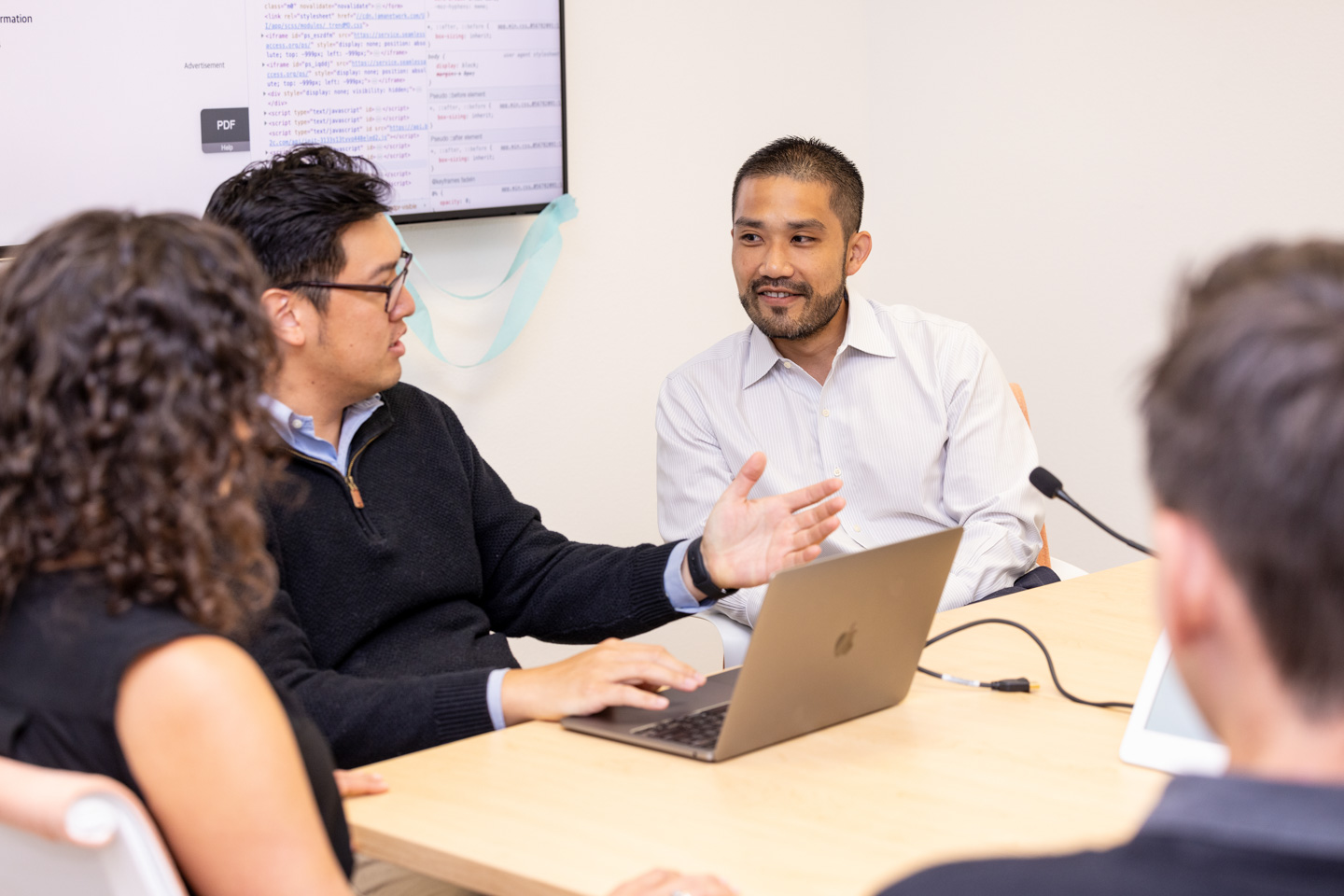
Amelia Sattler, MD, addresses Hea3rt Lab staff. From left: Timothy Tsai, DO; Yejin Jeong; Steven Lin, MD; Trevor Cromwell; Betsy Yang, MD.

ChatGPT Accelerates Innovation

With a successful track record of collaboration, HEA₃RT isn’t afraid to partner on the latest cutting-edge technology. When ChatGPT’s consumer-friendly artificial intelligence program burst on the scene, it completely altered health care’s historically timid approach to adopting artificial intelligence.

“It has completely changed the AI/ML world to the point that every single health system is tripping over itself to incorporate it,” says Lin.

As the ChatGPT boom created a sense of renewed excitement and potential in the industry, HEA₃RT jumped in with both feet. The team is partnering with Stanford Medicine Technology and Digital Solutions to use ChatGPT to draft responses to patient messages, an incredibly burdensome task for primary care physicians.

“That project is not happening in the span of years — it’s happening in weeks,” Lin says. “ChatGPT is an example of how one particular, remarkable piece of technology has just taken the world by storm.”
Providers are not worried about whether or not they can diagnose and treat patients. They’re worried about burning out and leaving medicine altogether because the amount of work they must do is unsustainable.

Google, a Case Study for Success

HEA₃RT doesn’t stop at implementation. The team is dedicated to producing equity-driven health research around artificial intelligence by working with the biggest players in the technology space.

Their collaboration on the Google product DermAssist, an app equipped with advanced machine learning that diagnoses skin conditions from images and alerts users about the urgency of seeing a doctor, is a prime example of how they apply all three prongs — primary care, implementation research, and equity.

The app addresses the issue of limited access to dermatology care worldwide, particularly in rural areas. Primary care physicians handle 70% of skin cases, much more than dermatologists.

When it comes to issues of equity in AI, over the years, an outsize effort has been exerted upon addressing biased algorithms. While it’s important, Lin notes a whole other side of equity that includes involving patients and underserved communities in conversations about AI design and development.

Seeking HEA₃RT’s assistance, Google wanted research conducted to assess the app design and algorithm performance across diverse skin tones and use cases. A study conducted in partnership with Santa Clara Family Health Plan, serving a low-income community of mostly Latinx and Vietnamese individuals, provided valuable feedback and performance data. This collaboration advanced research and demonstrated that the app worked on different skin colors and included underrepresented populations.

Facilitating the collaboration with Google and Santa Clara Family Health Plan illustrated HEA₃RT’s commitment to rebuilding trust among underrepresented communities, Lin says.

ChatGPT Accelerates Innovation

With a successful track record of collaboration, HEA₃RT isn’t afraid to partner on the latest cutting-edge technology. When ChatGPT’s consumer-friendly artificial intelligence program burst on the scene, it completely altered health care’s historically timid approach to adopting artificial intelligence.

“It has completely changed the AI/ML world to the point that every single health system is tripping over itself to incorporate it,” says Lin.

As the ChatGPT boom created a sense of renewed excitement and potential in the industry, HEA₃RT jumped in with both feet. The team is partnering with Stanford Medicine Technology and Digital Solutions to use ChatGPT to draft responses to patient messages, an incredibly burdensome task for primary care physicians.

“That project is not happening in the span of years — it’s happening in weeks,” Lin says. “ChatGPT is an example of how one particular, remarkable piece of technology has just taken the world by storm.”

Clinical Informatics Harnesses Information Technology to Revolutionize Patient Care

The clinical informatics group uses AI to improve how doctors and nurses identify and assess hospitalized patients at risk of deterioration

The Clinical Informatics Group uses AI to improve how doctors and nurses identify and assess hospitalized patients at risk of deterioration.

Clinical Informatics Harnesses Information Technology to Revolutionize Patient Care

The clinical informatics group uses AI to improve how doctors and nurses identify and assess hospitalized patients at risk of deterioration

The Clinical Informatics Group uses AI to improve how doctors and nurses identify and assess hospitalized patients at risk of deterioration.

Clinical Informatics Harnesses Information Technology to Revolutionize Patient Care

Controversies around artificial intelligence (AI) and ChatGPT seem to be everywhere these days — from students using these technologies to cheat on tests to chatbots threatening to take away people’s jobs. But Stanford physicians are balancing the scale by using these technologies to innovate ways to improve patient care — and nowhere is that passion greater than in the Clinical Informatics Group in the hospital medicine division of the Department of Medicine.

These physicians are hospitalists who not only treat patients but also use their interest in computer science to conduct research, fine-tune operational workflow, and design medical education around the latest technologies. While these physicians have a wide range of interests and expertise, ultimately they all want to improve the quality and safety of hospital stays, as well as the overall delivery of health care.

Hospitalists and Research Are a Natural Match

The Clinical Informatics Group includes a robust team of researchers who collaborate with divisions and departments across Stanford University and Stanford Health Care. Pilot projects showing positive outcomes have led to improved patient care practices systemwide.

“As academic clinicians, we as hospitalists have interests and passions outside of practicing medicine, and for many that’s research,” explains Ashwin Nayak, MD, clinical assistant professor of hospital medicine. “Within research, informatics is a broad foundation that can be applied to different specialties and problems.”

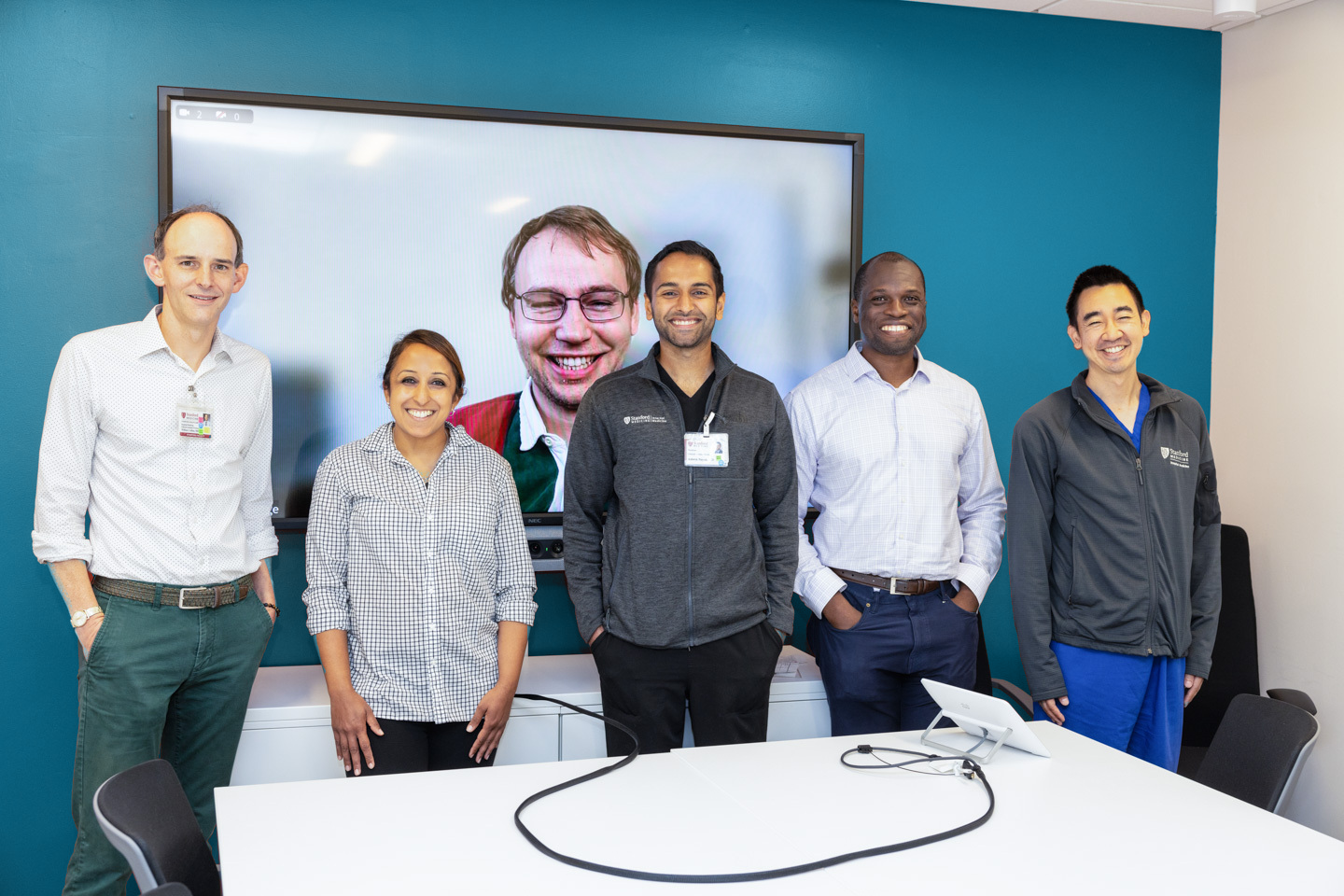
From left: William Collins, MD; Poonam Hosamani, MD; Thomas Savage, MD (on the screen); Ashwin Nayak, MD; Oluseyi Fayanju, MD; Jason Hom, MD

Adds Ron Li, MD, medical informatics director for digital health, “As hospitalists, we are system thinkers. We are not focused on one specific disease but about the entire care journey for a patient who may have many complex issues during a hospital stay.

Clinical informatics research projects are increasingly exploring the use of AI — specifically ChatGPT — in clinical practice.

Hospitalized patients with complex conditions are typically cared for by multiperson teams who assess large amounts of constantly changing data, making it challenging for the team to stay in sync. One recent research project, Clinical Deterioration Prediction & Prevention Using Artificial Intelligence, looked at how AI could be used to improve how doctors and nurses work together to identify patients whose condition could deteriorate in a hospital setting.

Controversies around artificial intelligence (AI) and ChatGPT seem to be everywhere these days — from students using these technologies to cheat on tests to chatbots threatening to take away people’s jobs. But Stanford physicians are balancing the scale by using these technologies to innovate ways to improve patient care — and nowhere is that passion greater than in the Clinical Informatics Group in the hospital medicine division of the Department of Medicine.

These physicians are hospitalists who not only treat patients but also use their interest in computer science to conduct research, fine-tune operational workflow, and design medical education around the latest technologies. While these physicians have a wide range of interests and expertise, ultimately they all want to improve the quality and safety of hospital stays, as well as the overall delivery of health care.

Hospitalists and Research Are a Natural Match

The Clinical Informatics Group includes a robust team of researchers who collaborate with divisions and departments across Stanford University and Stanford Health Care. Pilot projects showing positive outcomes have led to improved patient care practices systemwide.

“As academic clinicians, we as hospitalists have interests and passions outside of practicing medicine, and for many that’s research,” explains Ashwin Nayak, MD, clinical assistant professor of hospital medicine. “Within research, informatics is a broad foundation that can be applied to different specialties and problems.”

Adds Ron Li, MD, medical informatics director for digital health, “As hospitalists, we are system thinkers. We are not focused on one specific disease but about the entire care journey for a patient who may have many complex issues during a hospital stay.”

Clinical informatics research projects are increasingly exploring the use of AI — specifically ChatGPT — in clinical practice.

Hospitalized patients with complex conditions are typically cared for by multiperson teams who assess large amounts of constantly changing data, making it challenging for the team to stay in sync. One recent research project, Clinical Deterioration Prediction & Prevention Using Artificial Intelligence, looked at how AI could be used to improve how doctors and nurses work together to identify patients whose condition could deteriorate in a hospital setting.

Explains Li, who is a clinical assistant professor of hospital medicine and biomedical informatics research, “We used AI to develop a collaborative huddle and checklist process, allowing doctors and nurses to better assess at-risk patients and work together to intervene more quickly.” Not only did the pilot project reduce deterioration events at Stanford Hospital by 20%, but also it won the 2023 Healthcare Information and Management Systems Society (HIMSS) Nicholas E. Davies Award of Excellence for using health information technology to substantially improve patient outcomes.

Large language model chatbots such as ChatGPT are a particular area of interest for Clinical Informatics Group members. A recently published study comparing the clinical notes written by ChatGPT versus Internal Medicine residents found the quality to be comparable. “This study shows one of the many time-saving applications of large language models that could help free up clinicians so they can focus more on patient care,” comments Nayak, who was first author of the study.

As academic clinicians, we as hospitalists have interests and passions outside of practicing medicine, and for many that’s research.

— Ashwin Nayak, MD, clinical assistant professor of hospital medicine 

Information Technology Drives Hospital Efficiency and Safety

“Informatics is the glue that underlies the operation of the modern hospital. Every step in a hospital’s workflow requires a computer or cellphone app,” notes Weihan Chu, MD, clinical assistant professor of hospital medicine and associate chief medical officer of Stanford Health Care Tri-Valley and medical informatics director, Stanford Health Care.

Chu works extensively with the Stanford IT department to represent the physician perspective in developing and updating content used in nearly 200 hospital workflows, from auto-populated content for doctor notes for greater accuracy to checklists for hospital-admitted patients to improve consistency and efficiency.

Even basic hospital operations can have complex workflows involving many different areas. Explains Chu, “A blood transfusion for a patient’s cardiac surgery involves many behind-the-scenes steps, from routing the request to a blood bank and getting it filled and picked up to the operating room notifying the blood bank if they need more blood. IT tools make this process seamless.”

Before there were computers there was paper. “When we used paper to track patient care, there wasn’t one easily referenced source of truth,” he notes. “You can’t have multiple people looking at and updating the same piece of paper at the same time. Ultimately, these IT tools help us better coordinate care and improve patient safety.”

The Role of Informatics in Medical Education

AI technology is moving so quickly and integrating into so many areas within health care that Clinical Informatics Group members are exploring how to incorporate training into the Stanford School of Medicine’s basic curriculum for medical students and physician assistants obtaining an MSPA degree.

“It’s not a question of ‘if’ we’re going to integrate formal teaching about AI into the curriculum for students, but ‘how’ and ‘when,’” says Jason Hom, MD, clinical associate professor of hospital medicine. “We want to make sure our students are fully prepared for what they encounter in their clinical rotations. And since practicing clinicians were trained in a pre-AI world, we’re looking at continuing medical education courses as well,” adds Hom, who also serves as course director, Practice of Medicine Year 2, at the Stanford School of Medicine.

Educators around the world are intrigued by ChatGPT’s performance capabilities. In a study published in the Journal of the American Medical Association Internal Medicine, several Clinical Informatics Group members found that ChatGPT performed well on answering free-form questions from Stanford School of Medicine clinical reasoning exams. The study, Chatbot vs. Medical Student Performance on Free-Response Clinical Reasoning Examinations, was co-first authored by clinical associate professor of hospital medicine Eric Strong, MD, and School of Medicine Associate Director for Evaluation and Scholarship Alicia DiGiammarino, along with co-senior authors Jonathan Chen, MD, PhD, assistant professor of hospital medicine, and Hom. Yingjie WengAndre Kumar, MD, MEd, and Poonam Hosamani, MD were also co-authors. “We have to ensure new MD and MSPA students have a minimum level of unassisted competency before integrating AI into their studies. And we have to ensure that students have a basic understanding of how these emerging models work and can be used and what their limitations/biases are,” says Hom.

While the debate over how best to integrate AI into health care continues, the uniquely human aspects of medical training become even more important. “Teaching how to build rapport with patients, how to compassionately tell patients about a cancer diagnosis, how to listen to a patient’s heart — these are irreplaceable aspects of the patient-clinician relationship that we can focus on in training,” explains Hom.

Stanford and Technology Go Hand in Hand

Li cites Stanford leadership’s strong support for the use of informatics to solve problems as instrumental in the success of the group’s projects. “At Stanford, it’s in our DNA to use technology in service of innovation. There’s the rich ecosystem we’ve developed with Silicon Valley companies and cross-pollination with local industry. Plus, we tend to attract faculty who are skilled both as informaticians and as physicians,” he says. One such faculty member is Jonathan Chen, who is also assistant professor of biomedical informatics research and is featured in “How to Endure in a Pandemic? Magic!”

Explains Li, who is a clinical assistant professor of hospital medicine and biomedical informatics research, “We used AI to develop a collaborative huddle and checklist process, allowing doctors and nurses to better assess at-risk patients and work together to intervene more quickly.” Not only did the pilot project reduce deterioration events at Stanford Hospital by 20%, but also it won the 2023 Healthcare Information and Management Systems Society (HIMSS) Nicholas E. Davies Award of Excellence for using health information technology to substantially improve patient outcomes.

Large language model chatbots such as ChatGPT are a particular area of interest for Clinical Informatics Group members. A recently published study comparing the clinical notes written by ChatGPT versus Internal Medicine residents found the quality to be comparable. “This study shows one of the many time-saving applications of large language models that could help free up clinicians so they can focus more on patient care,” comments Nayak, who was first author of the study.

As academic clinicians, we as hospitalists have interests and passions outside of practicing medicine, and for many that’s research.

— Ashwin Nayak, MD, clinical assistant professor of hospital medicine

Information Technology Drives Hospital Efficiency and Safety

“Informatics is the glue that underlies the operation of the modern hospital. Every step in a hospital’s workflow requires a computer or cellphone app,” notes Weihan Chu, MD, clinical assistant professor of hospital medicine and associate chief medical officer of Stanford Health Care Tri-Valley and medical informatics director, Stanford Health Care.

Chu works extensively with the Stanford IT department to represent the physician perspective in developing and updating content used in nearly 200 hospital workflows, from auto-populated content for doctor notes for greater accuracy to checklists for hospital-admitted patients to improve consistency and efficiency.

Even basic hospital operations can have complex workflows involving many different areas. Explains Chu, “A blood transfusion for a patient’s cardiac surgery involves many behind-the-scenes steps, from routing the request to a blood bank and getting it filled and picked up to the operating room notifying the blood bank if they need more blood. IT tools make this process seamless.”

Before there were computers there was paper. “When we used paper to track patient care, there wasn’t one easily referenced source of truth,” he notes. “You can’t have multiple people looking at and updating the same piece of paper at the same time. Ultimately, these IT tools help us better coordinate care and improve patient safety.”

The Role of Informatics in Medical Education

AI technology is moving so quickly and integrating into so many areas within health care that Clinical Informatics Group members are exploring how to incorporate training into the Stanford School of Medicine’s basic curriculum for medical students and physician assistants obtaining an MSPA degree.

“It’s not a question of ‘if’ we’re going to integrate formal teaching about AI into the curriculum for students, but ‘how’ and ‘when,’” says Jason Hom, MD, clinical associate professor of hospital medicine. “We want to make sure our students are fully prepared for what they encounter in their clinical rotations. And since practicing clinicians were trained in a pre-AI world, we’re looking at continuing medical education courses as well,” adds Hom, who also serves as course director, Practice of Medicine Year 2, at the Stanford School of Medicine.

Educators around the world are intrigued by ChatGPT’s performance capabilities. In a study published in the Journal of the American Medical Association Internal Medicine, several Clinical Informatics Group members found that ChatGPT performed well on answering free-form questions from Stanford School of Medicine clinical reasoning exams. The study, Chatbot vs. Medical Student Performance on Free-Response Clinical Reasoning Examinations, was co-first authored by clinical associate professor of hospital medicine Eric Strong, MD, and School of Medicine Associate Director for Evaluation and Scholarship Alicia DiGiammarino, along with co-senior authors Jonathan Chen, MD, PhD, assistant professor of hospital medicine, and Hom. Yingjie WengAndre Kumar, MD, MEd, and Poonam Hosamani, MD were also co-authors. “We have to ensure new MD and MSPA students have a minimum level of unassisted competency before integrating AI into their studies. And we have to ensure that students have a basic understanding of how these emerging models work and can be used and what their limitations/biases are,” says Hom.

While the debate over how best to integrate AI into health care continues, the uniquely human aspects of medical training become even more important. “Teaching how to build rapport with patients, how to compassionately tell patients about a cancer diagnosis, how to listen to a patient’s heart — these are irreplaceable aspects of the patient-clinician relationship that we can focus on in training,” explains Hom.

Stanford and Technology Go Hand in Hand

Li cites Stanford leadership’s strong support for the use of informatics to solve problems as instrumental in the success of the group’s projects. “At Stanford, it’s in our DNA to use technology in service of innovation. There’s the rich ecosystem we’ve developed with Silicon Valley companies and cross-pollination with local industry. Plus, we tend to attract faculty who are skilled both as informaticians and as physicians,” he says. One such faculty member is Jonathan Chen, who is also assistant professor of biomedical informatics research and is featured in “How to Endure in a Pandemic? Magic!”

CHIP: Where Artificial Intelligence and Cardiology Come Together

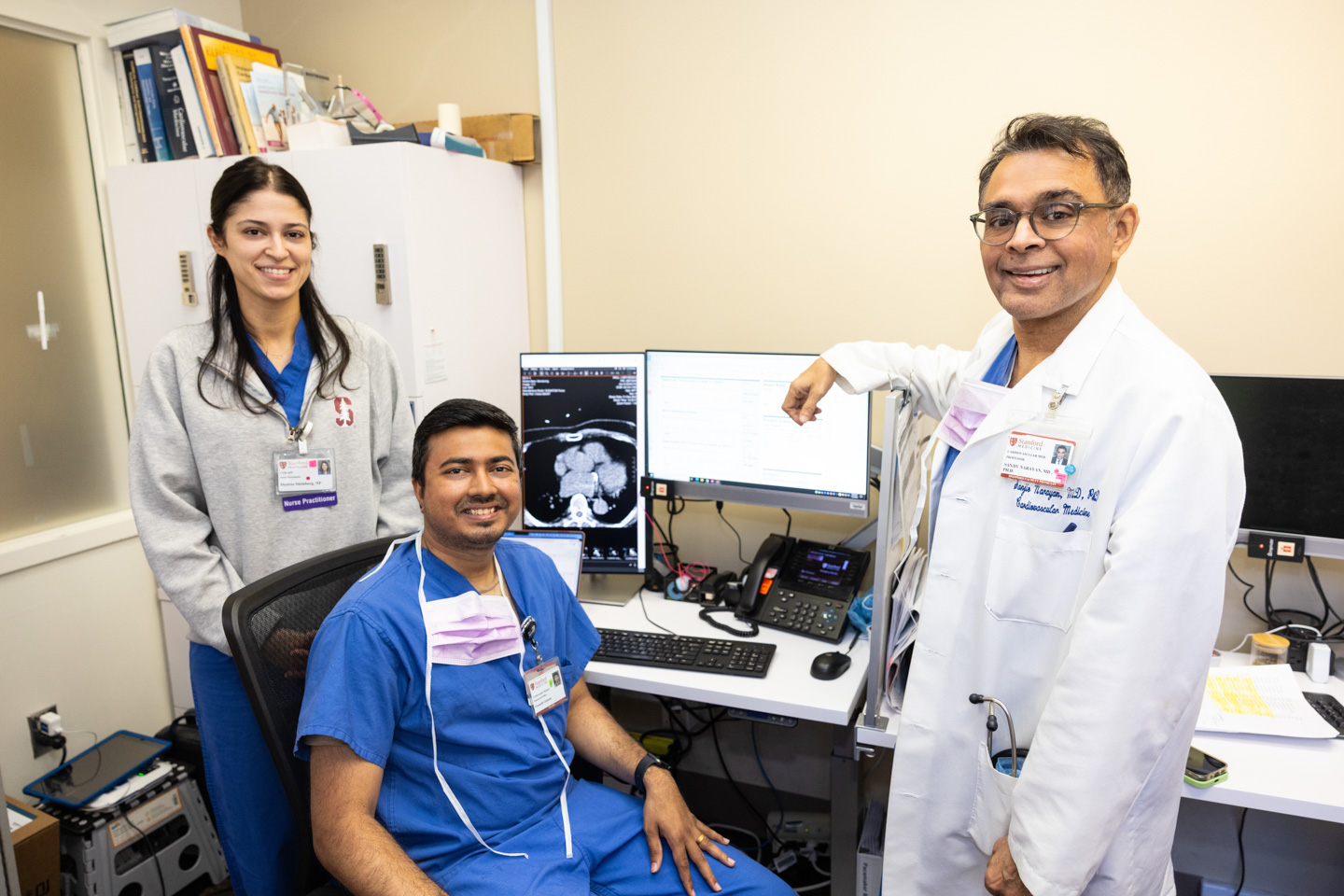
From left: Desiree Steinberg, NP; Prasanth Ganesan, PhD; and Sanjiv M. Narayan, MD, PhD

From left: Desiree Steinberg, NP; Prasanth Ganesan, PhD; and Sanjiv M. Narayan, MD, PhD

CHIP: Where Artificial Intelligence and Cardiology Come Together

From left: Desiree Steinberg, NP; Prasanth Ganesan, PhD; and Sanjiv M. Narayan, MD, PhD

From left: Desiree Steinberg, NP; Prasanth Ganesan, PhD; and Sanjiv M. Narayan, MD, PhD

CHIP: Where Artificial Intelligence and Cardiology Come Together

“Computer tools are everywhere. They’re in your phone. They’re in your TV remote. They’re in your car gearbox,” says Sanjiv M. Narayan, MD, PhD, professor of cardiovascular medicine. As the benefits of artificial intelligence (AI) and machine learning in the medical setting become increasingly clear, it is imperative that physicians understand them, so they can be safely and thoughtfully leveraged to improve research and patient care. That is why he and his co-director Alison Marsden, PhD, have founded the first-of-its-kind Computational Medicine in the Heart: Integrated Training Program (CHIP). Marsden is Douglass M. and Nola Leishman Professor of Cardiovascular Diseases in the departments of Pediatrics, Bioengineering, and, by courtesy, Mechanical Engineering.

“If we don’t understand [machine learning and AI], we are ceding our responsibility to tech companies, who may have priorities other than patient care or science,” Narayan says. “If we understand these things better, we are better prepared. … It just makes the scientific mission better.”

At the same time, computer scientists and engineers, the professionals who typically develop the computer-based technologies that are used in medicine, may do a better job if they understand the nuanced medical and biological contexts in which they are used.

Learning How to Speak the Same Language

Welcoming its very first students during the summer of 2023, CHIP operates under the aegis of the Stanford Cardiovascular Institute (CVI) and the Institute for Computational and Mathematical Engineering (ICME). It is a truly multidisciplinary program, accepting students with diverse backgrounds to develop the novel specialty of computational medicine. CHIP cross-trains biologists and medical specialists on the one hand and engineers, mathematicians, and computer scientists on the other. “The idea is to have enough [mutual] understanding so we can talk the same language,” says Narayan, who in addition to being director of CHIP is also a professor of medicine and co-director of another multidisciplinary program — the Stanford Center for Arrhythmia Research.

While many are already working in the space that CHIP straddles, most are formally educated in one field and self-taught in the other. CHIP provides education that spans both while at the same time offering opportunities to make practical use of this multidisciplinary training in clinical and research settings.

Made possible via a prestigious and highly sought-after National Institutes of Health (NIH) T32 grant, the two-year research program offers on-the-job practical training to those with an MD or PhD in the fields of medicine, biology, computer science, or engineering. Students engage with Stanford faculty across the entire campus, including the schools of Medicine, Engineering, and Humanities and Sciences. “We want people who are committed to this intersection,” says Narayan. “They have proven to us that they are not just doing it to work with a certain faculty. They believe in the mission. To me, it’s a mindset.”

Harnessing a Powerful Tool in Medicine

“Medical AI, when it is used to complement the physician, is incredibly powerful,” continues Narayan. Examples include the Apple Watch, which can detect atrial fibrillation, or AI and machine learning algorithms to aid in the interpretation of findings on imaging. Unlike people, AI doesn’t get tired. It doesn’t get hungry. It doesn’t have good and bad days. But computers should never replace a physician. They simply provide new pieces of information with which to make decisions. In fact, a recent Stanford study revealed that using machine learning can help identify evidence of cardiovascular disease on imaging that was missed by clinicians. One of Narayan’s own specialties is in digital phenotyping to predict cardiovascular outcomes. The use of AI and machine learning allows for the number of factors included in an individual digital phenotype to be virtually limitless.

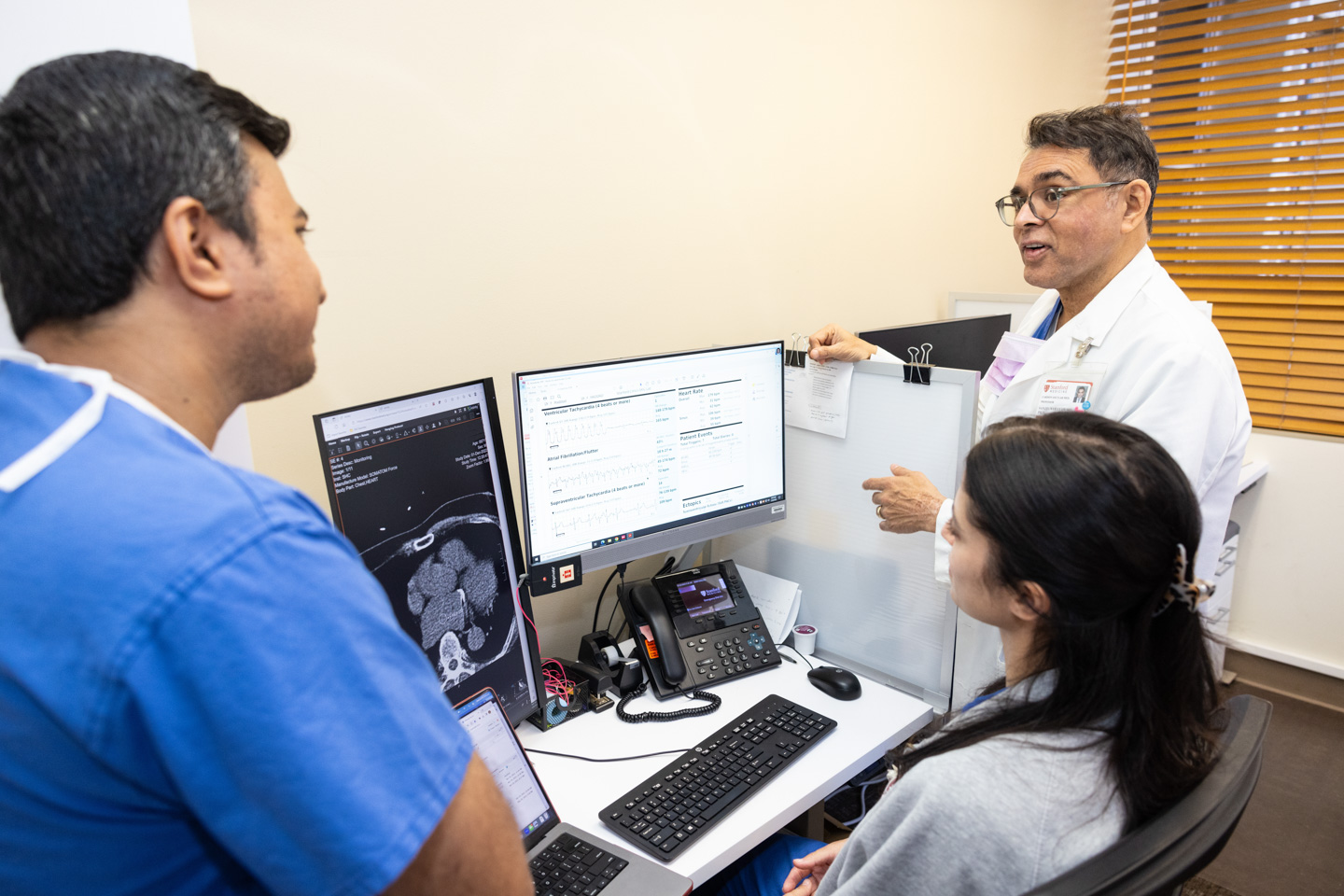
CHIP program participants from left: Prasanth Ganesan, PhD, cardiovascular medicine postdoctoral fellow; Desiree Steinberg, NP; and Sanjiv M. Narayan, MD, PhD

“Computer tools are everywhere. They’re in your phone. They’re in your TV remote. They’re in your car gearbox,” says Sanjiv M. Narayan, MD, PhD, professor of cardiovascular medicine. As the benefits of artificial intelligence (AI) and machine learning in the medical setting become increasingly clear, it is imperative that physicians understand them, so they can be safely and thoughtfully leveraged to improve research and patient care. That is why he and his co-director Alison Marsden, PhD, have founded the first-of-its-kind Computational Medicine in the Heart: Integrated Training Program (CHIP). Marsden is Douglass M. and Nola Leishman Professor of Cardiovascular Diseases in the departments of Pediatrics, Bioengineering, and, by courtesy, Mechanical Engineering.

“If we don’t understand [machine learning and AI], we are ceding our responsibility to tech companies, who may have priorities other than patient care or science,” Narayan says. “If we understand these things better, we are better prepared. … It just makes the scientific mission better.” At the same time, computer scientists and engineers, the professionals who typically develop the computer-based technologies that are used in medicine, may do a better job if they understand the nuanced medical and biological contexts in which they are used.

Learning How to Speak the Same Language

Welcoming its very first students during the summer of 2023, CHIP operates under the aegis of the Stanford Cardiovascular Institute (CVI) and the Institute for Computational and Mathematical Engineering (ICME). It is a truly multidisciplinary program, accepting students with diverse backgrounds to develop the novel specialty of computational medicine. CHIP cross-trains biologists and medical specialists on the one hand and engineers, mathematicians, and computer scientists on the other. “The idea is to have enough [mutual] understanding so we can talk the same language,” says Narayan, who in addition to being director of CHIP is also a professor of medicine and co-director of another multidisciplinary program — the Stanford Center for Arrhythmia Research. While many are already working in the space that CHIP straddles, most are formally educated in one field and self-taught in the other. CHIP provides education that spans both while at the same time offering opportunities to make practical use of this multidisciplinary training in clinical and research settings.

Made possible via a prestigious and highly sought-after National Institutes of Health (NIH) T32 grant, the two-year research program offers on-the-job practical training to those with an MD or PhD in the fields of medicine, biology, computer science, or engineering. Students engage with Stanford faculty across the entire campus, including the schools of Medicine, Engineering, and Humanities and Sciences. “We want people who are committed to this intersection,” says Narayan. “They have proven to us that they are not just doing it to work with a certain faculty. They believe in the mission. To me, it’s a mindset.”

Harnessing a Powerful Tool in Medicine

“Medical AI, when it is used to complement the physician, is incredibly powerful,” continues Narayan. Examples include the Apple Watch, which can detect atrial fibrillation, or AI and machine learning algorithms to aid in the interpretation of findings on imaging. Unlike people, AI doesn’t get tired. It doesn’t get hungry. It doesn’t have good and bad days. But computers should never replace a physician. They simply provide new pieces of information with which to make decisions. In fact, a recent Stanford study revealed that using machine learning can help identify evidence of cardiovascular disease on imaging that was missed by clinicians. One of Narayan’s own specialties is in digital phenotyping to predict cardiovascular outcomes. The use of AI and machine learning allows for the number of factors included in an individual digital phenotype to be virtually limitless.

CHIP program participants from left: Prasanth Ganesan, PhD, cardiovascular medicine postdoctoral fellow; Desiree Steinberg, NP; and Sanjiv M. Narayan, MD, PhD

We are at the cutting edge of next-generation computational engineering and medicine, to deliver solutions to improve the lives of patients.
Sanjiv Narayan, MD

Integrating New Technology by Improving Competence Across Disciplines

Narayan uses the analogy of the increasing importance of statistics in medicine to explain the importance of programs like CHIP. “There was a time when physicians were not taught statistics. Now it’s such a major part of what we [as physicians] do,” he says. Computer science is becoming integral to how medicine is practiced, just as statistics has become integral to weighing evidence and ultimately making clinical decisions.

Narayan expects that by the end of their training, students will have worked and published across disciplines. Upon graduation, they will continue to leverage their understanding of computational medicine in their careers in academia, government, or industry. “The quality of our graduates will make this a signature for Stanford,” he says. “We are at the cutting edge of next-generation computational engineering and medicine, to deliver solutions to improve the lives of patients.” Ultimately, he says, he would like CHIP to be the catalyst behind the birth of the field of computational medicine, with one day perhaps a Center for Computational Medicine within the Stanford School of Medicine. “If we have done that,” he says, “we have moved the needle. The science will be more robust, outcomes should be better. Patients should get better treatment.”