Resilience and Resourcefulness

Resilience and Resourcefulness

Lessons From Stanford African Scholars in Global Health

The Stanford African Scholars in Global Health (SASH) program provides valuable insights into navigating recent declines in federal support for global health initiatives. SASH Scholars – drawing from their own experiences as clinicians, researchers, and educators at medical universities in low- and middle- income African countries – emphasize the power of partnership and knowledge exchange to sustain global health programming during times of crisis and uncertainty.

“SASH provides a timely help and opportunity for something very big,” says SASH Scholar Ombeva Malande, MD, of Moi Teaching and Referral Hospital in Kenya, who is using his SASH training and funding to address the growing threat of antimicrobial resistance in Kenya and neighboring countries. His unique and sustainable approach of incorporating an infectious disease fellowship training program alongside a new infection control program will ensure a new workforce of infectious disease doctors who can run the program for years to come, benefiting countries around East Africa. “We will be offering an opportunity to close to half a billion people to have specialists trained to deal with one of the biggest problems we face in health care,” he said.

Rishi Mediratta, MD, and Alemayehu Toni, MD, discuss their partnership to improve childhood vaccine uptake in Ethiopia through the Stanford African Scholars in Global Health (SASH) Program.

Malande is just one of 24 SASH scholars whom Stanford hosted in 2025. The midcareer physician educators and leaders from nine African countries were selected from a highly competitive pool of nearly 450 applicants. SASH scholars, paired with Stanford faculty mentors, engaged in six-week immersive experiences, where they gained new skills and shared their expertise with the Stanford community. Bidirectional learning forms the core of SASH’s unique approach, allowing Stanford mentors and trainees to gain fresh perspectives from SASH scholars while the scholars acquire new skills at Stanford.

Maha Mohamed, MD, a clinical associate professor of medicine–nephrology at Stanford and a mentor in the SASH program, emphasizes the mutually beneficial learning that occurred during her collaboration with SASH Scholar Mary Kubo, MBChB, MMed, a nephrologist from Kenya. As Kubo sought to gain new skills and insights about increasing vaccination uptake to prevent bacterial infections among patients with chronic kidney disease in Kenya, Mohamed was interested in exploring cost-effective approaches for developing a new kidney transplant program in Zambia. Their collaboration through the SASH program fostered a mutual exchange of ideas and best practices, enabling them to learn from each other’s experiences and ultimately strengthen their programs.

“SASH is not just about teaching; it’s about creating a network of collaboration where we can share ideas and strategies that benefit both high-income and low-resource settings,” Mohamed says.

“Our African scholars have greatly enriched the Stanford medical and educational communities this year. In times of scarcity, the lessons we learn from our scholars about resilience and creativity in global health are more important than ever.” – Michele Barry, MD

Mohamed recounts being inspired by Kubo’s lessons about overcoming funding restrictions in Kenya, including negotiating for cost-sharing with the local government and finding a new way to prevent tuberculosis in transplant patients that avoided the costly step of TB testing. “SASH scholars have many important insights to share with Stanford practitioners about creative and cost-effective approaches at a time of reduced federal funding for health care and medical research,” Mohamed says.

Program founder Michele Barry, MD, director of the Stanford Center for Innovation in Global Health, agrees: “Our African scholars have greatly enriched the Stanford medical and educational communities this year. In times of scarcity, the lessons we learn from our scholars about resilience and creativity in global health are more important than ever.”

Throughout their six weeks at Stanford, scholars participated in clinical training, academic exchange, and mentorship, shadowing clinicians and experts at Stanford hospitals, clinics, and labs. They also presented their areas of expertise during a range of events, including Africa Table lectures co-hosted with the Stanford Center for African Studies, along with networking events with groups like the Stanford Graduate Global Health Network for Stanford postdocs conducting global health research and graduate students studying or interested in global health.

Esohe Ogboghodo, MBBS, for example, participated in a Stanford panel on measles outbreaks, sharing Nigeria’s national response and key strategies that the U.S. can adopt to address misinformation and vaccine hesitancy. At Africa Table lectures, Temesgen Abicho, MD, and Alemayehu Teklu Toni, MD, shared lessons learned while maintaining international collaboration during the COVID-19 pandemic – critical partnership lessons that serve us particularly well now at Stanford as the university works to find resourceful ways to accomplish more with less.

Scholar-mentor pairs like Ombeva Malande, MD, and Cybele Renault, MD, meanwhile, exemplify the fact that the most sustainable programs are developed in partnership. Renault’s preexisting working relationship with Malande’s teaching hospital facilitated trust and connections that have enabled the collaboration to flourish.

After their time at Stanford, scholars returned to their academic institutions with additional funding from Pfizer and ongoing virtual Stanford faculty mentorship to conduct yearlong quality improvement projects, ensuring that the spirit of collaboration and learning, along with the impact on patient health in Africa, endures long after their visit.

For instance, Nahom Teshager, MD, associate professor of pediatrics at the University of Gondar in Ethiopia, is applying his SASH experience to address a pressing challenge: reducing neonatal hospital-acquired infection and sepsis-related mortality in Northwest Ethiopia. With a targeted goal of reducing neonatal hospital-acquired infection by 30% in 12 months, his work is already contributing to systems-level change.

For Malande, SASH’s emphasis on true partnership and collaboration between countries in the Global South and North has restored a sense of hope in the world, despite the current climate of global uncertainty and insecurity.

“Stanford is providing that star that we can use if and when we think the light at the end of the tunnel has been shut off,” he said.

SASH scholar-mentor pairs like Ombeva Malande, MD, and Cybele Renault, MD, (left to right), exemplify the fact that the most sustainable programs are developed in partnership.

  Save as PDF

Related Spotlights

Partnering for Health Equity and Global Health Education

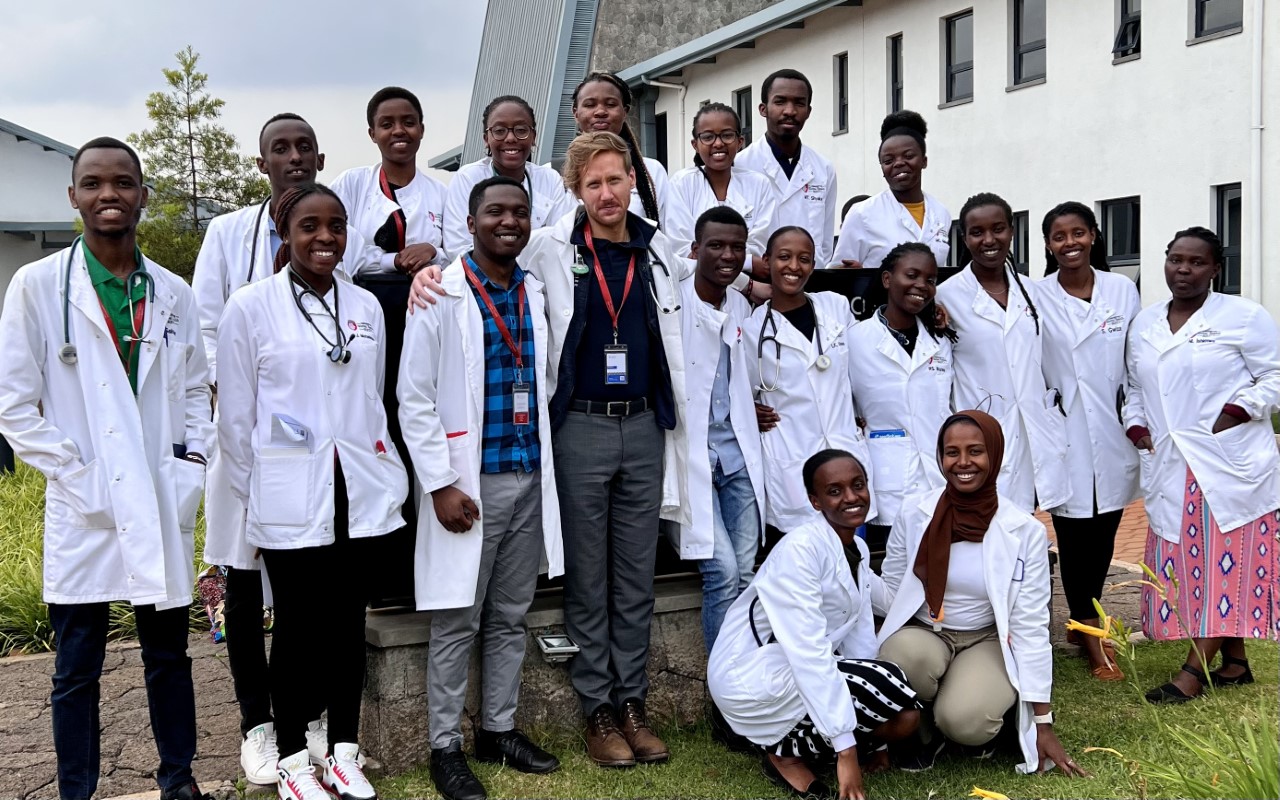
Dr. Andrew Enslen, a global health track resident at the time, spent six weeks in the spring of 2023 working with UGHE in a local district hospital, functioning as a consultant attending physician who supervised and taught 3rd-year medical students (pictured here). Working closely with these passionate and committed students was a highlight of his experience, he said.

Dr. Andrew Enslen, a global health track resident at the time, spent six weeks in the spring of 2023 working with UGHE in a local district hospital, functioning as a consultant attending physician who supervised and taught 3rd-year medical students (pictured here). Working closely with these passionate and committed students was a highlight of his experience, he said.

Partnering for Health Equity and Global Health Education

Dr. Andrew Enslen, a global health track resident at the time, spent six weeks in the spring of 2023 working with UGHE in a local district hospital, functioning as a consultant attending physician who supervised and taught 3rd-year medical students (pictured here). Working closely with these passionate and committed students was a highlight of his experience, he said.

Partnering for Health Equity and Global Health Education

This story is adapted from an article originally published by the Stanford Center for Innovation in Global Health in May 2023. This version has been edited to focus on the contributions of Department of Medicine faculty. You can read the original story here.

A shared commitment to healthcare capacity-building and fostering global health equity has brought together Stanford Medicine faculty and leaders of the University of Global Health Equity (UGHE) in Rwanda. 

UGHE launched in rural Butaro, Rwanda, in 2015, with a novel mission: “To change the way health care is delivered around the world by training the next generation of global health professionals to deliver more equitable, quality health services for all.” 

The university is partnering with globally minded medical schools, including Stanford, to provide high-quality education to its students and build healthcare capacity in Eastern Africa. 

“The brainchild of two global health visionaries, Agnes Binagwaho and the late Dr. Paul Farmer, UGHE is on track to be a premier medical school on the continent,” says Michele Barry, MD, director of the Stanford Center for Innovation in Global Health (CIGH) and Shenson Professor, who has served on UGHE’s member advisory council since 2018. Binagwaho is the retired vice chancellor of the university, former Rwandan minister of health, and health equity advocate. 

Farmer was a global health equity leader who founded the nonprofit Partners in Health, which helped launch UGHE.

Department of Medicine faculty say they’re deeply inspired by UGHE leaders’ and students’ commitment to excellence and serving their communities. “Bidirectionality,” a spirit of equal exchange and learning, is fundamental to these Stanford-UGHE collaborations, leaders agreed.

“This idea, this place, and these people are paving the way for a better world for all of us,” says Brooke Cotter, MD, Stanford clinical assistant professor of hospital medicine, who serves in a new, CIGH-supported role as director of education and collaboration between the universities.

A Bridge Between Data Scientists and the Front Lines of Health Care

Shortly after the university formed, UGHE-Stanford partnerships began to take shape — often shepherded by UGHE’s founding dean of medicine, Abebe Bekele, says Charles Prober, MD. Prober, professor of pediatrics, microbiology, and immunology and senior associate vice provost for health education at Stanford Medicine, chaired a Dean’s Advisory Committee that Bekele assembled.

“Dean Abebe can pull many people into his tent from institutions around the world,” Prober says.

When Bekele visited Stanford several years ago, Prober introduced him to Stanford colleagues including Laurence Katznelson, MD, professor of neurosurgery and endocrinology and associate dean of graduate medical education. They discussed how Stanford could help teach UGHE’s first medical students as the university developed its faculty.

Katznelson, Lars Osterberg, MD, John Kugler, MD, and Cotter developed an initiative to provide online instructional support for preclinical medical students. Stanford faculty helped lead monthly Zoom discussions with UGHE students on various clinical cases.

The program helped foster rich ties between Stanford faculty, UGHE counterparts, and students despite pandemic travel restrictions.

Stanford physician Dr. Lars Osterberg visits a patient alongside UGHE medical student Rosine during his visit in spring 2023.

Kugler, clinical professor of medicine and director of the Educators-4-Care program, says this type of teaching opened up meaningful global health engagement opportunities to physicians who cannot easily travel overseas: “The ability to provide helpful clinical education from a remote location allows for a new type of impact that we are only just beginning to tap into.”

Virtual Connections Become Tangible

The collaboration is now extending from the virtual to the in-person world, further deepening connections.

In June 2023, Osterberg, professor (teaching) of medicine and co-director of Stanford Medicine’s teaching and mentoring academy, traveled to the UGHE campus to teach and serve as an attending physician at Butaro Hospital for third-year students completing their internal medicine rotation. It was his third time doing so since 2022, working alongside the same students he’d previously taught over Zoom. Stanford Global Health Track resident Andrew Enslen, MD, also recently spent six weeks there, teaching and overseeing clinical rotations.

Stanford physician Dr. Lars Osterberg stands with several medical students, Prisca, Arnold, and Eric, whom he mentored during his time teaching and serving as an attending physician at UGHE in the spring of 2023. 

This story is adapted from an article originally published by the Stanford Center for Innovation in Global Health in May 2023. This version has been edited to focus on the contributions of Department of Medicine faculty. You can read the original story here.

A shared commitment to healthcare capacity-building and fostering global health equity has brought together Stanford Medicine faculty and leaders of the University of Global Health Equity (UGHE) in Rwanda. 

UGHE launched in rural Butaro, Rwanda, in 2015, with a novel mission: “To change the way health care is delivered around the world by training the next generation of global health professionals to deliver more equitable, quality health services for all.” The university is partnering with globally minded medical schools, including Stanford, to provide high-quality education to its students and build healthcare capacity in Eastern Africa. 

“The brainchild of two global health visionaries, Agnes Binagwaho and the late Dr. Paul Farmer, UGHE is on track to be a premier medical school on the continent,” says Michele Barry, MD, director of the Stanford Center for Innovation in Global Health (CIGH) and Shenson Professor, who has served on UGHE’s member advisory council since 2018. Binagwaho is the retired vice chancellor of the university, former Rwandan minister of health, and health equity advocate. Farmer was a global health equity leader who founded the nonprofit Partners in Health, which helped launch UGHE.

Department of Medicine faculty say they’re deeply inspired by UGHE leaders’ and students’ commitment to excellence and serving their communities. “Bidirectionality,” a spirit of equal exchange and learning, is fundamental to these Stanford-UGHE collaborations, leaders agreed.

“This idea, this place, and these people are paving the way for a better world for all of us,” says Brooke Cotter, MD, Stanford clinical assistant professor of hospital medicine, who serves in a new, CIGH-supported role as director of education and collaboration between the universities.

Stanford physician Dr. Lars Osterberg visits a patient alongside UGHE medical student Rosine during his visit in spring 2023.

A Bridge Between Data Scientists and the Front Lines of Health Care

Shortly after the university formed, UGHE-Stanford partnerships began to take shape — often shepherded by UGHE’s founding dean of medicine, Abebe Bekele, says Charles Prober, MD. Prober, professor of pediatrics, microbiology, and immunology and senior associate vice provost for health education at Stanford Medicine, chaired a Dean’s Advisory Committee that Bekele assembled.

“Dean Abebe can pull many people into his tent from institutions around the world,” Prober says.

When Bekele visited Stanford several years ago, Prober introduced him to Stanford colleagues including Laurence Katznelson, MD, professor of neurosurgery and endocrinology and associate dean of graduate medical education. They discussed how Stanford could help teach UGHE’s first medical students as the university developed its faculty.

Katznelson, Lars Osterberg, MD, John Kugler, MD, and Cotter developed an initiative to provide online instructional support for preclinical medical students. Stanford faculty helped lead monthly Zoom discussions with UGHE students on various clinical cases.

The program helped foster rich ties between Stanford faculty, UGHE counterparts, and students despite pandemic travel restrictions.

Kugler, clinical professor of medicine and director of the Educators-4-Care program, says this type of teaching opened up meaningful global health engagement opportunities to physicians who cannot easily travel overseas: “The ability to provide helpful clinical education from a remote location allows for a new type of impact that we are only just beginning to tap into.”

Stanford physician Dr. Lars Osterberg stands with several medical students, Prisca, Arnold, and Eric, whom he mentored during his time teaching and serving as an attending physician at UGHE in the spring of 2023. 

Virtual Connections Become Tangible

The collaboration is now extending from the virtual to the in-person world, further deepening connections.

In June 2023, Osterberg, professor (teaching) of medicine and co-director of Stanford Medicine’s teaching and mentoring academy, traveled to the UGHE campus to teach and serve as an attending physician at Butaro Hospital for third-year students completing their internal medicine rotation. It was his third time doing so since 2022, working alongside the same students he’d previously taught over Zoom. Stanford Global Health Track resident Andrew Enslen, MD, also recently spent six weeks there, teaching and overseeing clinical rotations.

The ability to provide helpful clinical education from a remote location allows for a new type of impact that we are only just beginning to tap into.

— John Kugler, MD, clinical professor of medicine 

Cotter, who traveled to UGHE during spring 2023 to attend on the wards and teach third-year medical students, hopes to develop a group of core faculty who can return annually to assist with rotations.

All were inspired by students’ deep commitment to serving their communities. Osterberg relates how Rwandan patients and their families often have to purchase supplies for medical procedures themselves. Medical students took the extra step of walking family members to the pharmacy to assist with this overwhelming task. Osterberg also recalls how students volunteered to remain on campus over a holiday weekend to ensure that patients were cared for.

“These students go far and beyond to get things done,” Osterberg says.

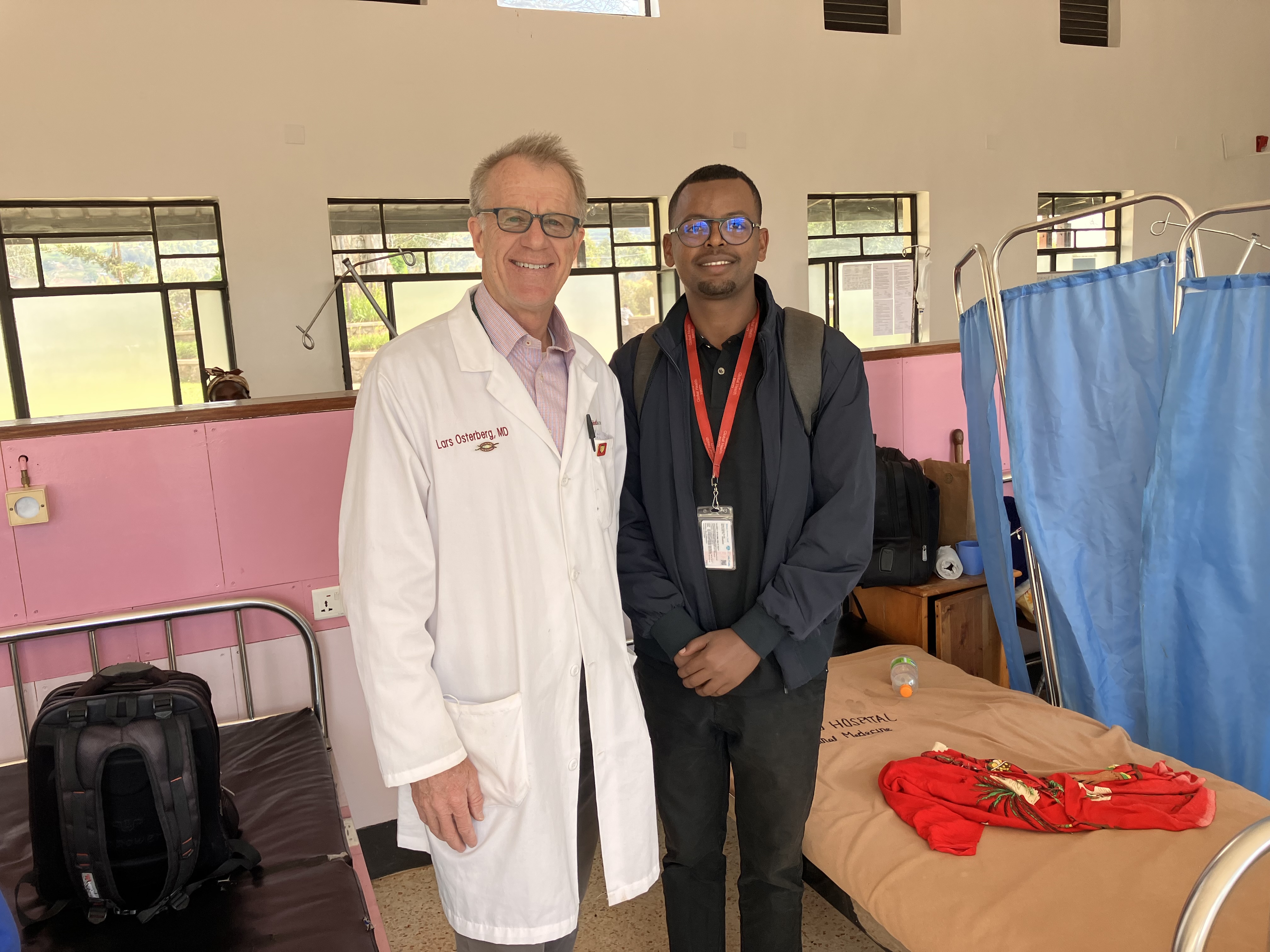
During his visit to UGHE in spring 2023, Stanford physician Dr. Lars Osterberg meets with Dr. Olana Wakoya Gichile at Butaro District Hospital, where he served as an attending physician on the internal medicine ward and taught third-year medical students.

Building Local Capacity

Beyond teaching, many Stanford faculty members have supported UGHE in building its local capacity for world-class care and instruction.

Prober helped build a mentorship program that matched UGHE faculty with medical school faculty from prestigious U.S. medical institutions. Osterberg has provided “teach the teacher” trainings for educators. Joseph Becker, MD, clinical associate professor of emergency medicine, helped develop the university’s emergency medicine curriculum.

UGHE has partnered with Stanford Surgery’s global engagement initiative, the Center for Health Education, and the Stanford Byers Center for Biodesign on technological initiatives to expand capacity for teaching, learning, and medical innovation.

“There are so many wonderful people doing great things at both UGHE and Stanford,” says Cotter, who sees her role as strengthening and expanding partnerships between the institutions. “The hope is that through coordination, we can cross-pollinate our efforts.”

Barry affirms CIGH’s commitment to building and strengthening the UGHE-Stanford collaboration: “We have much to learn from one another.”

The ability to provide helpful clinical education from a remote location allows for a new type of impact that we are only just beginning to tap into.

— John Kugler, MD, clinical professor of medicine 

Cotter, who traveled to UGHE during spring 2023 to attend on the wards and teach third-year medical students, hopes to develop a group of core faculty who can return annually to assist with rotations.

All were inspired by students’ deep commitment to serving their communities. Osterberg relates how Rwandan patients and their families often have to purchase supplies for medical procedures themselves. Medical students took the extra step of walking family members to the pharmacy to assist with this overwhelming task. Osterberg also recalls how students volunteered to remain on campus over a holiday weekend to ensure that patients were cared for.

“These students go far and beyond to get things done,” Osterberg says.

During his visit to UGHE in spring 2023, Stanford physician Dr. Lars Osterberg meets with Dr. Olana Wakoya Gichile at Butaro District Hospital, where he served as an attending physician on the internal medicine ward and taught third-year medical students.

Building Local Capacity

Beyond teaching, many Stanford faculty members have supported UGHE in building its local capacity for world-class care and instruction.

Prober helped build a mentorship program that matched UGHE faculty with medical school faculty from prestigious U.S. medical institutions. Osterberg has provided “teach the teacher” trainings for educators. Joseph Becker, MD, clinical associate professor of emergency medicine, helped develop the university’s emergency medicine curriculum.

UGHE has partnered with Stanford Surgery’s global engagement initiative, the Center for Health Education, and the Stanford Byers Center for Biodesign on technological initiatives to expand capacity for teaching, learning, and medical innovation.

“There are so many wonderful people doing great things at both UGHE and Stanford,” says Cotter, who sees her role as strengthening and expanding partnerships between the institutions. “The hope is that through coordination, we can cross-pollinate our efforts.”

Barry affirms CIGH’s commitment to building and strengthening the UGHE-Stanford collaboration: “We have much to learn from one another.”