Partnering for Health Equity and Global Health Education
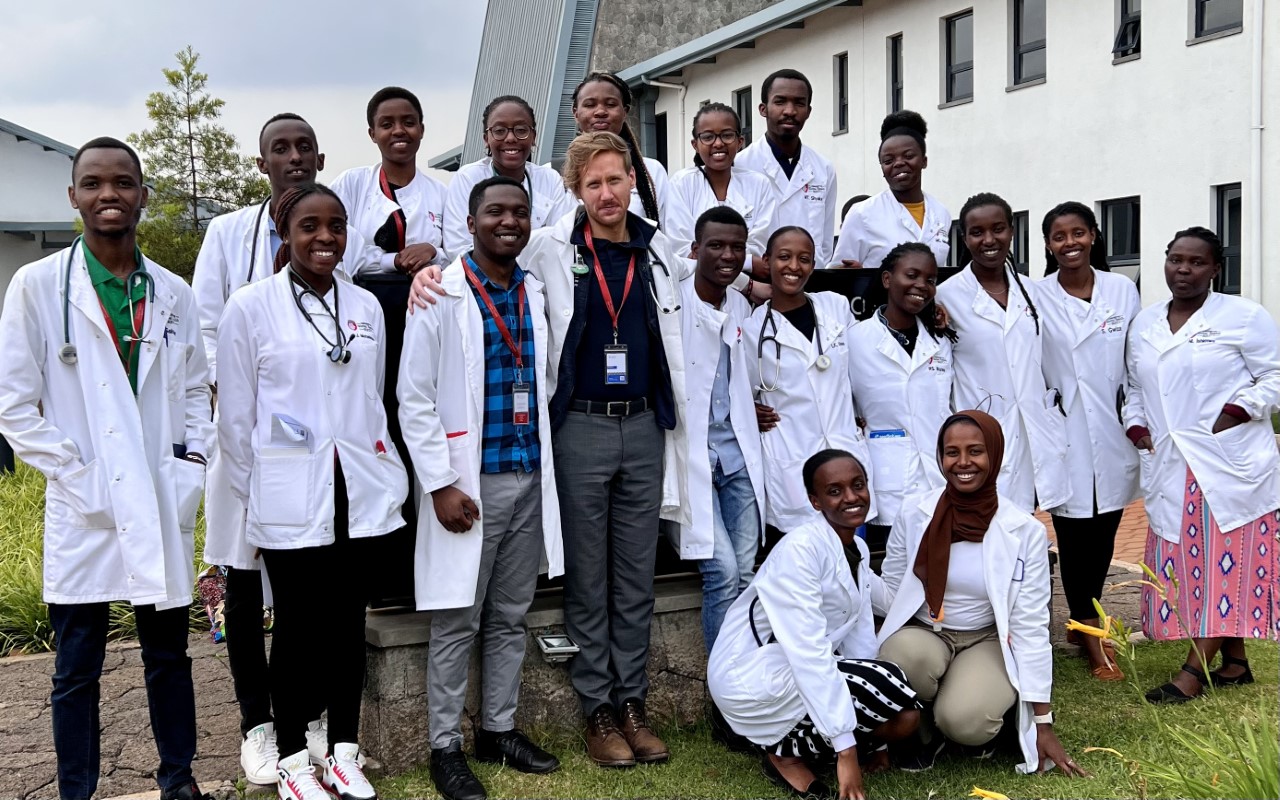
Dr. Andrew Enslen, a global health track resident at the time, spent six weeks in the spring of 2023 working with UGHE in a local district hospital, functioning as a consultant attending physician who supervised and taught 3rd-year medical students (pictured here). Working closely with these passionate and committed students was a highlight of his experience, he said.
Partnering for Health Equity and Global Health Education
Dr. Andrew Enslen, a global health track resident at the time, spent six weeks in the spring of 2023 working with UGHE in a local district hospital, functioning as a consultant attending physician who supervised and taught 3rd-year medical students (pictured here). Working closely with these passionate and committed students was a highlight of his experience, he said.
Partnering for Health Equity and Global Health Education
This story is adapted from an article originally published by the Stanford Center for Innovation in Global Health in May 2023. This version has been edited to focus on the contributions of Department of Medicine faculty. You can read the original story here.
A shared commitment to healthcare capacity-building and fostering global health equity has brought together Stanford Medicine faculty and leaders of the University of Global Health Equity (UGHE) in Rwanda.
UGHE launched in rural Butaro, Rwanda, in 2015, with a novel mission: “To change the way health care is delivered around the world by training the next generation of global health professionals to deliver more equitable, quality health services for all.”
The university is partnering with globally minded medical schools, including Stanford, to provide high-quality education to its students and build healthcare capacity in Eastern Africa.
“The brainchild of two global health visionaries, Agnes Binagwaho and the late Dr. Paul Farmer, UGHE is on track to be a premier medical school on the continent,” says Michele Barry, MD, director of the Stanford Center for Innovation in Global Health (CIGH) and Shenson Professor, who has served on UGHE’s member advisory council since 2018. Binagwaho is the retired vice chancellor of the university, former Rwandan minister of health, and health equity advocate.
Farmer was a global health equity leader who founded the nonprofit Partners in Health, which helped launch UGHE.
Department of Medicine faculty say they’re deeply inspired by UGHE leaders’ and students’ commitment to excellence and serving their communities. “Bidirectionality,” a spirit of equal exchange and learning, is fundamental to these Stanford-UGHE collaborations, leaders agreed.
“This idea, this place, and these people are paving the way for a better world for all of us,” says Brooke Cotter, MD, Stanford clinical assistant professor of hospital medicine, who serves in a new, CIGH-supported role as director of education and collaboration between the universities.
A Bridge Between Data Scientists and the Front Lines of Health Care
Shortly after the university formed, UGHE-Stanford partnerships began to take shape — often shepherded by UGHE’s founding dean of medicine, Abebe Bekele, says Charles Prober, MD. Prober, professor of pediatrics, microbiology, and immunology and senior associate vice provost for health education at Stanford Medicine, chaired a Dean’s Advisory Committee that Bekele assembled.
“Dean Abebe can pull many people into his tent from institutions around the world,” Prober says.
When Bekele visited Stanford several years ago, Prober introduced him to Stanford colleagues including Laurence Katznelson, MD, professor of neurosurgery and endocrinology and associate dean of graduate medical education. They discussed how Stanford could help teach UGHE’s first medical students as the university developed its faculty.
Katznelson, Lars Osterberg, MD, John Kugler, MD, and Cotter developed an initiative to provide online instructional support for preclinical medical students. Stanford faculty helped lead monthly Zoom discussions with UGHE students on various clinical cases.
The program helped foster rich ties between Stanford faculty, UGHE counterparts, and students despite pandemic travel restrictions.
Stanford physician Dr. Lars Osterberg visits a patient alongside UGHE medical student Rosine during his visit in spring 2023.
Kugler, clinical professor of medicine and director of the Educators-4-Care program, says this type of teaching opened up meaningful global health engagement opportunities to physicians who cannot easily travel overseas: “The ability to provide helpful clinical education from a remote location allows for a new type of impact that we are only just beginning to tap into.”
Virtual Connections Become Tangible
The collaboration is now extending from the virtual to the in-person world, further deepening connections.
In June 2023, Osterberg, professor (teaching) of medicine and co-director of Stanford Medicine’s teaching and mentoring academy, traveled to the UGHE campus to teach and serve as an attending physician at Butaro Hospital for third-year students completing their internal medicine rotation. It was his third time doing so since 2022, working alongside the same students he’d previously taught over Zoom. Stanford Global Health Track resident Andrew Enslen, MD, also recently spent six weeks there, teaching and overseeing clinical rotations.
Stanford physician Dr. Lars Osterberg stands with several medical students, Prisca, Arnold, and Eric, whom he mentored during his time teaching and serving as an attending physician at UGHE in the spring of 2023.
This story is adapted from an article originally published by the Stanford Center for Innovation in Global Health in May 2023. This version has been edited to focus on the contributions of Department of Medicine faculty. You can read the original story here.
A shared commitment to healthcare capacity-building and fostering global health equity has brought together Stanford Medicine faculty and leaders of the University of Global Health Equity (UGHE) in Rwanda.
UGHE launched in rural Butaro, Rwanda, in 2015, with a novel mission: “To change the way health care is delivered around the world by training the next generation of global health professionals to deliver more equitable, quality health services for all.” The university is partnering with globally minded medical schools, including Stanford, to provide high-quality education to its students and build healthcare capacity in Eastern Africa.
“The brainchild of two global health visionaries, Agnes Binagwaho and the late Dr. Paul Farmer, UGHE is on track to be a premier medical school on the continent,” says Michele Barry, MD, director of the Stanford Center for Innovation in Global Health (CIGH) and Shenson Professor, who has served on UGHE’s member advisory council since 2018. Binagwaho is the retired vice chancellor of the university, former Rwandan minister of health, and health equity advocate. Farmer was a global health equity leader who founded the nonprofit Partners in Health, which helped launch UGHE.
Department of Medicine faculty say they’re deeply inspired by UGHE leaders’ and students’ commitment to excellence and serving their communities. “Bidirectionality,” a spirit of equal exchange and learning, is fundamental to these Stanford-UGHE collaborations, leaders agreed.
“This idea, this place, and these people are paving the way for a better world for all of us,” says Brooke Cotter, MD, Stanford clinical assistant professor of hospital medicine, who serves in a new, CIGH-supported role as director of education and collaboration between the universities.

Stanford physician Dr. Lars Osterberg visits a patient alongside UGHE medical student Rosine during his visit in spring 2023.
A Bridge Between Data Scientists and the Front Lines of Health Care
Shortly after the university formed, UGHE-Stanford partnerships began to take shape — often shepherded by UGHE’s founding dean of medicine, Abebe Bekele, says Charles Prober, MD. Prober, professor of pediatrics, microbiology, and immunology and senior associate vice provost for health education at Stanford Medicine, chaired a Dean’s Advisory Committee that Bekele assembled.
“Dean Abebe can pull many people into his tent from institutions around the world,” Prober says.
When Bekele visited Stanford several years ago, Prober introduced him to Stanford colleagues including Laurence Katznelson, MD, professor of neurosurgery and endocrinology and associate dean of graduate medical education. They discussed how Stanford could help teach UGHE’s first medical students as the university developed its faculty.
Katznelson, Lars Osterberg, MD, John Kugler, MD, and Cotter developed an initiative to provide online instructional support for preclinical medical students. Stanford faculty helped lead monthly Zoom discussions with UGHE students on various clinical cases.
The program helped foster rich ties between Stanford faculty, UGHE counterparts, and students despite pandemic travel restrictions.
Kugler, clinical professor of medicine and director of the Educators-4-Care program, says this type of teaching opened up meaningful global health engagement opportunities to physicians who cannot easily travel overseas: “The ability to provide helpful clinical education from a remote location allows for a new type of impact that we are only just beginning to tap into.”

Stanford physician Dr. Lars Osterberg stands with several medical students, Prisca, Arnold, and Eric, whom he mentored during his time teaching and serving as an attending physician at UGHE in the spring of 2023.
Virtual Connections Become Tangible
The collaboration is now extending from the virtual to the in-person world, further deepening connections.
In June 2023, Osterberg, professor (teaching) of medicine and co-director of Stanford Medicine’s teaching and mentoring academy, traveled to the UGHE campus to teach and serve as an attending physician at Butaro Hospital for third-year students completing their internal medicine rotation. It was his third time doing so since 2022, working alongside the same students he’d previously taught over Zoom. Stanford Global Health Track resident Andrew Enslen, MD, also recently spent six weeks there, teaching and overseeing clinical rotations.

The ability to provide helpful clinical education from a remote location allows for a new type of impact that we are only just beginning to tap into.
— John Kugler, MD, clinical professor of medicine
Cotter, who traveled to UGHE during spring 2023 to attend on the wards and teach third-year medical students, hopes to develop a group of core faculty who can return annually to assist with rotations.
All were inspired by students’ deep commitment to serving their communities. Osterberg relates how Rwandan patients and their families often have to purchase supplies for medical procedures themselves. Medical students took the extra step of walking family members to the pharmacy to assist with this overwhelming task. Osterberg also recalls how students volunteered to remain on campus over a holiday weekend to ensure that patients were cared for.
“These students go far and beyond to get things done,” Osterberg says.
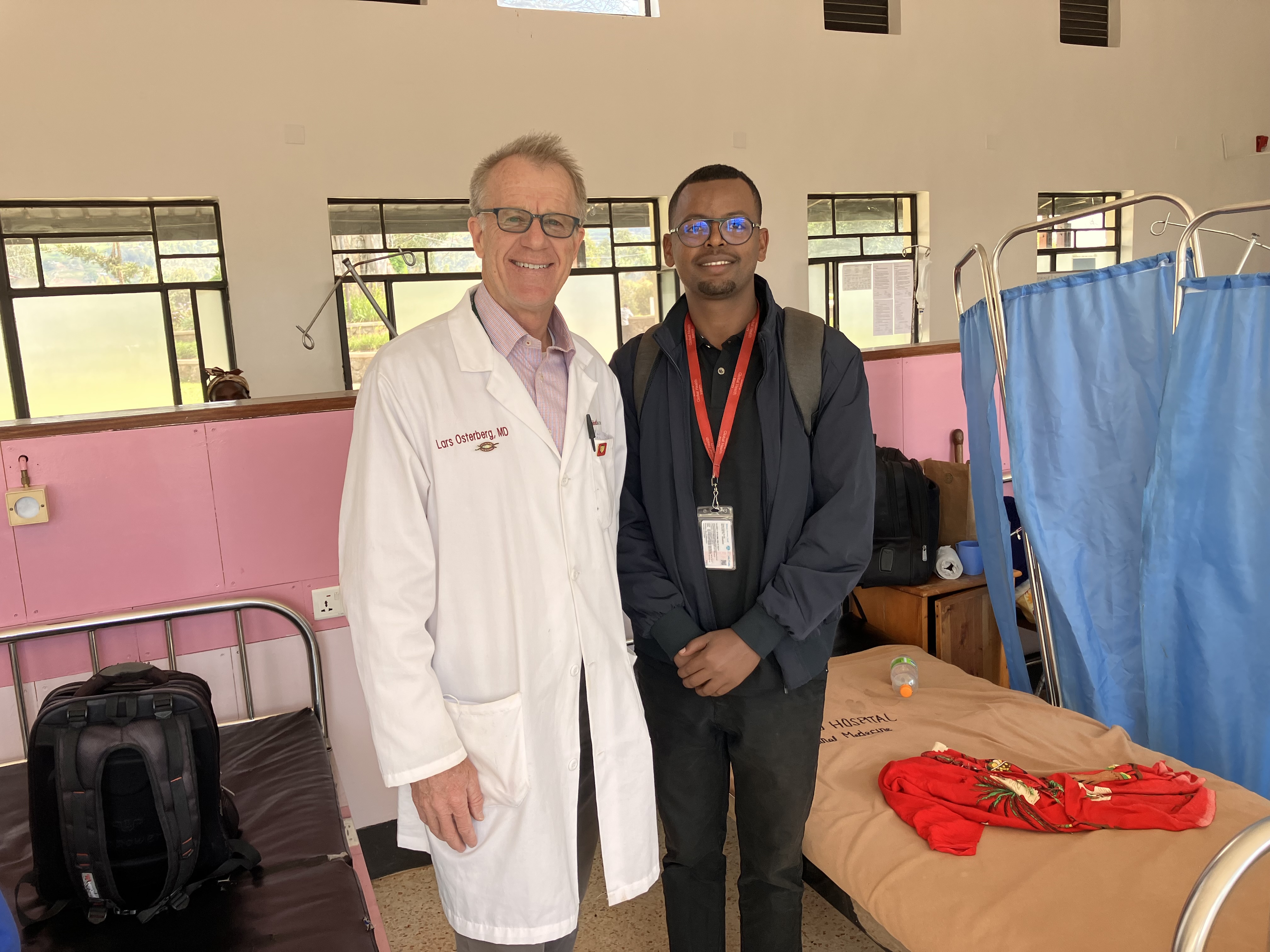
During his visit to UGHE in spring 2023, Stanford physician Dr. Lars Osterberg meets with Dr. Olana Wakoya Gichile at Butaro District Hospital, where he served as an attending physician on the internal medicine ward and taught third-year medical students.
Building Local Capacity
Beyond teaching, many Stanford faculty members have supported UGHE in building its local capacity for world-class care and instruction.
Prober helped build a mentorship program that matched UGHE faculty with medical school faculty from prestigious U.S. medical institutions. Osterberg has provided “teach the teacher” trainings for educators. Joseph Becker, MD, clinical associate professor of emergency medicine, helped develop the university’s emergency medicine curriculum.
UGHE has partnered with Stanford Surgery’s global engagement initiative, the Center for Health Education, and the Stanford Byers Center for Biodesign on technological initiatives to expand capacity for teaching, learning, and medical innovation.
“There are so many wonderful people doing great things at both UGHE and Stanford,” says Cotter, who sees her role as strengthening and expanding partnerships between the institutions. “The hope is that through coordination, we can cross-pollinate our efforts.”
Barry affirms CIGH’s commitment to building and strengthening the UGHE-Stanford collaboration: “We have much to learn from one another.”
The ability to provide helpful clinical education from a remote location allows for a new type of impact that we are only just beginning to tap into.
— John Kugler, MD, clinical professor of medicine
Cotter, who traveled to UGHE during spring 2023 to attend on the wards and teach third-year medical students, hopes to develop a group of core faculty who can return annually to assist with rotations.
All were inspired by students’ deep commitment to serving their communities. Osterberg relates how Rwandan patients and their families often have to purchase supplies for medical procedures themselves. Medical students took the extra step of walking family members to the pharmacy to assist with this overwhelming task. Osterberg also recalls how students volunteered to remain on campus over a holiday weekend to ensure that patients were cared for.
“These students go far and beyond to get things done,” Osterberg says.
During his visit to UGHE in spring 2023, Stanford physician Dr. Lars Osterberg meets with Dr. Olana Wakoya Gichile at Butaro District Hospital, where he served as an attending physician on the internal medicine ward and taught third-year medical students.
Building Local Capacity
Beyond teaching, many Stanford faculty members have supported UGHE in building its local capacity for world-class care and instruction.
Prober helped build a mentorship program that matched UGHE faculty with medical school faculty from prestigious U.S. medical institutions. Osterberg has provided “teach the teacher” trainings for educators. Joseph Becker, MD, clinical associate professor of emergency medicine, helped develop the university’s emergency medicine curriculum.
UGHE has partnered with Stanford Surgery’s global engagement initiative, the Center for Health Education, and the Stanford Byers Center for Biodesign on technological initiatives to expand capacity for teaching, learning, and medical innovation.
“There are so many wonderful people doing great things at both UGHE and Stanford,” says Cotter, who sees her role as strengthening and expanding partnerships between the institutions. “The hope is that through coordination, we can cross-pollinate our efforts.”
Barry affirms CIGH’s commitment to building and strengthening the UGHE-Stanford collaboration: “We have much to learn from one another.”