Merger of Stanford Health Care and ValleyCare Begins with the Start of a New Hospitalist Program

Baldeep Singh, MD, with staff at Samaritan House

Minjoung Go, MD, David Svec, MD, and Brittney Kendall, MHA, BSN,RN

Merger of Stanford Health Care and ValleyCare Begins with the Start of a New Hospitalist Program
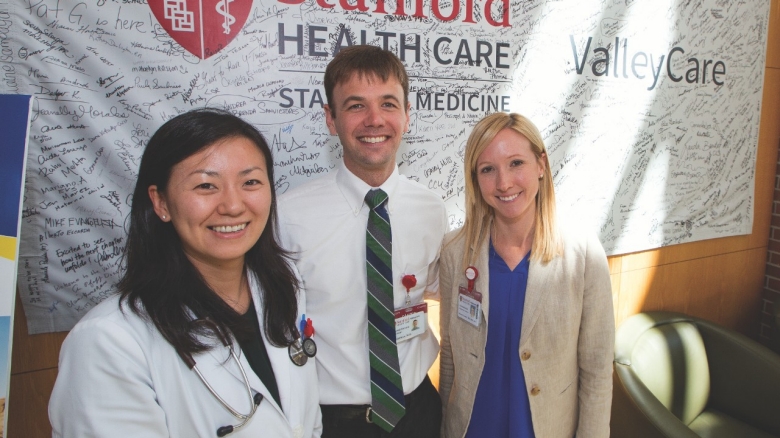
Minjoung Go, MD, David Svec, MD, and Brittney Kendall, MHA, BSN,RN

Merger of Stanford Health Care and ValleyCare Begins with the Start of a New Hospitalist Program

During a time of mergers and acquisitions in all manner of businesses, it should not surprise anyone to learn that Stanford Health Care has joined forces with a nearby community hospital. What might surprise, however, is the warmth of the merger and the excitement on both sides as the first new clinical program rolled out on August 1, introducing hospitalists from the Department of Medicine to the physicians, staff, and community served by ValleyCare, now known as Stanford Health Care – ValleyCare.

Stanford Health Care – ValleyCare’s hospital of approximately 200 beds is located in Pleasanton, about an hour east of Palo Alto. According to John Yee, MD, an internist specializing in pulmonary and critical care medicine, the ValleyCare Physician Affiliate Group has had the responsibility for covering unassigned inpatients from the Emergency Department for years. During a year-long transition prior to the merger, “other health systems around us tried to grab whatever market share they could grab,” he says. “We began to lose physicians, and our hiring process was frozen, so the remaining physicians not only had to cover the outpatients but also the unassigned inpatients of the physicians who left, in addition to their own outpatients and inpatients.”

Yee took aggressive steps. “As CMO, I rallied the troops, pressing even older doctors who have been in practice for 20 or 30 years to help cover the ED. We basically had an all-able-body alert in our group.” When the merger was completed in late May, as its first clinical program Stanford offered to introduce fulltime hospitalists. “It was a God-sent opportunity,” says Yee.

Neera Ahuja, MD (clinical associate professor, General Medical Disciplines, and director, Stanford Hospitalist Program) has overall responsibility for the new program. She sees it as a win-win for both doctors and patients: “Now physicians can focus on spending time with their clinic patients and not worry about rushing to the wards early in the morning or at the end of their day to take care of sick inpatients. The patients, the nurses, and the ED physicians will now have a physician available to be at the bedside as needed throughout the day.

“Because this program falls under the Stanford Hospital Hospitalist Program, and I head that one, I asked one of our talented hospitalists, David Svec, MD, MBA (clinical instructor, General Medical Disciplines), to help lead the program at ValleyCare. I can’t credit him enough,” she says; “he’s done an amazing job.”

Svec has already found his business education to be helpful at Stanford Health Care – ValleyCare. He is a believer in workflow processes, high value care (the best quality care at the lowest cost), checklists, and growing correctly. “We intend to provide 24/7 coverage,” he says. “Right now we are growing to that point, but it will take some time to ensure that we grow appropriately with both the academic and research missions of Stanford. I hope within 12 to 18 months we will be able to take care of a sizable majority if not all patients in the inpatient setting. That’s our goal.”

“On a day-to-day basis, we will have one hospitalist at ValleyCare all the time. We will most likely have several different teams eventually: a daytime team, a swing shift, and a nocturnist. We may also want to introduce a surgical co-management team, depending on the surgical volumes and if that is desired.”

He continues: “Two hospitalists are currently onsite fulltime: Minjoung Go, MD (clinical instructor, General Medical Disciplines) and Alex Chu, MD (clinical instructor, General Medical Disciplines). Both of them went through Stanford residency, finished on June 30, and took their Boards.”

During a time of mergers and acquisitions in all manner of businesses, it should not surprise anyone to learn that Stanford Health Care has joined forces with a nearby community hospital. What might surprise, however, is the warmth of the merger and the excitement on both sides as the first new clinical program rolled out on August 1, introducing hospitalists from the Department of Medicine to the physicians, staff, and community served by ValleyCare, now known as Stanford Health Care – ValleyCare.

Stanford Health Care – ValleyCare’s hospital of approximately 200 beds is located in Pleasanton, about an hour east of Palo Alto. According to John Yee, MD, an internist specializing in pulmonary and critical care medicine, the ValleyCare Physician Affiliate Group has had the responsibility for covering unassigned inpatients from the Emergency Department for years. During a year-long transition prior to the merger, “other health systems around us tried to grab whatever market share they could grab,” he says. “We began to lose physicians, and our hiring process was frozen, so the remaining physicians not only had to cover the outpatients but also the unassigned inpatients of the physicians who left, in addition to their own outpatients and inpatients.”

Yee took aggressive steps. “As CMO, I rallied the troops, pressing even older doctors who have been in practice for 20 or 30 years to help cover the ED. We basically had an all-able-body alert in our group.” When the merger was completed in late May, as its first clinical program Stanford offered to introduce fulltime hospitalists. “It was a God-sent opportunity,” says Yee.

Neera Ahuja, MD (clinical associate professor, General Medical Disciplines, and director, Stanford Hospitalist Program) has overall responsibility for the new program. She sees it as a win-win for both doctors and patients: “Now physicians can focus on spending time with their clinic patients and not worry about rushing to the wards early in the morning or at the end of their day to take care of sick inpatients. The patients, the nurses, and the ED physicians will now have a physician available to be at the bedside as needed throughout the day.

“Because this program falls under the Stanford Hospital Hospitalist Program, and I head that one, I asked one of our talented hospitalists, David Svec, MD, MBA (clinical instructor, General Medical Disciplines), to help lead the program at ValleyCare. I can’t credit him enough,” she says; “he’s done an amazing job.”

…the potential for continuing the educational mission of Stanford…

Svec has already found his business education to be helpful at Stanford Health Care – ValleyCare. He is a believer in workflow processes, high value care (the best quality care at the lowest cost), checklists, and growing correctly. “We intend to provide 24/7 coverage,” he says. “Right now we are growing to that point, but it will take some time to ensure that we grow appropriately with both the academic and research missions of Stanford. I hope within 12 to 18 months we will be able to take care of a sizable majority if not all patients in the inpatient setting. That’s our goal.”

“On a day-to-day basis, we will have one hospitalist at ValleyCare all the time. We will most likely have several different teams eventually: a daytime team, a swing shift, and a nocturnist. We may also want to introduce a surgical co-management team, depending on the surgical volumes and if that is desired.”

He continues: “Two hospitalists are currently onsite fulltime: Minjoung Go, MD (clinical instructor, General Medical Disciplines) and Alex Chu, MD (clinical instructor, General Medical Disciplines). Both of them went through Stanford residency, finished on June 30, and took their Boards.”

One of the attractions for Go and Chu was being involved in a program that was starting from the ground up. Svec says, “Even during their Board preparation they helped out by creating templates and smoothing the workflow for the hospitalist team.”

For Svec, education follows right after patient care on his list of achievable goals. “One of the things about ValleyCare that excites me is the potential for continuing the educational mission of Stanford, having medical students, advanced residents, and physician assistant students train here.”

After only a few weeks praises were being sung on all sides. But this successful rolling out of the hospitalists could not have occurred without additional help from Brittney Kendall, Manager of Strategic Initiatives at Stanford Health Care – ValleyCare. Kendall’s role critically involves, as she says, “building out programs that add value from the perspective of our patients and driving communications among various disciplines in support of this vision.”

Her role has been significant, according to Svec: “Brittney has been extremely helpful with data that we needed in order to properly plan and properly structure the hospitalist team. She’s been able to find us the resources (a hospitalist workroom) and supplies (for example, a pocket ultrasound machine to enhance our physical diagnoses). She has helped us through the credentialing process, helped us understand what the current status is like, and helped us plan for the future.”

Overall, the hospitalists feel totally welcomed. Svec describes it: “I have to stress how supportive everyone here has been. I can only imagine how difficult it is for them to have brand new faces as well as a new concept of care. Yet from Scott Gregerson (Stanford Health Care – ValleyCare President) on down—nurses, pharmacists, patients, physicians—everyone is willing to help, provide insights, support the team.”

Given the auspicious introduction of the ValleyCare-Stanford hospitalist endeavor, it is not too early to ask how the team will define success. On their behalf, Svec responds: “When we are able to provide educational opportunities and research opportunities as well as excellent patient care in this uniquely different environment.”
…the potential for continuing the educational mission of Stanford…

One of the attractions for Go and Chu was being involved in a program that was starting from the ground up. Svec says, “Even during their Board preparation they helped out by creating templates and smoothing the workflow for the hospitalist team.”

For Svec, education follows right after patient care on his list of achievable goals. “One of the things about ValleyCare that excites me is the potential for continuing the educational mission of Stanford, having medical students, advanced residents, and physician assistant students train here.”

After only a few weeks praises were being sung on all sides. But this successful rolling out of the hospitalists could not have occurred without additional help from Brittney Kendall, Manager of Strategic Initiatives at Stanford Health Care – ValleyCare. Kendall’s role critically involves, as she says, “building out programs that add value from the perspective of our patients and driving communications among various disciplines in support of this vision.”

Her role has been significant, according to Svec: “Brittney has been extremely helpful with data that we needed in order to properly plan and properly structure the hospitalist team. She’s been able to find us the resources (a hospitalist workroom) and supplies (for example, a pocket ultrasound machine to enhance our physical diagnoses). She has helped us through the credentialing process, helped us understand what the current status is like, and helped us plan for the future.”

Overall, the hospitalists feel totally welcomed. Svec describes it: “I have to stress how supportive everyone here has been. I can only imagine how difficult it is for them to have brand new faces as well as a new concept of care. Yet from Scott Gregerson (Stanford Health Care – ValleyCare President) on down—nurses, pharmacists, patients, physicians—everyone is willing to help, provide insights, support the team.”

Given the auspicious introduction of the ValleyCare-Stanford hospitalist endeavor, it is not too early to ask how the team will define success. On their behalf, Svec responds: “When we are able to provide educational opportunities and research opportunities as well as excellent patient care in this uniquely different environment.”
The Contemporary Approach to Managing Bone Disease

Baldeep Singh, MD, with staff at Samaritan House

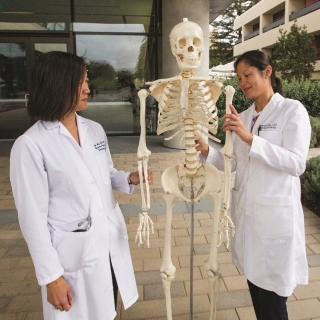
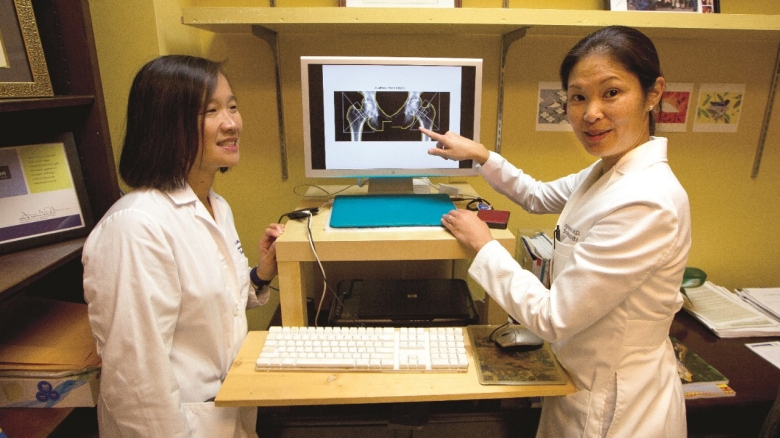
Joy Wu, MD, PhD, and Aimee Shu, MD

The Contemporary Approach to Managing Bone Disease

Joy Wu, MD, PhD, and Aimee Shu, MD

The Contemporary Approach to Managing Bone Disease

It’s easy enough to take our bones for granted when everything is working correctly. In the normal course of events our bone tissue turns over regularly, with mature bone being replaced (through resorption) by new bone (through formation). Problems arise when our bone strength declines and we sustain fragility fractures.

In the Osteoporosis and Metabolic Bone Disease Clinic and in other venues, Joy Wu, MD, PhD (assistant professor, Endocrinology, Gerontology, & Metabolism) and Aimee Shu, MD (clinical assistant professor, Endocrinology, Gerontology, & Metabolism), see patients with a broad range of problems they are well equipped to manage. And they are increasingly working in a multidisciplinary fashion with colleagues in other divisions and departments.

Osteoporosis
Long considered a disease of aging, particularly of aging women, osteoporosis often first manifests itself as a fragility fracture sustained with minimal trauma. Particularly devastating is the elderly woman who falls and breaks a hip.

Of approximately 250,000 such fractures in the US each year, only 100,000 patients return to normal life; 100,000 are thereafter bedridden and 50,000 die. It is clearly best that osteoporosis be prevented. If that is not possible, the best option is to treat it aggressively once it is diagnosed.

A history of fractures in the young increases the risk of hip fracture later in life. “Among patients who have hip fractures,” Shu says, “more than half had a previous fracture, perhaps of a wrist. So taking care of early fractures and making sure that the patient’s bone health is optimal may help to avoid devastating hip fractures later in life. If you want to build your bones, it’s usually best around the time of your growth spurt for both men and women. We encourage our patients to be playing sports.”

The best known and most used therapies for preventing and treating osteoporosis are the bisphosphonates, which reduce bone resorption. 

“This class of drugs has gotten a bad reputation,” Wu explains, “because of two exceedingly rare occurrences associated with them: osteonecrosis of the jaw and atypical femur fractures. But osteonecrosis of the jaw occurs almost entirely in cancer patients, who are treated with much higher doses of bisphosphonates than are patients with osteoporosis, while atypical fractures are clearly associated with longer-term use of bisphosphonates. Our fear is that the rate of hip fractures, which had been declining, will rise if patients abandon these therapies, which are very effective at preventing fragility fractures.”

To avoid atypical fractures from long-term use of bisphosphonates, endocrinologists today employ them with a more nuanced approach. Shu explains that “the evolving concepts are time of therapy initiation, doses used, and duration of treatment – perhaps three to five years – before we take a drug holiday. And then the question becomes: how long a drug holiday do we recommend?”

Osteoporosis is a common problem for women, but men are also at risk. About one-quarter of hip fractures occur in men. Wu says that it’s easy to lose sight of how devastating hip fractures can be for men: “If anything, their mortality rates are even higher than women’s. They are less likely to be treated appropriately yet more likely to die after hip fractures.”

Multidisciplinary Interest in Bone Disease
Diseases of the bones pay no attention to specialty silos. Shu explains that this fact encourages teamwork, “including the relationships that we’ve built with other divisions in the Department of Medicine. For example, we have formed a ‘Bones and Stones’ program with the nephrologists since patients who have abnormally high levels of urine calcium are at higher risk for both kidney stones and low bone mass. We also work closely with our colleagues in rheumatology, oncology, gastroenterology, and of course primary care.”

Important therapies used in rheumatology and oncology (glucocorticoids, for example) can have long-term adverse effects on patients’ bones. Once these patients have survived their acute health threats, they need to attend to their compromised bone health. Shu explains, “We care for childhood survivors of systemic illnesses – leukemia patients and lupus patients, for example – and they often experience bone fragility sooner than their peers do. We strive to be proactive about protecting their bones sooner than when they are in their 80s and 90s.

Joy Wu, MD, PhD, and Aimee Shu, MD

We encourage our patients to be playing sports.

It’s easy enough to take our bones for granted when everything is working correctly. In the normal course of events our bone tissue turns over regularly, with mature bone being replaced (through resorption) by new bone (through formation). Problems arise when our bone strength declines and we sustain fragility fractures.

In the Osteoporosis and Metabolic Bone Disease Clinic and in other venues, Joy Wu, MD, PhD (assistant professor, Endocrinology, Gerontology, & Metabolism) and Aimee Shu, MD (clinical assistant professor, Endocrinology, Gerontology, & Metabolism), see patients with a broad range of problems they are well equipped to manage. And they are increasingly working in a multidisciplinary fashion with colleagues in other divisions and departments.

Osteoporosis
Long considered a disease of aging, particularly of aging women, osteoporosis often first manifests itself as a fragility fracture sustained with minimal trauma. Particularly devastating is the elderly woman who falls and breaks a hip. Of approximately 250,000 such fractures in the US each year, only 100,000 patients return to normal life; 100,000 are thereafter bedridden and 50,000 die. It is clearly best that osteoporosis be prevented. If that is not possible, the best option is to treat it aggressively once it is diagnosed.

A history of fractures in the young increases the risk of hip fracture later in life. “Among patients who have hip fractures,” Shu says, “more than half had a previous fracture, perhaps of a wrist. So taking care of early fractures and making sure that the patient’s bone health is optimal may help to avoid devastating hip fractures later in life. If you want to build your bones, it’s usually best around the time of your growth spurt for both men and women. We encourage our patients to be playing sports.”

The best known and most used therapies for preventing and treating osteoporosis are the bisphosphonates, which reduce bone resorption. “This class of drugs has gotten a bad reputation,” Wu explains, “because of two exceedingly rare occurrences associated with them: osteonecrosis of the jaw and atypical femur fractures. But osteonecrosis of the jaw occurs almost entirely in cancer patients, who are treated with much higher doses of bisphosphonates than are patients with osteoporosis, while atypical fractures are clearly associated with longer-term use of bisphosphonates. Our fear is that the rate of hip fractures, which had been declining, will rise if patients abandon these therapies, which are very effective at preventing fragility fractures.”

We encourage our patients to be playing sports.

To avoid atypical fractures from long-term use of bisphosphonates, endocrinologists today employ them with a more nuanced approach. Shu explains that “the evolving concepts are time of therapy initiation, doses used, and duration of treatment – perhaps three to five years – before we take a drug holiday. And then the question becomes: how long a drug holiday do we recommend?”

Osteoporosis is a common problem for women, but men are also at risk. About one-quarter of hip fractures occur in men. Wu says that it’s easy to lose sight of how devastating hip fractures can be for men: “If anything, their mortality rates are even higher than women’s. They are less likely to be treated appropriately yet more likely to die after hip fractures.”

Multidisciplinary Interest in Bone Disease
Diseases of the bones pay no attention to specialty silos. Shu explains that this fact encourages teamwork, “including the relationships that we’ve built with other divisions in the Department of Medicine. For example, we have formed a ‘Bones and Stones’ program with the nephrologists since patients who have abnormally high levels of urine calcium are at higher risk for both kidney stones and low bone mass. We also work closely with our colleagues in rheumatology, oncology, gastroenterology, and of course primary care.”

Important therapies used in rheumatology and oncology (glucocorticoids, for example) can have long-term adverse effects on patients’ bones. Once these patients have survived their acute health threats, they need to attend to their compromised bone health. Shu explains, “We care for childhood survivors of systemic illnesses – leukemia patients and lupus patients, for example – and they often experience bone fragility sooner than their peers do. We strive to be proactive about protecting their bones sooner than when they are in their 80s and 90s.

Joy Wu, MD, PhD, and Aimee Shu, MD

“In addition,” Shu continues, “we share many patients with our surgical colleagues in orthopaedics, sports medicine, and transplant medicine. We even have a bone health clinic housed within the orthopaedics facility.”

Novel bone therapies are currently in clinical studies and may debut in coming years. In the meantime, endocrinologists are making use of their current armamentarium in creative combinations and sequences. Wu explains: “There are exciting early studies about how denosumab (FDA-approved in 2010) and teriparatide (approved in 2002) can be used in combination or sequentially. We would consider the combination for patients who have very low bone density or a significant fracture history. Or perhaps for patients who are particularly young and we are concerned about their bones in the future. These are all very early studies so we are just learning.”

Drs. Wu and Shu are encouraged by the many inventive ways they and their colleagues are able to optimize the care of their patients’ bones.

“In addition,” Shu continues, “we share many patients with our surgical colleagues in orthopaedics, sports medicine, and transplant medicine. We even have a bone health clinic housed within the orthopaedics facility.”

Novel bone therapies are currently in clinical studies and may debut in coming years. In the meantime, endocrinologists are making use of their current armamentarium in creative combinations and sequences. Wu explains: “There are exciting early studies about how denosumab (FDA-approved in 2010) and teriparatide (approved in 2002) can be used in combination or sequentially. We would consider the combination for patients who have very low bone density or a significant fracture history. Or perhaps for patients who are particularly young and we are concerned about their bones in the future. These are all very early studies so we are just learning.”

Drs. Wu and Shu are encouraged by the many inventive ways they and their colleagues are able to optimize the care of their patients’ bones.

Birthing the Center for Population Health Sciences

Baldeep Singh, MD, with staff at Samaritan House

Mark Cullen, MD

Birthing the Center for Population Health Sciences

Mark Cullen, MD

Birthing the Center for Population Health Sciences

We are told to beware of moving parts, and those of us who value our digits and appendages wisely stay out of the way. In the new Center for Population Health Sciences, there are an infinite number of moving parts; standing there in the middle of them is Mark R. Cullen, MD, its director (professor, General Medical Disciplines), bringing order to this new venture.

All new academic endeavors have some similar needs: space, funds, staff, interest. The center has some of these, especially a lot of the latter. “There is incredible interest,” says Cullen enthusiastically. “We are enrolling people who are interested in being affiliate members. We already have 350 from the School of Medicine, and we anticipate another few hundred from across the campus.”

Together with Deputy Director Lorene Nelson, PhD (associate professor, Health Policy and Research), Cullen is creating “a place where health and other forms of data derived from large populations will be made accessible to Stanford faculty and staff supported by our curation services to assist investigators in finding collaborators and analytic support.”

Working Groups
The fundamental unit of these collaborations is the working group, which Cullen describes this way: “What I imagine is that each working group will attract 10 to 12 people who are really interested in a particular project and another 10 or 20 who will be bystanders, watching everything on the intranet we are building to facilitate the work before they get engaged.

“We’ve got 10 working groups that we’re about to spawn,” Cullen continues. “Each targets a problem area or phase of the life-course where there are myriad unanswered questions about the origins of health and disease. Some examples are ‘Sex Differences in Health’ or ‘Retirement, Disability, Cognitive Decline and Aging’ or ‘Immigration and Health.’ It’s hard to know how fast these and the others will gel, but I’ll be disappointed if some don’t begin to gain traction by the end of 2015.

“For every group, I’m trying to group faculty on the main campus with counterparts from the School of Medicine so that there are at least two very distinctive perspectives about what’s important, and different research approaches.”

We are told to beware of moving parts, and those of us who value our digits and appendages wisely stay out of the way. In the new Center for Population Health Sciences, there are an infinite number of moving parts; standing there in the middle of them is Mark R. Cullen, MD, its director (professor, General Medical Disciplines), bringing order to this new venture.

All new academic endeavors have some similar needs: space, funds, staff, interest. The center has some of these, especially a lot of the latter. “There is incredible interest,” says Cullen enthusiastically. “We are enrolling people who are interested in being affiliate members. We already have 350 from the School of Medicine, and we anticipate another few hundred from across the campus.”

Together with Deputy Director Lorene Nelson, PhD (associate professor, Health Policy and Research), Cullen is creating “a place where health and other forms of data derived from large populations will be made accessible to Stanford faculty and staff supported by our curation services to assist investigators in finding collaborators and analytic support.”

Working Groups
The fundamental unit of these collaborations is the working group, which Cullen describes this way: “What I imagine is that each working group will attract 10 to 12 people who are really interested in a particular project and another 10 or 20 who will be bystanders, watching everything on the intranet we are building to facilitate the work before they get engaged.

“We’ve got 10 working groups that we’re about to spawn,” Cullen continues. “Each targets a problem area or phase of the life-course where there are myriad unanswered questions about the origins of health and disease. Some examples are ‘Sex Differences in Health’ or ‘Retirement, Disability, Cognitive Decline and Aging’ or ‘Immigration and Health.’ It’s hard to know how fast these and the others will gel, but I’ll be disappointed if some don’t begin to gain traction by the end of 2015.

“For every group, I’m trying to group faculty on the main campus with counterparts from the School of Medicine so that there are at least two very distinctive perspectives about what’s important, and different research approaches.”

Raw Materials
Some working groups have great ideas but limited access to data or populations ideal for study. Cullen has an answer: “We’ve already bought a big commercial claims set; we are negotiating with the Centers for Medicare and Medicaid Services to buy the Medicare set; and there are literally dozens of fabulous data sets around campus, including the Federal Research Data Center, that need only new coordination to become a researcher’s dream.”

Some more ambitious projects with groups both local and global are also underway. For example, Cullen points to the INDEPTH dataset, about which “we are actually sending a group to meet in Addis.” INDEPTH has surveillance and demographic data on 52 discrete, large populations (10 to 300,000 people each) in 52 Southeast Asian and African countries. He continues: “A core agreement to facilitate exchange with the Danish Registries and Biobank has been executed and three pilot projects have been launched; we are having ongoing discussions with Santa Clara County to develop a health information exchange that will link electronic medical records on almost all county residents irrespective of which health care they use, and further link these to population-level data at the County Health Department. Recently we received expressions of interest from both Singapore and Taiwan about collaborating with their national health authorities, gaining access to additional data troves.”

Cullen cautions that “some of these projects will take several years to mature, but that’s the whole point. We want them to mature under the watchful guidance of the working groups so that people can mold what might come from them.”

Cullen also has plans to support the working groups in novel ways. For instance, “When our intranet is up and going, we will start a resource exchange where people can post projects, ideas, opportunities for postdocs, requirements for a research assistant, etc. A student seeking a particular type of research experience could post that, hoping a faculty member might say, ‘oh great, a student with nothing to do; just what I need for the new study….’“

As grants are funded and donations received, Cullen will achieve another goal: “Someday I’d like to say to the leaders of the working groups, ‘here is $5,000 or $10,000 to help you grow; here’s a full-time staffer to help you write grants; here are two postdoc stipends; here’s a stipend for a visiting scholar to come work with your group.’”

Space
For most academic centers, space is right up there with money as the biggest concern. So too for Cullen. “A lot of working group faculty have no proximity to each other. What would be truly fantastic would be if we had a building, where people in working groups could use a chunk of space; where, for example, every Friday morning the working group on ‘The First 1000 Days of Life’ could meet. There would be hotelling space, good coffee, and quiet group work areas.”

Staffing
The center will not have a huge staff. Cullen explains: “I imagine we will eventually have 10 or 15 faculty who get some support from the center and a professional staff of another 20 people. We are shortly merging with the Office for Community Health, which already has a staff of 10. It will be the feet-on-the-ground link with the community health centers nearby, plus it will drive some of the education around population health.”

Funding
The Center received its initial operating budget from The Stanford Center for Clinical and Translational Research, Stanford Health Care, and the Dean of the School of Medicine, along with a future allocation of space and resources to attract new and promising faculty. The challenge is to develop a stream of revenue from grants, and through philanthropy raise the resources needed to become a sustainable fixture.

“We are trying to write some grants which themselves could generate immediate payback in terms of resources,” says Cullen. “For example, we are responding to a request for applications from the National Institute for Minority Health and Health Disparities to develop a center focused on using tools of precision health to address health disparities. If we’re successful, that would produce substantial resources to jump-start several working groups, including one on ‘Health Disparities’ and another on ‘Gene-Environment Interactions,’ as well as the Office for Community Health.”

It is obvious this is a work in progress, with many moving parts and uncertainties. But the director of this center has dreams and enthusiasm and plans to make it all come true. “It’s exciting precisely because it’s not all pat and set in stone,” he says. “There’s so much opportunity for innovation, for experimentation, and for leadership and members alike to shape and mold those future dreams.”

Raw Materials
Some working groups have great ideas but limited access to data or populations ideal for study. Cullen has an answer: “We’ve already bought a big commercial claims set; we are negotiating with the Centers for Medicare and Medicaid Services to buy the Medicare set; and there are literally dozens of fabulous data sets around campus, including the Federal Research Data Center, that need only new coordination to become a researcher’s dream.”

Some more ambitious projects with groups both local and global are also underway. For example, Cullen points to the INDEPTH dataset, about which “we are actually sending a group to meet in Addis.” INDEPTH has surveillance and demographic data on 52 discrete, large populations (10 to 300,000 people each) in 52 Southeast Asian and African countries. He continues: “A core agreement to facilitate exchange with the Danish Registries and Biobank has been executed and three pilot projects have been launched; we are having ongoing discussions with Santa Clara County to develop a health information exchange that will link electronic medical records on almost all county residents irrespective of which health care they use, and further link these to population-level data at the County Health Department. Recently we received expressions of interest from both Singapore and Taiwan about collaborating with their national health authorities, gaining access to additional data troves.”

Cullen cautions that “some of these projects will take several years to mature, but that’s the whole point. We want them to mature under the watchful guidance of the working groups so that people can mold what might come from them.”

Cullen also has plans to support the working groups in novel ways. For instance, “When our intranet is up and going, we will start a resource exchange where people can post projects, ideas, opportunities for postdocs, requirements for a research assistant, etc. A student seeking a particular type of research experience could post that, hoping a faculty member might say, ‘oh great, a student with nothing to do; just what I need for the new study….’“

As grants are funded and donations received, Cullen will achieve another goal: “Someday I’d like to say to the leaders of the working groups, ‘here is $5,000 or $10,000 to help you grow; here’s a full-time staffer to help you write grants; here are two postdoc stipends; here’s a stipend for a visiting scholar to come work with your group.’”

Space
For most academic centers, space is right up there with money as the biggest concern. So too for Cullen. “A lot of working group faculty have no proximity to each other. What would be truly fantastic would be if we had a building, where people in working groups could use a chunk of space; where, for example, every Friday morning the working group on ‘The First 1000 Days of Life’ could meet. There would be hotelling space, good coffee, and quiet group work areas.”

Staffing
The center will not have a huge staff. Cullen explains: “I imagine we will eventually have 10 or 15 faculty who get some support from the center and a professional staff of another 20 people. We are shortly merging with the Office for Community Health, which already has a staff of 10. It will be the feet-on-the-ground link with the community health centers nearby, plus it will drive some of the education around population health.”

Funding
The Center received its initial operating budget from The Stanford Center for Clinical and Translational Research, Stanford Health Care, and the Dean of the School of Medicine, along with a future allocation of space and resources to attract new and promising faculty. The challenge is to develop a stream of revenue from grants, and through philanthropy raise the resources needed to become a sustainable fixture.

“We are trying to write some grants which themselves could generate immediate payback in terms of resources,” says Cullen. “For example, we are responding to a request for applications from the National Institute for Minority Health and Health Disparities to develop a center focused on using tools of precision health to address health disparities. If we’re successful, that would produce substantial resources to jump-start several working groups, including one on ‘Health Disparities’ and another on ‘Gene-Environment Interactions,’ as well as the Office for Community Health.”

It is obvious this is a work in progress, with many moving parts and uncertainties. But the director of this center has dreams and enthusiasm and plans to make it all come true. “It’s exciting precisely because it’s not all pat and set in stone,” he says. “There’s so much opportunity for innovation, for experimentation, and for leadership and members alike to shape and mold those future dreams.”

An App to Improve Heart Health

Baldeep Singh, MD, with staff at Samaritan House

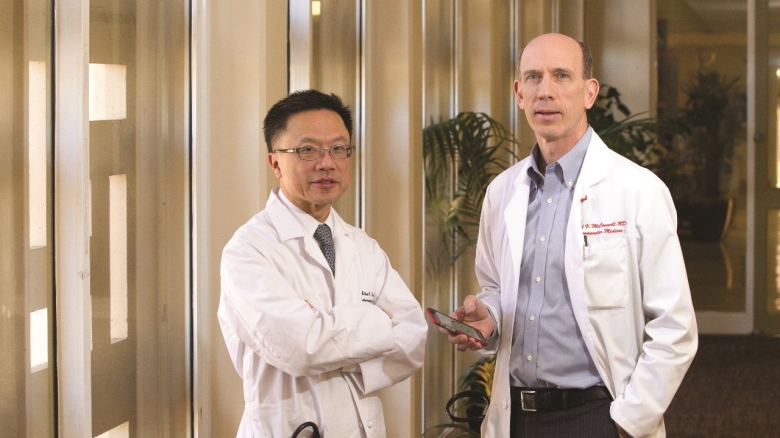
Alan Yeung, MD, and Michael McConnell, MD

An App to Improve Heart Health

Alan Yeung, MD, and Michael McConnell, MD

An App to Improve Heart Health

In March, Stanford cardiologists launched MyHeart Counts—a new mobile app that enables users to contribute to a large-scale study of heart health while learning about their own cardiovascular risk.

The public reception was overwhelming. To date, over 41,000 users have signed up for the free app and consented to participate in the study, and the number continues to climb. Apps may be a relatively new frontier of medicine, but they have the potential to reach large populations that traditional medical studies can’t. “There have been larger research studies, particularly national efforts to study their populations, but we believe enrolling this many participants in such a short time frame is unprecedented,” Michael McConnell, MD (professor, Cardiovascular Medicine), told Stanford Medicine earlier this year.

The goal of MyHeart Counts, McConnell said, is “to be the largest study of measured physical activity and cardiovascular health to date.” He continued, “We want people to join in this research effort to give them personalized information about their heart health and help provide fundamental new insights into how activity helps your heart, across all ages, genders, cultures, and countries.”

MyHeart Counts is one of the first five apps to use Apple’s ResearchKit, an open source software framework specifically designed for medical and health research.

The app relies on questionnaires, surveys, and the iPhone’s built-in motion sensors to collect data on cardiac risk factors, lifestyle behaviors, and physical activity. 

After an initial survey of basic health information – including age, weight, sleep patterns, daily exercise routines – users participate in a seven-day assessment of physical activity and complete a six-minute walk. Participants are then asked to check in with the app every three months.

Once users’ data has been collected, it is then used for research. As McConnell explained: “There are two major elements to the study. One is collecting data as broadly as possible on physical activity, fitness, and cardiovascular risk factors, which provides important feedback to the participants and helpful research data for our study. The second is studying ways to help people enhance activity and fitness, and decrease their chances of heart disease.”

In March, Stanford cardiologists launched MyHeart Counts—a new mobile app that enables users to contribute to a large-scale study of heart health while learning about their own cardiovascular risk.

The public reception was overwhelming. To date, over 41,000 users have signed up for the free app and consented to participate in the study, and the number continues to climb. Apps may be a relatively new frontier of medicine, but they have the potential to reach large populations that traditional medical studies can’t. “There have been larger research studies, particularly national efforts to study their populations, but we believe enrolling this many participants in such a short time frame is unprecedented,” Michael McConnell, MD (professor, Cardiovascular Medicine), told Stanford Medicine earlier this year.

The goal of MyHeart Counts, McConnell said, is “to be the largest study of measured physical activity and cardiovascular health to date.” He continued, “We want people to join in this research effort to give them personalized information about their heart health and help provide fundamental new insights into how activity helps your heart, across all ages, genders, cultures, and countries.”

MyHeart Counts is one of the first five apps to use Apple’s ResearchKit, an open source software framework specifically designed for medical and health research.

The app relies on questionnaires, surveys, and the iPhone’s built-in motion sensors to collect data on cardiac risk factors, lifestyle behaviors, and physical activity. After an initial survey of basic health information – including age, weight, sleep patterns, daily exercise routines – users participate in a seven-day assessment of physical activity and complete a six-minute walk. Participants are then asked to check in with the app every three months.

Open source “Apple Research Kit” and apps like “My Heart Counts” could have big effect on patient-centered research!

— Josh Knowles (@joshuawknowles) March 10, 2015

Once users’ data has been collected, it is then used for research. As McConnell explained: “There are two major elements to the study. One is collecting data as broadly as possible on physical activity, fitness, and cardiovascular risk factors, which provides important feedback to the participants and helpful research data for our study. The second is studying ways to help people enhance activity and fitness, and decrease their chances of heart disease.”

Five months after its debut, researchers launched MyHeart Counts in Hong Kong and the United Kingdom. At the same time, they released a new version of the app that focuses on providing participants with more feedback about their individual behaviors and risk, and compares an individual user’s fitness data to other participants.

“We are very excited to be able to take MyHeart Counts global,” said Euan Ashley, MD (professor, Cardiovascular Medicine), a co-investigator for the MyHeart Counts study. “Cardiovascular disease is the number one killer worldwide, and we have an unprecedented opportunity to study risk factors such as physical activity, fitness, and sleep in countries around the world.”

Open source “Apple Research Kit” and apps like “My Heart Counts” could have big effect on patient-centered research!

— Josh Knowles (@joshuawknowles) March 10, 2015

Five months after its debut, researchers launched MyHeart Counts in Hong Kong and the United Kingdom. At the same time, they released a new version of the app that focuses on providing participants with more feedback about their individual behaviors and risk, and compares an individual user’s fitness data to other participants.

“We are very excited to be able to take MyHeart Counts global,” said Euan Ashley, MD (professor, Cardiovascular Medicine), a co-investigator for the MyHeart Counts study. “Cardiovascular disease is the number one killer worldwide, and we have an unprecedented opportunity to study risk factors such as physical activity, fitness, and sleep in countries around the world.”

Endoscopic Submucosal Dissection

Baldeep Singh, MD, with staff at Samaritan House

Shai Friedland, MD

Endoscopic Submucosal Dissection

Shai Friedland, MD

Endoscopic Submucosal Dissection

Maybe it’s the sushi, or maybe it’s the Korean barbecue, but for some reason stomach cancer is more prevalent in Asia than in the United States. That’s why 10 years ago doctors in Japan developed a minimally invasive technique called endoscopic submucosal dissection to overcome the technical limitations of removing early gastric (stomach) cancer with other endoscopic tools.

About two years ago Shai Friedland, MD (associate professor, Gastroenterology and Hepatology), began performing the procedure at Stanford. That was after Friedland met several Japanese and Korean pioneers of the technique, observed them perform the procedure in Korea, attended courses they had taught in the United States, and practiced the technique under their careful supervision.

To date, Friedland has performed about 50 cases, and he’s currently collaborating with Dong-Hoon Yang, MD, a clinical associate professor at Asan Medical Center in Seoul, Korea, on a manuscript about a simplified endoscopic submucosal dissection technique in the colon. The two doctors are comparing the success of the technique at the two institutions, and they expect the paper to show that the technique is successful in both countries.

Because relatively few patients in the US have the stomach lesions that would merit the procedure, only a couple of doctors in this country have had an opportunity to perform endoscopic submucosal dissection, a procedure that usually takes one to two hours.

“The procedure is very challenging technically to perform, and it is relatively risky, especially for a doctor who is not very experienced in the technique,” says Friedland.

However, the procedure has many advantages over standard treatment methods.

“The endoscopic technique that this replaces is known as EMR – endoscopic mucosal resection,” Friedland points out. “That’s a technique where you also inject fluid underneath the lesion, but you use a snare, which is like a lasso with an electric cautery, to remove one piece at a time until the whole lesion is removed. That technique is suitable for very small lesions or when you don’t care about removing the lesion all in one piece.

Maybe it’s the sushi, or maybe it’s the Korean barbecue, but for some reason stomach cancer is more prevalent in Asia than in the United States. That’s why 10 years ago doctors in Japan developed a minimally invasive technique called endoscopic submucosal dissection to overcome the technical limitations of removing early gastric (stomach) cancer with other endoscopic tools.

About two years ago Shai Friedland, MD (associate professor, Gastroenterology and Hepatology), began performing the procedure at Stanford. That was after Friedland met several Japanese and Korean pioneers of the technique, observed them perform the procedure in Korea, attended courses they had taught in the United States, and practiced the technique under their careful supervision.

To date, Friedland has performed about 50 cases, and he’s currently collaborating with Dong-Hoon Yang, MD, a clinical associate professor at Asan Medical Center in Seoul, Korea, on a manuscript about a simplified endoscopic submucosal dissection technique in the colon. The two doctors are comparing the success of the technique at the two institutions, and they expect the paper to show that the technique is successful in both countries.

Because relatively few patients in the US have the stomach lesions that would merit the procedure, only a couple of doctors in this country have had an opportunity to perform endoscopic submucosal dissection, a procedure that usually takes one to two hours.

“The procedure is very challenging technically to perform, and it is relatively risky, especially for a doctor who is not very experienced in the technique,” says Friedland.

However, the procedure has many advantages over standard treatment methods.

“The endoscopic technique that this replaces is known as EMR – endoscopic mucosal resection,” Friedland points out. “That’s a technique where you also inject fluid underneath the lesion, but you use a snare, which is like a lasso with an electric cautery, to remove one piece at a time until the whole lesion is removed. That technique is suitable for very small lesions or when you don’t care about removing the lesion all in one piece. We use that technique with a lot of colon polyps because they’re more benign than these stomach cancers, and it seems to work pretty well in those instances. But for earlier stomach cancer, EMR is really inferior to endoscopic submucosal dissection. In those cases it’s important to remove the lesion in one piece, and those lesions are often fairly large—much larger than a snare can get.”

Often when there are larger lesions in the stomach, the recommended treatment is a total gastrectomy, which is open surgery to remove the entire stomach and connect the esophagus directly to the intestine.

“While a total gastrectomy is not overly complex and takes only a few hours, it is generally very difficult for patients to live well and eat well after that kind of surgery. They’ve lost their entire stomach, which means they then can no longer eat large meals, they can’t enjoy their food as much as they did before, and they lose a lot of weight,” Friedland says.

Before development of endoscopic submucosal dissection it was only possible to remove relatively small lesions in one piece, which the Japanese found to be sub-optimal for early gastric cancers, according to the Stanford professor.

“Because we’re just removing the mucosa—the inner lining of the stomach—the wound heals on its own in a few weeks, and the patient is basically left with a stomach that works as well as it did before. So that’s really the great advantage of these minimally invasive treatments,” Friedland says.

Endoscopic submucosal dissection is ideally suited for selected patients with pre-cancerous conditions or early cancer in their stomach, esophagus, colon, or rectum.

We use that technique with a lot of colon polyps because they’re more benign than these stomach cancers, and it seems to work pretty well in those instances. But for earlier stomach cancer, EMR is really inferior to endoscopic submucosal dissection. In those cases it’s important to remove the lesion in one piece, and those lesions are often fairly large—much larger than a snare can get.”

Often when there are larger lesions in the stomach, the recommended treatment is a total gastrectomy, which is open surgery to remove the entire stomach and connect the esophagus directly to the intestine.

“While a total gastrectomy is not overly complex and takes only a few hours, it is generally very difficult for patients to live well and eat well after that kind of surgery. They’ve lost their entire stomach, which means they then can no longer eat large meals, they can’t enjoy their food as much as they did before, and they lose a lot of weight,” Friedland says.

Before development of endoscopic submucosal dissection it was only possible to remove relatively small lesions in one piece, which the Japanese found to be sub-optimal for early gastric cancers, according to the Stanford professor.

“Because we’re just removing the mucosa—the inner lining of the stomach—the wound heals on its own in a few weeks, and the patient is basically left with a stomach that works as well as it did before. So that’s really the great advantage of these minimally invasive treatments,” Friedland says.

Endoscopic submucosal dissection is ideally suited for selected patients with pre-cancerous conditions or early cancer in their stomach, esophagus, colon, or rectum.