The Tipping Point: How Stanford’s Translational Investigator Program Supports—and Propels—the Careers of Early Physician-Scientists
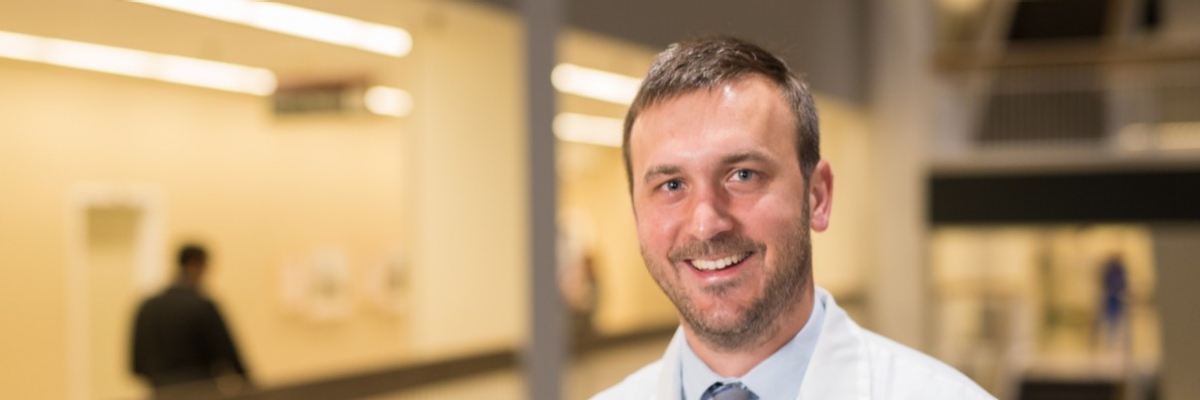
Baldeep Singh, MD, with staff at Samaritan House

Chad Weldy, MD, PhD

The Tipping Point: How Stanford’s Translational Investigator Program Supports—and Propels—the Careers of Early Physician-Scientists

Chad Weldy, MD, PhD

The Tipping Point: How Stanford’s Translational Investigator Program Supports—and Propels—the Careers of Early Physician-Scientists

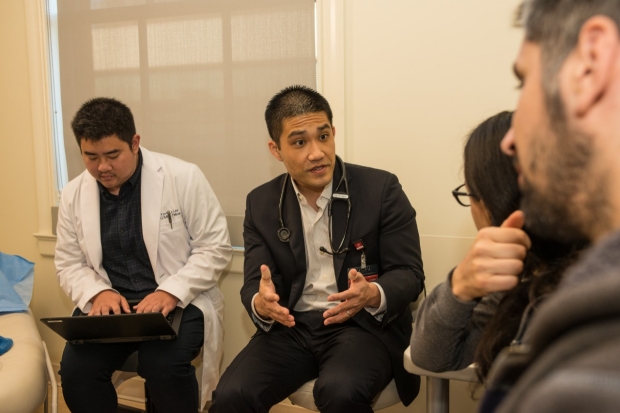
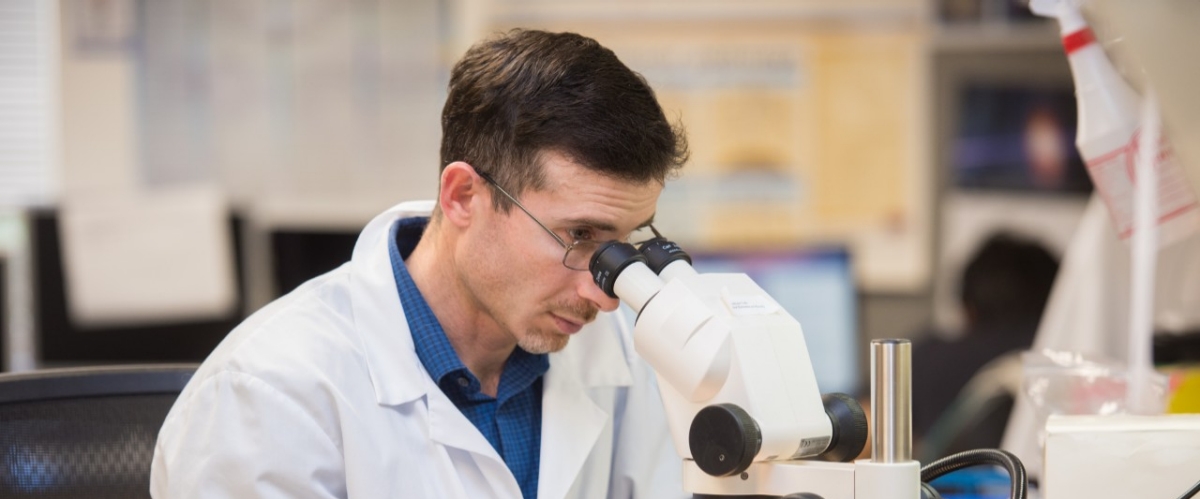
Chad Weldy, MD, PhD, found his calling deep in the toxicology laboratory at the University of Washington (UW), while he was working alongside physician-scientists to investigate the effects of air pollution on cardiovascular and pulmonary health. Weldy always knew that he loved scientific research, and it was this interest that propelled him through college at Western Washington University and a subsequent PhD program. But he had never considered a career in medicine. His work at UW—along with his exposure to a blend of cardiology and basic science—was “my first introduction to the possibility of doing both,” he recalls. “I decided that was my goal.”

After earning his doctorate, Weldy pursued that goal in earnest—completing a postdoctoral fellowship at UW in the lab of a prominent cardiologist, and receiving his MD from Duke University. He landed at Stanford in 2017 as one of nine residents in the Department of Medicine’s Translational Investigator Program (TIP).

TIP is designed to provide unparalleled training and mentorship to individuals like Weldy, who are planning careers as physician-scientists. It’s an important goal, says Joy Wu, MD, PhD, one of three co-directors of the program. Physician-scientists bring a unique perspective to the practice of medicine—bridging the divide between the bench and the bedside. And recent reports from organizations like the National Institutes of Health suggest their numbers are dwindling.

“It’s becoming harder to retain physician-scientists in a research career,” Wu explains. “This program exists to reach them as early as possible—when they’re applying to residency—and to support a robust pool of physician-scientists that will become faculty here or at other leading academic medical centers.”

For current residents in the TIP program, this support takes many forms.

Participants are guaranteed a salary at the full Accreditation Council for Graduate Medical Education level even during their American Board of Internal Medicine–mandated research years, along with additional supplements for housing and education. They’re also guaranteed a fellowship position at Stanford after successfully meeting residency requirements. Weldy, for example, will be joining the cardiovascular medicine fellowship after he completes two years in the internal medicine fast track program.

Additionally, TIP provides myriad mentorship opportunities—from quarterly dinners hosted by faculty to involvement in the Pathways of Distinction program, a mentorship initiative that allows residents to select one of several individual pathways that best aligns with their academic interests. These initiatives help build a sense of community, says Weldy.

Chad Weldy, MD, PhD, found his calling deep in the toxicology laboratory at the University of Washington (UW), while he was working alongside physician-scientists to investigate the effects of air pollution on cardiovascular and pulmonary health. Weldy always knew that he loved scientific research, and it was this interest that propelled him through college at Western Washington University and a subsequent PhD program. But he had never considered a career in medicine. His work at UW—along with his exposure to a blend of cardiology and basic science—was “my first introduction to the possibility of doing both,” he recalls. “I decided that was my goal.”

After earning his doctorate, Weldy pursued that goal in earnest—completing a postdoctoral fellowship at UW in the lab of a prominent cardiologist, and receiving his MD from Duke University. He landed at Stanford in 2017 as one of nine residents in the Department of Medicine’s Translational Investigator Program (TIP).

TIP is designed to provide unparalleled training and mentorship to individuals like Weldy, who are planning careers as physician-scientists. It’s an important goal, says Joy Wu, MD, PhD, one of three co-directors of the program. Physician-scientists bring a unique perspective to the practice of medicine—bridging the divide between the bench and the bedside. And recent reports from organizations like the National Institutes of Health suggest their numbers are dwindling.

“It’s becoming harder to retain physician-scientists in a research career,” Wu explains. “This program exists to reach them as early as possible—when they’re applying to residency—and to support a robust pool of physician-scientists that will become faculty here or at other leading academic medical centers.”

For current residents in the TIP program, this support takes many forms. Participants are guaranteed a salary at the full Accreditation Council for Graduate Medical Education level even during their American Board of Internal Medicine–mandated research years, along with additional supplements for housing and education. They’re also guaranteed a fellowship position at Stanford after successfully meeting residency requirements. Weldy, for example, will be joining the cardiovascular medicine fellowship after he completes two years in the internal medicine fast track program.

It’s becoming harder to retain physician-scientists in a RESEARCH CAREER

Additionally, TIP provides myriad mentorship opportunities—from quarterly dinners hosted by faculty to involvement in the Pathways of Distinction program, a mentorship initiative that allows residents to select one of several individual pathways that best aligns with their academic interests. These initiatives help build a sense of community, says Weldy.

“We’ve had several lunches where we have had amazing investigators present some of their research, as well as their path to how they ended up as faculty at Stanford. I love being able to get away from the wards for an hour to sit with other physician-scientists and talk science.”

Training is another key component. Wu elaborates: “We have sessions on everything related to career development, including grant writing, how to seek a mentor, how to apply for faculty positions, and more.”

Participants also benefit from Stanford’s collaborative and innovative spirit. “At many medical centers the university is separate from the medical school and the hospital,” Wu explains. “At Stanford everything is in close proximity. I think that leads to a rich array of opportunities for research and collaboration.”

Weldy agrees, adding: “The TIP program stood out to me because of the unique culture of innovation and discovery that is infused across campus. There’s not only a history of discovery—there’s a palpable sense that Stanford is on the tip of changing the practice of medicine.”
It’s becoming harder to retain physician-scientists in a RESEARCH CAREER

“We’ve had several lunches where we have had amazing investigators present some of their research, as well as their path to how they ended up as faculty at Stanford. I love being able to get away from the wards for an hour to sit with other physician-scientists and talk science.”

Training is another key component. Wu elaborates: “We have sessions on everything related to career development, including grant writing, how to seek a mentor, how to apply for faculty positions, and more.”

Participants also benefit from Stanford’s collaborative and innovative spirit. “At many medical centers the university is separate from the medical school and the hospital,” Wu explains. “At Stanford everything is in close proximity. I think that leads to a rich array of opportunities for research and collaboration.”

Weldy agrees, adding: “The TIP program stood out to me because of the unique culture of innovation and discovery that is infused across campus. There’s not only a history of discovery—there’s a palpable sense that Stanford is on the tip of changing the practice of medicine.”

Embracing a Growing Community of Advanced Practice Providers

Baldeep Singh, MD, with staff at Samaritan House

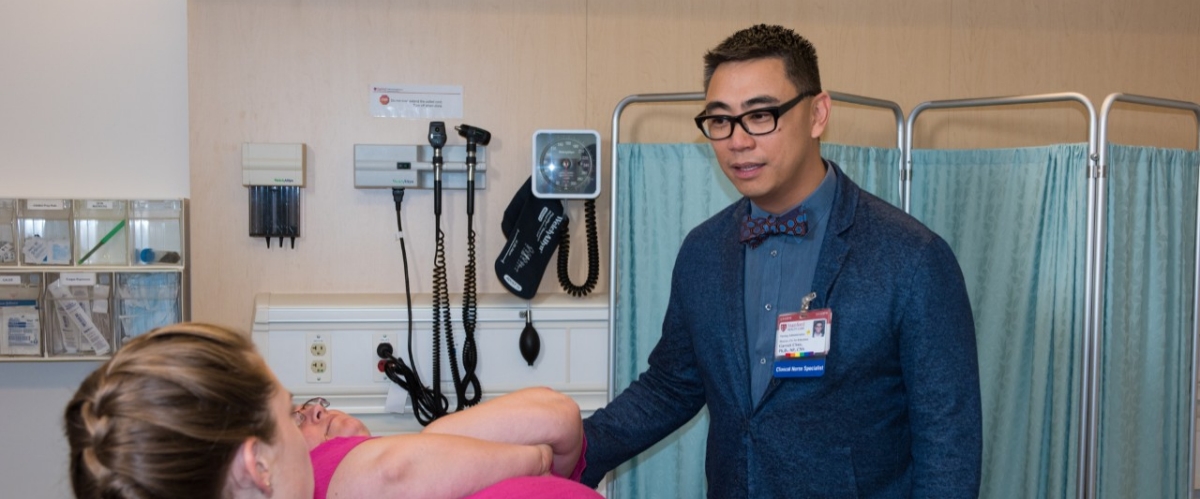
Garrett Chan, PhD, RN, teaching in a simulation lab.

Embracing a Growing Community of Advanced Practice Providers

Garrett Chan, PhD, RN, teaching in a simulation lab.

Embracing a Growing Community of Advanced Practice Providers

Garrett Chan, PhD, a clinical associate professor of primary care and population health and emergency medicine, spent his 20s pursuing a career as an art curator, taking classes like art history and humanities, with the eventual goal of working at a museum.

But then he met with a counselor, who prompted him to scrap the curatorial track and explore a career in nursing. Chan was surprisingly receptive. “I said sure!” he explains, “so she handed me a paper with a list of courses like chemistry, anatomy, and biology.” Clutching his new curriculum, he set off to embark on an entirely new path.

Chan spent the next several years acquiring degrees (an RN and BSN from San José State and a MS and PhD from UC-San Francisco), and clinical experience (in the emergency department and palliative care services of the San Jose Medical Center and at Stanford) at breakneck speed.

He joined Stanford Health Care as a nurse-scientist in 2006, and the Department of Medicine as a faculty member in 2014. Chan is not exclusively a nurse. His interests—and identities—vary widely. “My daily work as a faculty member includes administration in Stanford Health Care, direct care of patients, and work as a research scientist and an educator.”

On any given day, he can be found in the emergency department, helping faculty evaluate the efficacy of a new critical care program; in the lab, acting as principal investigator on a multi-site clinical trial of an FDA-approved device designed to test subepidermal moisture and writing up the results; in the office, creating curriculum for an RN postdoctoral fellowship in palliative care; or in the classroom, leading the advanced practice provider fellowship program and training interdisciplinary staff as the director of the Center for Professional Development.

Garrett Chan, PhD, a clinical associate professor of primary care and population health and emergency medicine, spent his 20s pursuing a career as an art curator, taking classes like art history and humanities, with the eventual goal of working at a museum.

But then he met with a counselor, who prompted him to scrap the curatorial track and explore a career in nursing. Chan was surprisingly receptive. “I said sure!” he explains, “so she handed me a paper with a list of courses like chemistry, anatomy, and biology.” Clutching his new curriculum, he set off to embark on an entirely new path.

Chan spent the next several years acquiring degrees (an RN and BSN from San José State and a MS and PhD from UC-San Francisco), and clinical experience (in the emergency department and palliative care services of the San Jose Medical Center and at Stanford) at breakneck speed.

They bring a very HOLISTIC perspective to health care.

He joined Stanford Health Care as a nurse-scientist in 2006, and the Department of Medicine as a faculty member in 2014. Chan is not exclusively a nurse. His interests—and identities—vary widely. “My daily work as a faculty member includes administration in Stanford Health Care, direct care of patients, and work as a research scientist and an educator.” On any given day, he can be found in the emergency department, helping faculty evaluate the efficacy of a new critical care program; in the lab, acting as principal investigator on a multi-site clinical trial of an FDA-approved device designed to test subepidermal moisture and writing up the results; in the office, creating curriculum for an RN postdoctoral fellowship in palliative care; or in the classroom, leading the advanced practice provider fellowship program and training interdisciplinary staff as the director of the Center for Professional Development.

Chan is also part of a growing community of advanced-practice providers—including registered nurses, nurse practitioners, and physician assistants—working alongside medical doctors on campus. There are several nurse scientists employed by the department. And in August Stanford welcomed the inaugural class of 27 students in the master of science in physician assistant studies program. It’s an exciting and beneficial shift, Chan explains. “A significant part of physician education and practice is focused on disease management,” he says. “And while nurses always have disease management in mind, they bring a very holistic perspective to health care. We’re paying attention to how patients and families are coping, patient education, and other psycho-social aspects of care.” Chan predicts that the inclusion of different care perspectives will both complement—and enhance—the practice of medicine and delivery of health care at Stanford.

They bring a very HOLISTIC perspective to health care.

Chan is also part of a growing community of advanced-practice providers—including registered nurses, nurse practitioners, and physician assistants—working alongside medical doctors on campus. There are several nurse scientists employed by the department. And in August Stanford welcomed the inaugural class of 27 students in the master of science in physician assistant studies program. It’s an exciting and beneficial shift, Chan explains. “A significant part of physician education and practice is focused on disease management,” he says. “And while nurses always have disease management in mind, they bring a very holistic perspective to health care. We’re paying attention to how patients and families are coping, patient education, and other psycho-social aspects of care.” Chan predicts that the inclusion of different care perspectives will both complement—and enhance—the practice of medicine and delivery of health care at Stanford.

Old Gut, Young Gut: What’s the Difference?

Baldeep Singh, MD, with staff at Samaritan House

Laren Becker, MD, PhD

Old Gut, Young Gut: What’s the Difference?

Laren Becker, MD, PhD

Old Gut, Young Gut: What’s the Difference?

Growing old can be a pain in the neck—or a pain in the stomach. As you age, you’re more prone to constipation, acid reflux, and bowel control problems. Some of that’s due to medications older people are more likely to take, chronic diseases, or inactivity, but it may also be due to changes in the gut, according to Laren Becker, MD, PhD. A physician-scientist in the Division of Gastroenterology & Hepatology and an instructor of medicine, Becker has advised undergraduate and graduate students during their research rotations during the past several years.

Recently, Becker studied the guts of mice, which led him to discover another factor driving gut problems: immune cells change with age and drive inflammation, which in turn, change the function of the GI tract.

“If this is also true in humans, and we could find a way to prevent these changes, we wouldn’t have this overwhelming burden of GI problems in older people,” says Becker, whose research was published in Gut in February 2017.

Immune System to Blame
Like every other system in the body, the digestive system is chock full of immune cells that patrol for invading pathogens that we might have swallowed with our food. In the muscle layer of the gut, the most plentiful of these cells are muscularis macrophages, immune cells that surround the nerve cells of the intestines. Becker wanted to study how these macrophages—which, aside from their defensive role, are known to help coordinate the cross-talk between the nervous system and GI tract—change during aging. In initial studies, he turned to young and old mice to make the comparisons. Here’s what he found:


Growing old can be a pain in the neck—or a pain in the stomach. As you age, you’re more prone to constipation, acid reflux, and bowel control problems. Some of that’s due to medications older people are more likely to take, chronic diseases, or inactivity, but it may also be due to changes in the gut, according to Laren Becker, MD, PhD. A physician-scientist in the Division of Gastroenterology & Hepatology and an instructor of medicine, Becker has advised undergraduate and graduate students during their research rotations during the past several years.

Recently, Becker studied the guts of mice, which led him to discover another factor driving gut problems: immune cells change with age and drive inflammation, which in turn, change the function of the GI tract.

“If this is also true in humans, and we could find a way to prevent these changes, we wouldn’t have this overwhelming burden of GI problems in older people,” says Becker, whose research was published in Gut in February 2017.

Immune System to Blame
Like every other system in the body, the digestive system is chock full of immune cells that patrol for invading pathogens that we might have swallowed with our food. In the muscle layer of the gut, the most plentiful of these cells are muscularis macrophages, immune cells that surround the nerve cells of the intestines. Becker wanted to study how these macrophages—which, aside from their defensive role, are known to help coordinate the cross-talk between the nervous system and GI tract—change during aging. In initial studies, he turned to young and old mice to make the comparisons. Here’s what he found:

Targeting these cells could be a way to RESTORE many parts of the body to a more youthful state

To sum up, the entire population of muscularis macrophages in the gut changed as the mice aged, promoting inflammation and killing off lots of neurons in the gut. This could lead to all sorts of gastrointestinal conditions, Becker says, since those neurons are critical to keeping the gut moving.

Next, Becker wants to see whether the findings made in mice hold true in humans. He’s also curious which factors are initially responsible for the shift in FoxO3 levels and macrophage function. The microbiome—the collection of bacteria that live in your gut—may play a role, for instance. And more work is needed to reveal whether macrophages in other organs of the body make similar shifts toward inflammation during aging.

“If we have a better understanding of how macrophages change with age, targeting these cells could be a way to restore many parts of the body to a more youthful state,” Becker says.

Targeting these cells could be a way to RESTORE many parts of the body to a more youthful state

To sum up, the entire population of muscularis macrophages in the gut changed as the mice aged, promoting inflammation and killing off lots of neurons in the gut. This could lead to all sorts of gastrointestinal conditions, Becker says, since those neurons are critical to keeping the gut moving.

Next, Becker wants to see whether the findings made in mice hold true in humans. He’s also curious which factors are initially responsible for the shift in FoxO3 levels and macrophage function. The microbiome—the collection of bacteria that live in your gut—may play a role, for instance. And more work is needed to reveal whether macrophages in other organs of the body make similar shifts toward inflammation during aging.

“If we have a better understanding of how macrophages change with age, targeting these cells could be a way to restore many parts of the body to a more youthful state,” Becker says.

A Unique Scribing Model: The Comet Fellowship for College Graduates

Baldeep Singh, MD, with staff at Samaritan House

Steven Lin, MD, has the help of scribe Kevin Lee (left) during a patient encounter. 

A Unique Scribing Model: The Comet Fellowship for College Graduates

Steven Lin, MD, has the help of scribe Kevin Lee (left) during a patient encounter.

A Unique Scribing Model: The Comet Fellowship for College Graduates

Like many of her recent college graduate peers, Cat Carragee was unsure how to get from here to there. There was a job in the health professions, perhaps as a doctor, but here wasn’t where she needed to be.

Here was work she was doing as a scribe in the emergency department at O’Connor Hospital in San Jose, California, for minimum wage. While she was getting some exposure to clinical medicine, she wasn’t really learning clinical medicine. “As a scribe I was there to help the doctors,” she says. “Any clinical learning was just a sideline.” She also knew that she needed research experience to strengthen an application to medical school, but to get such a job would require years of experience including work in the field.

Then a friend told her about COMET, and her life changed.

COMET (Clinical Observation and Medical Transcription Fellowship) is the brainchild of Steven Lin, MD, a clinical assistant professor of primary care and population health, who proposed a scribe service model with a twist.

Lin was interested in scribing after seeing his colleagues burn out from what he describes as “an explosion of administrative work being put on the shoulders of primary care physicians, plus frustration with the inefficiencies of electronic health record [EHR] systems like EPIC.”

But he also knew that many scribes are interested in a health career, perhaps as physician assistants, doctors, or nurse practitioners. He thought that having a longitudinal relationship with one or more providers would be valuable in the eyes of admissions committees, as would “opportunities to stand out and get experience.”

Scribing, he thought, “was an obvious place to go to, but I wanted to do it in a way that was a win-win-win scenario. Could we provide an experience that would benefit the scribes so they could go on to achieve their dreams of working in the health profession?” 

Like many of her recent college graduate peers, Cat Carragee was unsure how to get from here to there. There was a job in the health professions, perhaps as a doctor, but here wasn’t where she needed to be.

Here was work she was doing as a scribe in the emergency department at O’Connor Hospital in San Jose, California, for minimum wage. While she was getting some exposure to clinical medicine, she wasn’t really learning clinical medicine. “As a scribe I was there to help the doctors,” she says. “Any clinical learning was just a sideline.” She also knew that she needed research experience to strengthen an application to medical school, but to get such a job would require years of experience including work in the field.

Then a friend told her about COMET, and her life changed.

COMET (Clinical Observation and Medical Transcription Fellowship) is the brainchild of Steven Lin, MD, a clinical assistant professor of primary care and population health, who proposed a scribe service model with a twist.

Lin was interested in scribing after seeing his colleagues burn out from what he describes as “an explosion of administrative work being put on the shoulders of primary care physicians, plus frustration with the inefficiencies of electronic health record [EHR] systems like EPIC.”

But he also knew that many scribes are interested in a health career, perhaps as physician assistants, doctors, or nurse practitioners. He thought that having a longitudinal relationship with one or more providers would be valuable in the eyes of admissions committees, as would “opportunities to stand out and get experience.”

Scribing, he thought, “was an obvious place to go to, but I wanted to do it in a way that was a win-win-win scenario. Could we provide an experience that would benefit the scribes so they could go on to achieve their dreams of working in the health profession?” At the same time, could this model “be of tangible help to our primary care physicians, be meaningful, and decrease their work responsibilities in terms of charting and the EHR so they could spend more time with their families?”

Lin further describes COMET: “That’s how the post-baccalaureate scribe fellowship came about. In our unique model a mentoring relationship is central. We’re committed to the scribes and their education. They work with one to three physicians for an entire year. These are faculty members who mentor them, teach them at the bedside, do scholarly research projects with them that scribes then present at national conferences. We write recommendation letters for them and mentor them on their applications and their career development. It’s been a really good experience for both our scribes and our providers.”

Carragee could not agree more. After being one of the two pilot COMET fellows in 2015, she spent an additional year as chief scribe, orienting and supporting the incoming class of six fellows and finding ways to expand COMET to more clinics. She’s finished with that now, though; in September 2017 she started medical school at University College Dublin. She has reached her there.

As for the providers, Lin reports that “the scribes relieve the documentation burden. They increase our physicians’ ability to complete their charts on schedule. They can go home on time and have weekends free with family. It’s really been a great benefit to them.”

At the same time, could this model “be of tangible help to our primary care physicians, be meaningful, and decrease their work responsibilities in terms of charting and the EHR so they could spend more time with their families?”

Lin further describes COMET: “That’s how the post-baccalaureate scribe fellowship came about. In our unique model a mentoring relationship is central. We’re committed to the scribes and their education. They work with one to three physicians for an entire year. These are faculty members who mentor them, teach them at the bedside, do scholarly research projects with them that scribes then present at national conferences. We write recommendation letters for them and mentor them on their applications and their career development. It’s been a really good experience for both our scribes and our providers.”

Carragee could not agree more. After being one of the two pilot COMET fellows in 2015, she spent an additional year as chief scribe, orienting and supporting the incoming class of six fellows and finding ways to expand COMET to more clinics. She’s finished with that now, though; in September 2017 she started medical school at University College Dublin. She has reached her there.

As for the providers, Lin reports that “the scribes relieve the documentation burden. They increase our physicians’ ability to complete their charts on schedule. They can go home on time and have weekends free with family. It’s really been a great benefit to them.”

Musculoskeletal Ultrasound Clinic Is a Boon to Patient Care, Education, and Research

Baldeep Singh, MD, with staff at Samaritan House

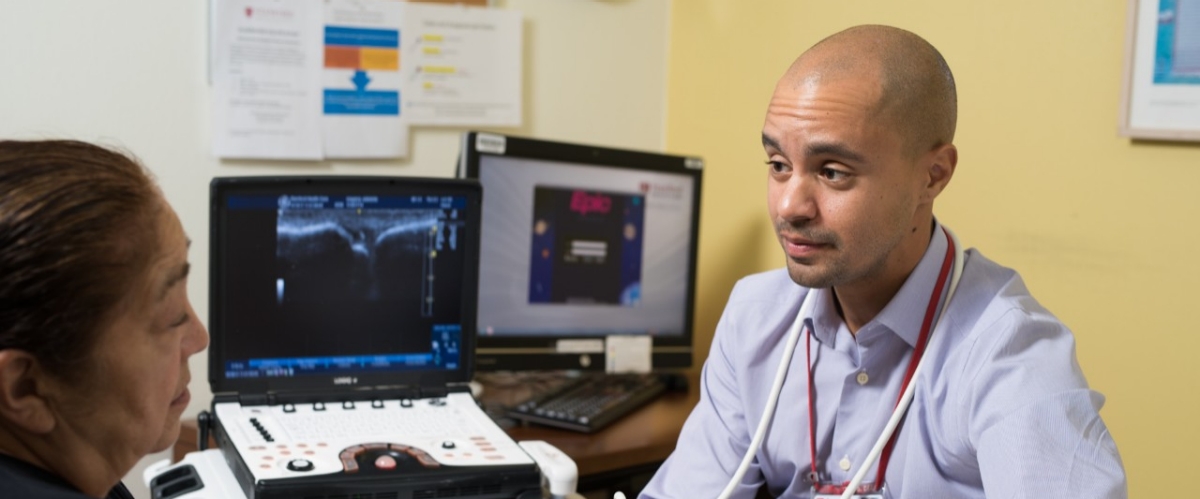
Rob Fairchild, MD, uses ultrasound for many diagnostic and treatment purposes, including evaluating inflammatory arthritis.

Musculoskeletal Ultrasound Clinic Is a Boon to Patient Care, Education, and Research

Rob Fairchild, MD, uses ultrasound for many diagnostic and treatment purposes, including evaluating inflammatory arthritis.

Musculoskeletal Ultrasound Clinic Is a Boon to Patient Care, Education, and Research

As a fellow in immunology and rheumatology, Rob Fairchild, MD, noticed something lacking in the care of rheumatology patients, and he set out to change that.

“The use of ultrasound by rheumatologists is more common in Europe than in the United States,” Fairchild observed. He was intrigued because ultrasound is a relatively easy tool that can be performed quickly in the clinic, and it’s an effective means for viewing soft tissue and other structures that can help rheumatologists with diagnosis and treatment.

“I did some training on ultrasound during my first year of fellowship, and that led me to devote one of my fellowship electives to starting a musculoskeletal ultrasound clinic dedicated to rheumatology evaluations and interventions,” he says.

Now, as the newest full-time member of the immunology and rheumatology faculty, Fairchild is seeing that the clinic continues not only for the benefit of patients, but also for the education of other trainees.

In fact, the American College of Rheumatology is moving toward incorporating ultrasound as part of rheumatology training, so Fairchild will be building that training into the fellowship curriculum.

The Craft So Long to Learn
The rheumatologist admits that ultrasound is very complicated and takes a long time to master. It requires learning separate views for each of the joints, and there are a lot of structures to know.

But ultrasound has long been an effective and accepted modality among many specialties, so what makes the Rheumatology Ultrasound Clinic distinct from other musculoskeletal ultrasound clinics?

“There’s actually a really big distinction. First and foremost, I’m a rheumatologist/immunologist. While most specialties use musculoskeletal ultrasound for soft tissue ailments like tendonitis, bursitis, and other joint abnormalities, rheumatologists are also trained to evaluate and manage conditions specific to our field, such as inflammatory arthritis or gout. So, we are often looking for very different things than other ultrasonographers.”

As a fellow in immunology and rheumatology, Rob Fairchild, MD, noticed something lacking in the care of rheumatology patients, and he set out to change that.

“The use of ultrasound by rheumatologists is more common in Europe than in the United States,” Fairchild observed. He was intrigued because ultrasound is a relatively easy tool that can be performed quickly in the clinic, and it’s an effective means for viewing soft tissue and other structures that can help rheumatologists with diagnosis and treatment.

“I did some training on ultrasound during my first year of fellowship, and that led me to devote one of my fellowship electives to starting a musculoskeletal ultrasound clinic dedicated to rheumatology evaluations and interventions,” he says.

Now, as the newest full-time member of the immunology and rheumatology faculty, Fairchild is seeing that the clinic continues not only for the benefit of patients, but also for the education of other trainees.

In fact, the American College of Rheumatology is moving toward incorporating ultrasound as part of rheumatology training, so Fairchild will be building that training into the fellowship curriculum.

The Craft So Long to Learn
The rheumatologist admits that ultrasound is very complicated and takes a long time to master. It requires learning separate views for each of the joints, and there are a lot of structures to know.

But ultrasound has long been an effective and accepted modality among many specialties, so what makes the Rheumatology Ultrasound Clinic distinct from other musculoskeletal ultrasound clinics?

“There’s actually a really big distinction. First and foremost, I’m a rheumatologist/immunologist. While most specialties use musculoskeletal ultrasound for soft tissue ailments like tendonitis, bursitis, and other joint abnormalities, rheumatologists are also trained to evaluate and manage conditions specific to our field, such as inflammatory arthritis or gout. So, we are often looking for very different things than other ultrasonographers.”

While Fairchild heads the clinic, two other attending rheumatologists—Jison Hong, MD, and Janice Lin, MD—also perform several procedures.

Evaluation and Treatment
Ultrasound helps Fairchild, Hong, and Lin when they are on the lookout for unusual disease manifestations like glandular disease in Sjogren’s syndrome, a debilitating condition that causes the eyes, mouth, or other parts of the body to dry out. It’s also useful in diagnosing polymyalgia rheumatica, an inflammatory disorder that causes muscle pain and stiffness, especially in the shoulders and hips. And ultrasound is a great aid in looking at temporal arteries to spot giant cell arteritis, which, if left untreated, can lead to blindness.

Two of the most frequent referrals the clinic receives are inflammatory arthritis evaluations and interphalangeal joint injections of the hands. 

In one recent case Fairchild was asked to evaluate whether there was evidence of an underlying inflammatory arthritis in a patient, as diagnosed by the patient’s previous rheumatologist.

According to Fairchild, “The patient had been on significant immunosuppression with a combination of steroids, methotrexate, and weekly TNF-alpha inhibitor injections, which all have the potential for serious side effects, require frequent clinical and laboratory monitoring, and are expensive. Our clinic’s ultrasound evaluation of the hands showed no synovial hypertrophy, synovitis, joint effusion, or erosions, which are the hallmarks of rheumatoid arthritis. Using this additional information coupled with the patient’s history and clinical evaluation, the referring provider at Stanford felt confident that the patient’s immunosuppression was not warranted and began to wean the patient off the medications.”

Another recent referral was for intra-articular injections for severe inflammatory/erosive osteoarthritis. “This aggressive, debilitating disease causes severe damage to the distal joints of the fingers with bony proliferation coupled with inflammation, pain, and dysfunction,” he explains.

“One way to reduce swelling, pain, and inflammation in these joints is through steroid injection. However, these joints are very small, and needle injection can be quite painful and technically challenging because of the bony mass surrounding the joint, making needle guidance difficult. When referred these patients, I use ultrasound to accurately guide the needle into the joint in one pass, greatly improving procedure tolerability and accurate steroid placement. As a testament to the efficacy and tolerability of these ultrasound guided procedures, I frequently have patients request repeat visits for additional therapeutic intervention once the steroid has worn off,” he says. 

‘Old’ and ‘New School’ Practitioners
Not everyone is convinced of the value of ultrasound.

Many rheumatologists are familiar and comfortable with “classic” examination techniques like feeling a patient’s joints for warmth, swelling, and tenderness to make an excellent diagnosis. “That’s very different from the ‘new school’ practitioners who can pull out an ultrasound and combine it with a clinical exam to give even greater accuracy. A lot of ‘old school’ rheumatologists would balk at that, but studies have shown that ultrasound is superior in finding active disease, particularly when the disease is mild, where it can be missed with a clinical exam alone,” Fairchild notes.

His interest in ultrasound is convincing other, more established rheumatologists that this technique is important for everyone to know and incorporate into their practice. In fact, some providers who may not have appreciated the value of ultrasound initially are now warming up to it.

Plans for Research
Several areas of research fit into Fairchild’s plans for the clinic. One has to do with how patients perceive their disease when they see it by ultrasound.

“I can tell patients that their disease is really active as a means of encouraging them to take a very serious medication, but that’s quite different from putting an ultrasound on them, pointing to the inflamed area and showing them how the joint is abnormal or damaged. They have an immediate response to that,” he says when explaining his desire to develop a research project in that area.

Another research interest involves scleroderma patients, who can be very sick with soft tissue and skin manifestations. There’s been a lot in the literature recently that has looked at ultrasound and how it can be used to assess disease, severity, the kind of disease that the patient actually has, and how it can help with treatments. Fairchild is pursuing a project in that realm with Lorinda Chung, MD, MPH, who runs Stanford’s Autoimmune Skin Disease Clinic in Redwood City with David Fiorentino, MD, PhD.

Training Tomorrow’s Ultrasonographers
Resident and fellow training is another facet of the ultrasound clinic.

“Coupled with their training in the clinic, we also do training at the bedside as part of Stanford 25,” says Fairchild. “Last year Dr. Hong and I did several musculoskeletal ultrasound teaching sessions for the residents in the hospital—hands-on things to show them how to look for knee effusions and other simple things that would be useful on the floor. I want to try to expand that as much as possible in the future.” 

While Fairchild heads the clinic, two other attending rheumatologists—Jison Hong, MD, and Janice Lin, MD—also perform several procedures.

Evaluation and Treatment
Ultrasound helps Fairchild, Hong, and Lin when they are on the lookout for unusual disease manifestations like glandular disease in Sjogren’s syndrome, a debilitating condition that causes the eyes, mouth, or other parts of the body to dry out. It’s also useful in diagnosing polymyalgia rheumatica, an inflammatory disorder that causes muscle pain and stiffness, especially in the shoulders and hips. And ultrasound is a great aid in looking at temporal arteries to spot giant cell arteritis, which, if left untreated, can lead to blindness.

Two of the most frequent referrals the clinic receives are inflammatory arthritis evaluations and interphalangeal joint injections of the hands. 

In one recent case Fairchild was asked to evaluate whether there was evidence of an underlying inflammatory arthritis in a patient, as diagnosed by the patient’s previous rheumatologist.

According to Fairchild, “The patient had been on significant immunosuppression with a combination of steroids, methotrexate, and weekly TNF-alpha inhibitor injections, which all have the potential for serious side effects, require frequent clinical and laboratory monitoring, and are expensive. Our clinic’s ultrasound evaluation of the hands showed no synovial hypertrophy, synovitis, joint effusion, or erosions, which are the hallmarks of rheumatoid arthritis. Using this additional information coupled with the patient’s history and clinical evaluation, the referring provider at Stanford felt confident that the patient’s immunosuppression was not warranted and began to wean the patient off the medications.”

Another recent referral was for intra-articular injections for severe inflammatory/erosive osteoarthritis. “This aggressive, debilitating disease causes severe damage to the distal joints of the fingers with bony proliferation coupled with inflammation, pain, and dysfunction,” he explains.

“One way to reduce swelling, pain, and inflammation in these joints is through steroid injection. However, these joints are very small, and needle injection can be quite painful and technically challenging because of the bony mass surrounding the joint, making needle guidance difficult. When referred these patients, I use ultrasound to accurately guide the needle into the joint in one pass, greatly improving procedure tolerability and accurate steroid placement. As a testament to the efficacy and tolerability of these ultrasound guided procedures, I frequently have patients request repeat visits for additional therapeutic intervention once the steroid has worn off,” he says. 

‘Old’ and ‘New School’ Practitioners
Not everyone is convinced of the value of ultrasound.

Many rheumatologists are familiar and comfortable with “classic” examination techniques like feeling a patient’s joints for warmth, swelling, and tenderness to make an excellent diagnosis. “That’s very different from the ‘new school’ practitioners who can pull out an ultrasound and combine it with a clinical exam to give even greater accuracy. A lot of ‘old school’ rheumatologists would balk at that, but studies have shown that ultrasound is superior in finding active disease, particularly when the disease is mild, where it can be missed with a clinical exam alone,” Fairchild notes.

His interest in ultrasound is convincing other, more established rheumatologists that this technique is important for everyone to know and incorporate into their practice. In fact, some providers who may not have appreciated the value of ultrasound initially are now warming up to it.

Plans for Research
Several areas of research fit into Fairchild’s plans for the clinic. One has to do with how patients perceive their disease when they see it by ultrasound.

“I can tell patients that their disease is really active as a means of encouraging them to take a very serious medication, but that’s quite different from putting an ultrasound on them, pointing to the inflamed area and showing them how the joint is abnormal or damaged. They have an immediate response to that,” he says when explaining his desire to develop a research project in that area.

Another research interest involves scleroderma patients, who can be very sick with soft tissue and skin manifestations. There’s been a lot in the literature recently that has looked at ultrasound and how it can be used to assess disease, severity, the kind of disease that the patient actually has, and how it can help with treatments. Fairchild is pursuing a project in that realm with Lorinda Chung, MD, MPH, who runs Stanford’s Autoimmune Skin Disease Clinic in Redwood City with David Fiorentino, MD, PhD.

Training Tomorrow’s Ultrasonographers
Resident and fellow training is another facet of the ultrasound clinic.

“Coupled with their training in the clinic, we also do training at the bedside as part of Stanford 25,” says Fairchild. “Last year Dr. Hong and I did several musculoskeletal ultrasound teaching sessions for the residents in the hospital—hands-on things to show them how to look for knee effusions and other simple things that would be useful on the floor. I want to try to expand that as much as possible in the future.”